This 1 Insane Nvidia Stat Explains Why Wall Street Can’t Stop Buying the Stock
For decades, healthcare was viewed as one of the market’s untouchable giants. People always need medicine, hospitals, and medical devices regardless of whether the economy is booming or sliding into recession. That steady demand helped healthcare become one of the…


For decades, healthcare was viewed as one of the market’s untouchable giants. People always need medicine, hospitals, and medical devices regardless of whether the economy is booming or sliding into recession. That steady demand helped healthcare become one of the largest sectors in the S&P 500. But artificial intelligence has flipped the script in record time.
Today, one company — Nvidia (NASDAQ:NVDA | NVDA Price Prediction) — is worth more than the entire healthcare sector of the S&P 500 combined. That sounds absurd at first glance. Yet, the numbers show Nvidia has become the market’s gravitational center.
Nvidia’s Market Value Has Reached Historic Territory
According to S&P Global market data, Nvidia recently crossed a market capitalization above $5.3 trillion. By comparison, all 59 companies comprising the healthcare sector within the S&P 500 carry a combined valuation of about $5.2 trillion.
It means Nvidia is now worth more than:
- Drug giants like Johnson & Johnson (NYSE:JNJ), Eli Lilly (NYSE:LLY), and Merck (NYSE:MRK) combined ($1.75 trillion)
- Massive health insurers such as UnitedHealth Group (NYSE:UNH) and Elevance Health (NYSE:ELV) ($431.5 billion)
- Entire medical device leaders including Medtronic (NYSE:MDT) and Abbott Laboratories (NYSE:ABT) ($242.6 billion)
One semiconductor company now carries more market value than dozens of healthcare businesses serving millions of patients worldwide.
Granted, market capitalization alone does not determine whether a stock is overvalued. But it does reveal where Wall Street believes future profits will concentrate. Right now, that future is AI infrastructure.
The AI Gold Rush Is Fueling Nvidia’s Dominance
Nvidia did not stumble into this position accidentally. Its graphics processing units, or GPUs, became the backbone of artificial intelligence training years before most companies understood how large the opportunity would become.
Today, hyperscalers are spending at levels the market has rarely seen outside wartime infrastructure booms. The Big Four plan to spend upwards of $725 billion in AI capital expenditures in 2026 alone. Much of that money will flow directly toward Nvidia chips, networking equipment, and AI systems.
The result will be revenue growth that barely looks real. Nvidia generated $215.9 billion in revenue over the last 12 months. Just three years ago, annual revenue totaled $26.9 billion.
Even more remarkable is profitability. Nvidia produced over $120 billion in net income over the trailing 12 months. Compare that with healthcare giants:
| Company | Net Income (TTM) |
| Nvidia | $120.1 billion |
| Johnson & Johnson | $21.1 billion |
| Pfizer (NYSE:PFE) | $7.5 billion |
| Merck | $8.9 billion |
Source: Company annual reports and SEC filings.
Surprisingly, Nvidia is not just growing faster than healthcare companies — it is generating more profit than them, too — combined.
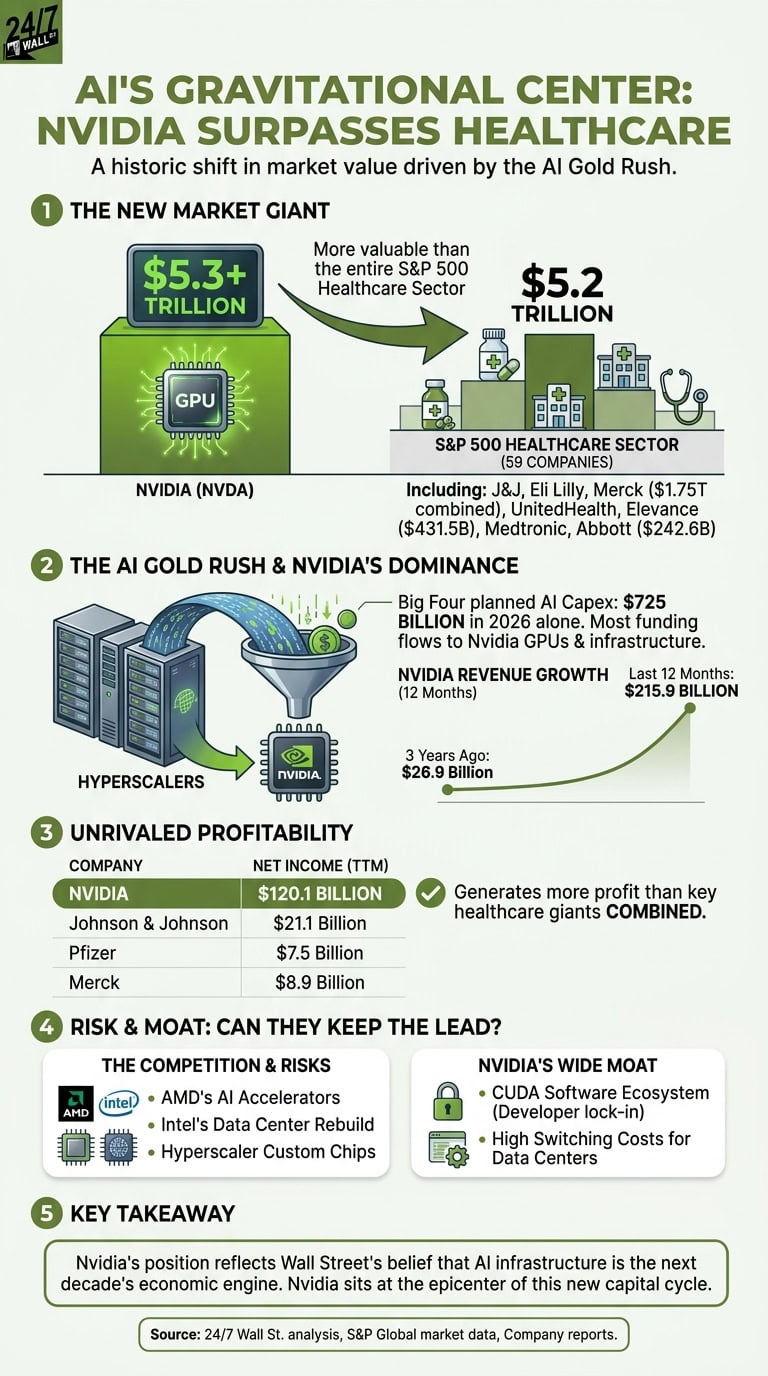 A $5.3 trillion shift in global power—Nvidia now commands more market value and more profit than the world’s biggest medical titans combined.
Can Nvidia Keep This Lead?
That is the question smart investors should be asking now. Nvidia trades at roughly 19 times forward earnings, not expensive for a company already worth $5.3 trillion. And earnings growth remains explosive enough that the valuation has not expanded wildly relative to profits.
That said, risks absolutely exist. Competition is intensifying. Advanced Micro Devices (NASDAQ:AMD) continues pushing deeper into AI accelerators. Intel (NASDAQ:INTC) is rebuilding its data center business. Meanwhile, hyperscalers themselves are designing custom AI chips to reduce dependence on Nvidia.
Still, the company’s moat remains wide. Nvidia’s CUDA software ecosystem keeps developers locked into its platform, and switching costs remain high for enterprise customers building massive AI data centers.
In any case, the healthcare comparison highlights something important — Wall Street increasingly views AI infrastructure as essential economic plumbing, not merely another tech trend.
Key Takeaway
In short, Nvidia surpassing the entire S&P 500 healthcare sector in market value is more than a headline-grabbing statistic. It reflects where investors believe the next decade of profits, productivity, and economic power will emerge.
Granted, no company dominates forever. Cisco Systems (NASDAQ:CSCO) once symbolized the internet boom, and it was once said about GM (NYSE:GM), “As goes General Motors, so goes the nation.” Leadership changes over time.
But when all is said and done, Nvidia currently sits at the epicenter of the AI economy. The company’s chips power everything from ChatGPT to autonomous vehicles to enterprise cloud computing. As long as hyperscalers keep spending hundreds of billions on AI infrastructure, Nvidia remains positioned to capture a large share of that growth.
For sharp investors, the takeaway is not necessarily to chase the stock at any price. Rather, it is to recognize that AI has evolved from a speculative theme into the market’s defining capital cycle — and Nvidia remains its biggest beneficiary.
Contact [email protected] for any questions or corrections.
After two decades of patrolling the dark corners of suburbia as a police officer, Rich Duprey hung up his badge and gun to begin writing full time about stocks and investing. For the past 20 years, he’s been cruising the markets looking for companies to lock up as long-term holdings in a portfolio while writing extensively on the broad sectors of consumer goods, technology, and industrials. Because his experience isn’t from the typical financial analyst track, Rich is able to break down complex topics into understandable and useful action points for the average investor. His writings have appeared on The Motley Fool, InvestorPlace, Yahoo! Finance, Money Morning, and, of course, 24/7 Wall St. He has been featured in both U.S. and international publications, including MarketWatch, Financial Times, Forbes, Fast Company, and USA Today.