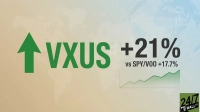
This Vanguard VEA ETF Is Beating Your S&P 500 ETF – Here’s Why
Most American portfolios contain a fund like Vanguard FTSE Developed Markets ETF (NYSEARCA:VEA) the way most American kitchens contain a wok. Technically present. Pulled out twice a year. The investor knows, vaguely, that international diversification is supposed to matter, and…


Most American portfolios contain a fund like Vanguard FTSE Developed Markets ETF (NYSEARCA:VEA) the way most American kitchens contain a wok. Technically present. Pulled out twice a year. The investor knows, vaguely, that international diversification is supposed to matter, and forgets about it because the S&P 500 has spent fifteen years making everything else look slow. VEA has spent 2026 quietly correcting that assumption. It is up roughly 15% year-to-date against the S&P 500’s approximately 10%, and the gap is structural, not accidental.
What you will own when you buy VEA
VEA holds approximately 3,868 stocks across Europe, Japan, Canada, Australia, and South Korea, weighted by market cap through the FTSE Developed All Cap ex US Index. The expense ratio is 0.03%, meaning Vanguard charges three dollars a year per ten thousand invested. That fee is among the lowest of any international ETF in existence. The trailing yield runs around 2.5%, comfortably above the S&P 500, because European and Japanese companies still distribute a large share of earnings rather than funneling them into buybacks. Assets sit near $231 billion, so liquidity is never the question.
The three engines running underneath
The reason VEA caught a bid in 2026 lives in three distinct regions. South Korea, which most US investors do not realize is even in the fund, has become a meaningful conduit for AI infrastructure spending. Samsung Electronics and SK Hynix, two of VEA’s largest individual holdings, supply the high-bandwidth memory that NVIDIA (NASDAQ:NVDA | NVDA Price Prediction) accelerators cannot function without. That demand has rerated Korean tech even more aggressively than it rerated American semiconductors in 2023. South Korea’s governance-focused Value-Up initiative has added a second tailwind, with companies disclosing capital-return plans and foreign investor participation nearly doubling since the program launched.
Europe is the second engine. Germany’s constitutional overhaul of its “debt brake” in March 2025 created a 500 billion euro infrastructure fund and exempted defense spending above 1% of GDP from borrowing limits, a structural shift that analysts at Deutsche Bank described as effectively a “whatever it takes” moment for German fiscal policy. At the NATO summit in The Hague in June 2025, all 32 allies committed to raising defense and security spending to 5% of GDP by 2035, replacing the old 2% benchmark. European allies and Canada had already increased their combined defense expenditure by nearly 20% in real terms in 2025 compared with 2024. That tide of capital has lifted industrials and defense champions across the continent that spent a prior decade treading water.
Japan is the third engine, finally delivering the corporate governance reforms that have been promised since the Abe administration. The Tokyo Stock Exchange has pushed companies to unwind cross-shareholdings, lift return on equity, and return cash to shareholders in concrete terms. Japanese companies set a record 22.3 trillion yen in share buybacks in FY2025, up from 19 trillion yen the prior year, and the TSE published a further update to its reform request in April 2026 to keep pressure on capital allocation. The work is not finished, but the results are becoming visible in earnings and valuations.
Does the math actually work
Near term, yes. Over the trailing year, VEA returned roughly 27% against SPDR S&P 500 ETF (NYSEARCA:SPY) at roughly 18%. JP Morgan projects developed international equities to return 7.5% annually over the next ten to fifteen years, ahead of its 6.7% projection for the S&P 500. That call rests on valuation gaps and a weakening dollar, both of which are doing exactly what the thesis requires.
The longer record is more sobering. Over five years VEA is up roughly 58%, well behind SPY’s comparable gain. Over ten years the gap widens further. If you owned VEA through the entire post-pandemic period, you accepted a decade of relative underperformance in exchange for diversification that is now paying off. That history stands. What the recent numbers suggest is that the regime producing those persistent gaps may be shifting.
What you give up to get it
Currency exposure cuts both ways, and a meaningful portion of recent returns came from dollar weakness rather than underlying earnings growth. Japan and Europe together dominate the country weights, so VEA functions as a developed-markets-without-China fund with all the regional concentration that implies. The dividend, while generous, suffers foreign withholding tax that matters more in taxable accounts than in IRAs. Investors who prefer purely fundamental foreign exposure, stripped of currency effects, may want to compare a currency-hedged competitor before committing.
Who this fund actually fits
VEA is built for portfolios that are currently 90%-plus American equity, which describes most American portfolios. A 10% to 15% allocation offers exposure to the Korean memory cycle, the European fiscal awakening, and the Japanese governance shift without requiring a single-region bet. Investors who want emerging markets in the mix should look at Vanguard FTSE All-World ex-US ETF (NYSEARCA:VEU), which adds Taiwan and China. Those who believe US tech concentration is the only trade that matters for the next decade will find little reason to change course. The recent numbers suggest that conviction is becoming an increasingly expensive one to hold.
Editor’s note: This update corrects VEA’s total net assets to approximately $231 billion and its stock count to roughly 3,868 holdings based on Vanguard’s June 2026 fact sheet, updates the trailing dividend yield to approximately 2.5%, adds detail on Germany’s March 2025 debt brake constitutional reform and the 500 billion euro infrastructure fund, incorporates the NATO 5% GDP defense commitment made at the 2025 Hague Summit, includes Japan’s record 22.3 trillion yen in share buybacks in FY2025, and adds context on South Korea’s Value-Up governance initiative.
Contact [email protected] for any questions or corrections.
Omor Ibne Ehsan is a writer at 24/7 Wall St. He is a self-taught investor with a focus on growth, cyclical, and dividend equities that have strong fundamentals, value, and long-term potential. He also has an interest in high-risk, high-reward investments such as penny stocks.