NVIDIA’s Secret New Products Could Be Staring Down a $40 Trillion Opportunity
It’s hard to believe that shares of Nvidia (NASDAQ:NVDA | NVDA Price Prediction) could still have gas left in the tank as the firm reports absolutely stunning results to a tough crowd that continues to discount, or even dismiss, the…

This post may contain links from our sponsors and affiliates, and Flywheel Publishing may receive compensation for actions taken through them.
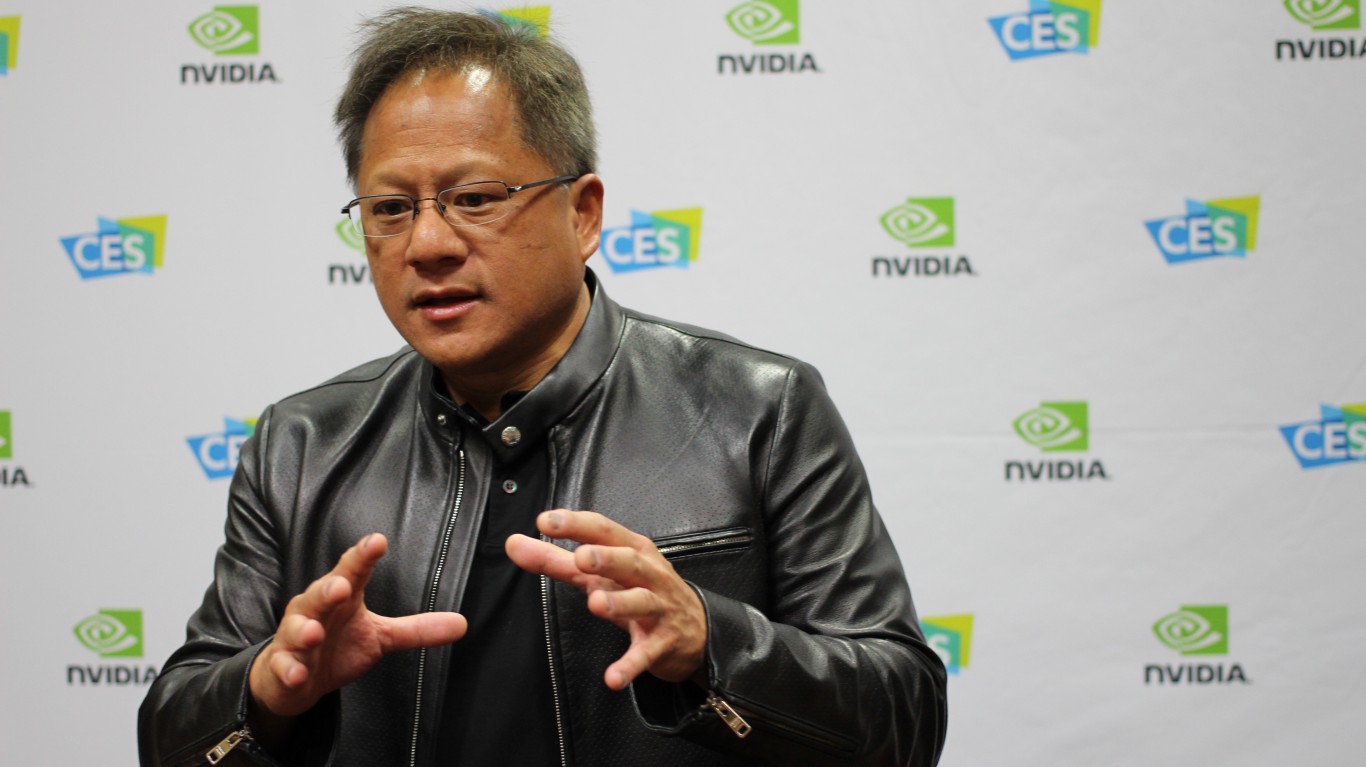
It’s hard to believe that shares of Nvidia (NASDAQ:NVDA | NVDA Price Prediction) could still have gas left in the tank as the firm reports absolutely stunning results to a tough crowd that continues to discount, or even dismiss, the massive strides that Jensen Huang’s empire has been making.
Of course, it’s hard to be truly bullish on a $5.2 trillion behemoth as someone as famed as Michael Burry, of The Big Short fame, bets against the company while fears of what could happen when AI and semiconductor finally do show signs of demand slowing and, eventually, peaking out.
After all, Nvidia is in a cyclical business, and it’s becoming harder to tell if Nvidia is an absolute steal of a bargain or something that’s far riskier than its seemingly modest multiple suggests. If earnings keep coming in hot and margins stay heightened, there’s no question that Nvidia might be a historic anomaly and a bargain in spite of its meteoric and bubbly-looking multi-year run.
Though the name isn’t without its fair share of risks, it still feels like Nvidia stock is either a steal of a deal or a trap. Which one will it be? Time will tell, but one thing, I believe, is clear: the company needs to go above and beyond GPUs if it’s to impress Wall Street, given how high the bar has been set.
As most others dismiss Nvidia as a cyclical AI chip play, though, the company is already looking ahead to the fast-rising robotics and physical AI opportunity.
Indeed, physical AI’s long-term potential could be profound enough to keep Nvidia ahead of the pack. And its colossal $5.2 trillion market cap does not seem to be all too much of a limiting factor when you consider the potential total addressable market (or TAM) of physical AI.
Could the physical AI opportunity really be that big over the long run?
Fellow 24/7WallSt contributor Jeremy Philips recently highlighted a “$40 trillion” figure for the TAM of physical AI. That’s a difficult figure to even begin to fathom. In my humble opinion, it’s a pretty aggressive estimate, but it’s worth contemplating, especially considering how far-reaching physical AI could become.
Whether physical AI’s TAM ends up being worth $40 trillion over the long term or significantly less, though, is up for debate. It’s really hard to pin down the magnitude in these early innings. Morgan Stanley (NYSE:MS) sees the humanoid market being worth $5 trillion by 2050. But that’s just humanoid robots. What about everything else?
Any way you look at it, it’s probably going to be big TAM. But, in my opinion, what’s more important is which firm could become a force in such a market.
Such an astronomical figure is anywhere close to the mark, perhaps arguing that Nvidia’s best days are over because of its sheer size no longer makes much sense. At the end of the day, there isn’t an actual ceiling that’s stopping a $5 trillion company from becoming a $10 trillion one and so on.
When Apple (NASDAQ:AAPL) blew through the $1 trillion market cap milestone for the very first time, it certainly did feel like that was the new ceiling for companies across America. Eventually, the firm broke the $4 trillion mark, and two other tech titans have since surpassed it, including Nvidia.
In my view, Nvidia is staring down the emerging physical AI market as it builds what could be the go-to ecosystem for physical AI. However large the market, it looks like it could be a needle-mover for Nvidia.
Nvidia’s ready for the physical AI era — a few surprises up its sleeves could excite
Whether we’re talking about Cosmos 3.0 and GR00T at the application layer or the powerful Jetson Thor hardware that’s behind it, I think Jensen Huang and company are already laser-focused on replicating the magic formula as we ring in the next and perhaps most explosive era of AI.
It’s easy to dismiss humanoid robots and all the sort as outlandish and the TAM as a giant question mark, given uncertainties regarding the timeline of when the tech will go mainstream, but the robots are being built at an accelerating pace, and if Nvidia can control as many layers of the “five-layer AI cake” in physical AI, perhaps there is a chance that Nvidia hasn’t yet reached the top.
In my humble opinion, Nvidia is smart for playing the operating system and System-on-a-Module (SOM) chip as the physical AI revolution looks to kick off.
With Jensen Huang teasing a new mystery chip “that will surprise the world,” it’s hard not to speculate as to what it could be. Based on the phrasing, it’s probably not another GPU. Could we be looking at quantum AI innovation? Or a new physical AI chip? Time will tell.
Nvidia and the next era of growth
Could it be that investors are too focused on increased ASIC competition and a shift in inference’s impact on GPU sales and margins? Possibly. Either way, if Nvidia stands behind the brains and OS of the robots of tomorrow, maybe Nvidia can maintain its unprecedented growth rate and margins for a whole while longer.
In my view, Nvidia looks poised to stay relevant as we enter such a new era, and I don’t think the stock is priced appropriately at 32.8 times trailing price-to-earnings (P/E), even considering the lower-end estimates of the physical AI TAM.
Contact [email protected] for any questions or corrections.
Joey is a 24/7 Wall St. contributor and seasoned investment writer whose work can also be found in publications such as The Motley Fool and TipRanks. Holding a B.A.Sc in Computer Engineering from the University of British Columbia (UBC), Joey has leveraged his technical background to provide insightful stock analyses to readers.
Joey's investment philosophy is heavily influenced by Warren Buffett's value investing principles. As a dedicated Buffett disciple, Joey is committed to unearthing value in the tech sector and beyond.