Jensen Huang Just Called Humanoid Robots a $40 Trillion Market. Here’s Why Wall Street Is Loading Up on Physical AI Stocks
Jensen Huang has spent the past year repeating one number that keeps growing louder: humanoid robots represent a $40 trillion total addressable market for labor automation. That figure came up again on the Animal Spirits Talk Your Book episode on…

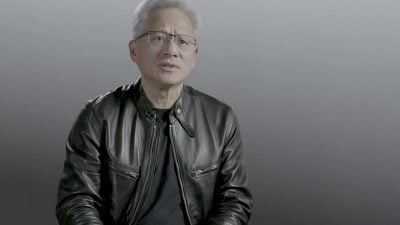
Jensen Huang has spent the past year repeating one number that keeps growing louder: humanoid robots represent a $40 trillion total addressable market for labor automation. That figure came up again on the Animal Spirits Talk Your Book episode on investing in the rise of the robots, where guest Derek Yan argued the opportunity is “potentially bigger” than EVs or smartphones. Huang has never attached a figure this large to a single end market, and Wall Street is starting to take the claim seriously.
The physical AI thesis has two clean public-market expressions. NVIDIA sells the picks and shovels. Tesla is the pure-play humanoid bet. Capital is positioning around both, and the credibility bridge is already on the road.
Waymo rides and trillion-dollar capital commitments
Yan framed physical AI as digital AI given a body. Autonomous driving is another application of physical AI: those cars are autonomous robots navigating the real world in real time. The Animal Spirits host described being blown away by his first Waymo ride, an experience that is becoming increasingly common. That reaction matters because it is the proof point that perception, planning, and control stacks actually work in uncontrolled environments.
Yan said on the podcast: “when like trillion-dollar company want it happen, it’s very likely to happen.” Huang at NVIDIA and Elon Musk at Tesla are each directing billions of dollars at the physical AI stack. The scale of that capital commitment is the institutional signal the market is watching.
NVIDIA: the compute layer under every humanoid
NVIDIA (NASDAQ:NVDA | NVDA Price Prediction) is the platform vendor for physical AI. Huang announced Isaac GR00T N1 at the most recent earnings call, describing it as “the world’s first open fully customizable foundation model for humanoid robots.” Partners including Agility Robotics, Boston Dynamics, and XPENG Robotics are already using Isaac simulation to train humanoids. Huang told investors: “Billions of robots, hundreds of millions of autonomous vehicles, and hundreds of thousands of robotic factories and warehouses will be developed.”
The financials make the platform story credible. Q1 FY2027 revenue hit $81.6 billion, up 85% year over year, beating Wall Street’s consensus of roughly $78.8 billion. Data Center revenue reached $75.2 billion, up 92% from a year ago, driven by surging Blackwell architecture demand. NVIDIA guided Q2 FY2027 revenue to $91 billion, a figure that prompted analysts to scramble with revised models. The company also raised its quarterly cash dividend 25-fold alongside those results, from $0.01 per share to $0.25 per share, signaling management’s confidence in the durability of the cash flow profile.
Shares trade near $193 as of late June 2026, well off the 52-week high of $237. The forward P/E sits at roughly 24x, a striking multiple for a company posting Data Center growth at this pace. Analyst consensus has moved to approximately $304, with the broad analyst community rating the stock a Strong Buy or Buy.

Tesla: the only public pure-play humanoid bet at scale
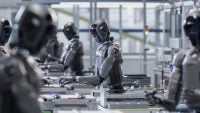
Tesla (NASDAQ:TSLA) is making an unusually concrete manufacturing bet on humanoids. The company is winding down Model S and Model X production at its Fremont factory and repurposing that line to build Optimus, with Gen 3 low-volume production targeted for summer 2026. A dedicated Optimus facility at Gigafactory Texas is designed for long-term capacity of up to 10 million units per year. As of June 2026, Gen 3 hands featuring 22 degrees of freedom are in 24-hour industrial shift testing. First external commercial customers are targeted for late 2026, with broader consumer availability expected in 2027. Musk has set a price target of $20,000 to $30,000 per unit at scale, against current manufacturing cost estimates that run significantly higher.
The FSD business is the existence proof: 1.28 million active FSD subscriptions, up 51% year over year, with Services revenue up 42% on a $22.39 billion top line. That track record shows Tesla can build a recurring-revenue software layer on top of hardware it manufactures at volume. The Optimus thesis demands the company repeat that trick at far greater scale.
The valuation embeds enormous expectations. Tesla carries a TTM P/E above 330x with a TTM EPS of $1.10. Shares trade near $380 as of late June 2026. The robot program has a documented history of timeline slippage, and on the Q4 2025 earnings call Musk himself acknowledged that Optimus units were “not in usage in our factories in a material way.” The gap between stated targets and actual production reality remains wide, which is what makes 2026 a genuine credibility test for the entire program.

What I am watching
If Huang’s $40 trillion figure is even directionally right, NVIDIA collects rent on every humanoid trained, simulated, and deployed. Tesla either delivers on Optimus at the volumes and timelines Musk has promised and becomes something much larger than an automaker, or that forward multiple compresses hard. The Fremont factory conversion is the most credible data point so far: shutting down profitable vehicle production to make room for a humanoid line is not a public relations move. It is a real capital commitment with real opportunity cost.
The Waymo ride that surprised the Animal Spirits host is the same underlying reason Coatue trimmed mega-cap tech in Q1. The picks-and-shovels case looks cleaner today. The pure-play case offers the bigger payoff if Gen 3 Optimus ships at volume. Both bets live or die on the same thesis: physical AI is real, and the trillion-dollar companies want it to happen.
Editor’s note: NVIDIA’s Data Center revenue for Q1 FY2027 was corrected to $75.2 billion, share prices for both NVIDIA and Tesla were updated to reflect late June 2026 levels, NVIDIA’s analyst consensus price target was revised to approximately $304, and Tesla’s TTM P/E was corrected to above 330x. New context was added on NVIDIA’s Q2 FY2027 revenue guidance of $91 billion, its 25-fold quarterly dividend increase, the Fremont factory conversion to Optimus production, and the status of Gen 3 hands in industrial testing as of June 2026.
Contact [email protected] for any questions or corrections.
I am a long time investor and student of business, and believe finding good companies that can become great investments is the best game on earth. After 20 years of writing and researching the public markets it is clear that individuals have never had more tools and information to take control of their financial lives. From ETFs and $0 commissions to cryptos and prediction markets there has never been a greater democratization of access to investing.
I write to help people understand the investments available to them so they can make the best choice for their portfolio, whether they're starting out or looking for income in retirement.