Walmart Worth Less Than Anthropic
It is a staggering valuation. AI superstar Anthropic raised $65 billion with a post-money valuation of $965 billion. That pushed it ahead of arch-rival OpenAI, which was most recently valued at $852 billion. It also puts the Anthropic’s figure ahead…


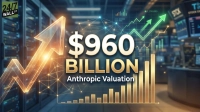
It is a staggering valuation. AI superstar Anthropic raised $65 billion with a post-money valuation of $965 billion. That pushed it ahead of arch-rival OpenAI, which was most recently valued at $852 billion. It also puts the Anthropic’s figure ahead of Walmart (NYSE: WMT | WMT Price Prediction), which has a market cap of $948 billion.
Walmart is the second-largest company in the US, after Amazon (NASDAQ: AMZN). Walmart’s revenue in its most recent fiscal year was $713 billion, with net income of $22 billion. Walmart has just shy of 11,000 stores worldwide and employs 2.1 million people. The employment number is about the same as the number of residents in New Mexico.
Anthropic’s revenue in the most recent quarter was $10.2 billion, on which $559 million in operating profit. That puts its annual revenue run rate at about $40 billion. Anthropic forecasts that its revenue in 2028 will be $70 billion. In the wild west of AI companies, that forecast number is little more than a guess.
Anthropic’s valuation is based on the belief that AI is the most important technology in history, that it is one of the companies that will rule the sector, and that AI has a tremendous commercial future. (It also depends on whether it can build data centers, which, in aggregate, could cost hundreds of billions of dollars.) It has received large investments from companies such as Amazon and Nvidia (NASDAQ: NVDA), which are willing to back it as one of, if not the, industry leader.
The entire AI sector’s future is beyond reasonable forecasts. Should it be measured by the person using its products, primarily Claude?. Claude’s download pace in the Apple App Store is just behind that of OpenAI’s ChatGPT.
The high valuation is more likely based on enterprise revenue. Venture Beat says Claude has taken the lead in business adoption. “Adoption of Anthropic rose 3.8% in April to 34.4% of businesses, according to the May 2026 release of the Ramp AI Index. OpenAI’s adoption fell 2.9% to 32.3%. Overall AI adoption among businesses rose 0.2 percentage points to 50.6%,” Venture Beat reports.
The comparisons between OpenAI and Anthropic leave out an incredibly important factor. Microsoft, Alphabet, DeepSeek, and Elon Musk’s xAI Grok are spending tens of billions of dollars on software development and hundreds of billions of dollars on AI data centers. The industry remains fragmented, and the cash war chests of each of these companies are staggering. Financial firms have also entered the race, providing capital for AI center buildouts.
While there are many reasons AI revenue will not rise quickly, one is that customers believe AI adoption is too far along at their companies, given the costs. Uber’s management recently said it was measuring AI costs against its productivity improvements. The Wall Street Journal recently reported, “Use of artificial intelligence by big companies is exploding—and the soaring cost has some of them pumping the brakes in a way that could complicate AI’s triumphal march across the economy.”
Anthropic’s valuation is based on both knowns and unknowns. That alone makes a nearly $1 trillion figure risky. At least Walmart has a proven track record.
Contact [email protected] for any questions or corrections.
Douglas A. McIntyre is the co-founder, chief executive officer and editor in chief of 24/7 Wall St. and 24/7 Tempo. He has held these jobs since 2006.
McIntyre has written thousands of articles for 24/7 Wall St. He is an expert on corporate finance, the automotive industry, media companies and international finance. He has edited articles on national demographics, sports, personal income and travel.
His work has been quoted or mentioned in The New York Times, The Wall Street Journal, Los Angeles Times, The Washington Post, NBC News, Time, The New Yorker, HuffPost USA Today, Business Insider, Yahoo, AOL, MarketWatch, The Atlantic, Bloomberg, New York Post, Chicago Tribune, Forbes, The Guardian and many other major publications. McIntyre has been a guest on CNBC, the BBC and television and radio stations across the country.
A magna cum laude graduate of Harvard College, McIntyre also was president of The Harvard Advocate. Founded in 1866, the Advocate is the oldest college publication in the United States.
TheStreet.com, Comps.com and Edgar Online are some of the public companies for which McIntyre served on the board of directors. He was a Vicinity Corporation board member when the company was sold to Microsoft in 2002. He served on the audit committees of some of these companies.
McIntyre has been the CEO of FutureSource, a provider of trading terminals and news to commodities and futures traders. He was president of Switchboard, the online phone directory company. He served as chairman and CEO of On2 Technologies, the video compression company that provided video compression software for Adobe’s Flash. Google bought On2 in 2009.