Investor Chris Camillo Predicts The ‘Last Easy Trade’ of the AI Supercycle Is About to Start
Retail investor Chris Camillo, host of the Dumb Money Live channel and a practitioner of what he calls “social arbitrage,” laid out a sweeping framework for the AI investment cycle on a recent episode of The Iced Coffee Hour with…

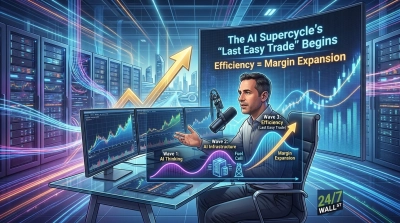
Retail investor Chris Camillo, host of the Dumb Money Live channel and a practitioner of what he calls “social arbitrage,” laid out a sweeping framework for the AI investment cycle on a recent episode of The Iced Coffee Hour with hosts Graham Stephan and Jack Selby. His core argument was simple. The first two phases of the AI boom already created massive winners, but the next phase may produce the clearest investment setup yet.
Camillo believes the “last easy trade” of the AI supercycle is about to begin, and he says he has spent roughly three years waiting for it.
The AI Boom May Be Entering Its “Productivity” Phase
Camillo breaks the AI cycle into three waves:
Wave 1 was the moment AI became consumer-facing. Large language models suddenly showed people that AI could write, reason, and interact in ways that felt dramatically different from earlier software tools. That triggered the first wave of excitement across the market.
Wave 2 focused on the infrastructure needed to support that demand. Hyperscalers ramped capital spending, GPU demand exploded, the data center construction accelerated, and power infrastructure became a bottleneck. J.P. Morgan estimates that data center capital expenditures now equal roughly 1.2% to 1.3% of GDP, levels that resemble those of previous infrastructure booms.
Wave 3, in Camillo’s framing, centers on companies using AI to operate more efficiently and reduce costs across large workforces. He pointed specifically to businesses with heavy customer service operations, administrative overhead, logistics networks, and repetitive white-collar functions.
Bloom Energy: The Wave 2 Anchor
When Selby asked how Camillo had been positioned for the earlier infrastructure wave, Camillo referenced Bloom Energy (NYSE:BE), noting the stock had risen to the $250 to $260 range at the time of recording. Shares last traded at $302.49 on May 22, 2026, after gaining 248.13% year-to-date.
The company’s operating results reflected that momentum. In Q1 2026, Bloom posted revenue of $751.05M, up 130.4% year over year, and non-GAAP EPS of $0.44 versus $0.13 consensus. Management raised full-year 2026 guidance to revenue of $3.40B to $3.80B, supported by a $5 billion strategic AI infrastructure partnership with Brookfield Asset Management and an Oracle data center power collaboration. CEO KR Sridhar described the shift bluntly: “Bring-your-own-power has shifted from a slogan to a business necessity for AI hyperscalers and manufacturing facilities.”

For Camillo, Bloom represented the Wave 2 Infrastructure side of the AI trade. His focus now appears to be shifting toward companies that can convert AI adoption into measurable profit expansion.
Why Camillo Calls Wave 3 the “Easy” Trade
Camillo argues the third wave may be simpler than the earlier phases because investors can track the payoff directly through margins.
The first wave required investors to bet on AI model capabilities before most business use cases existed. The second wave required investors to identify infrastructure winners in an increasingly crowded market.
Wave 3 may offer a cleaner signal.
Camillo believes investors should focus on companies where AI deployment begins showing up in operating margins and operating income. In his framework, the biggest winners may come from businesses with bloated cost structures that suddenly become far more efficient through automation.
That debate is already emerging across Silicon Valley and Wall Street. Investors and tech leaders, including Bill Gurley, Dan Shipper, and Dan Ives, have raised questions about how quickly AI productivity gains will translate into real labor disruption and measurable financial results.
Camillo’s argument focuses less on the labor debate itself and more on what eventually shows up in company financials. In his view, the clearest signal may simply be margin expansion.
The Timing Window
Camillo’s timeline for Wave 3 is deliberately wide. He said the efficiency wave “starts pretty soon” within the next year, while acknowledging “it might not start for another 2 years.” He frames the current moment as positioning rather than entry.
For investors, the practical takeaway is to watch for gross or operating margin expansion in cost-heavy businesses as AI tools roll in. That is the data point Camillo believes will define the next phase, and the one he says he has spent three years waiting to act on.
Contact [email protected] for any questions or corrections.
Thomas Richmond is a financial writer and content strategist with 5+ years of experience covering stocks and financial markets. He has published over 500 articles focused on individual stock analysis, helping investors better understand business fundamentals, stock valuations, and long-term opportunities.
Thomas previously served as a Content Lead at TIKR, a stock research platform, where he helped scale the company’s blog to hundreds of articles per month and contributed to a weekly newsletter reaching more than 100,000 investors.
Outside of work, Thomas enjoys weight lifting and soccer.