‘We’re in the First or Second Inning’ of AI Revolution, Says Top Analyst
Jordi Visser of Weiss Multi-Strategy Advisers is leaning hard into the AI buildout, telling Anthony Pompliano on The Pomp Podcast that “the AI generational situation is still in the first or second inning.” Visser said he holds 15 to 20…


Jordi Visser of Weiss Multi-Strategy Advisers is leaning hard into the AI buildout, telling Anthony Pompliano on The Pomp Podcast that “the AI generational situation is still in the first or second inning.”
Visser said he holds 15 to 20 international semiconductor and chemical companies in his AI thematic portfolio, naming ASML Holding (NASDAQ:ASML | ASML Price Prediction), Soitec, Ajinomoto, and Siemens Energy. Of those, ASML, the Dutch monopoly behind EUV lithography, stands out as the most accessible option for U.S. investors.
Why ASML Is the Anchor
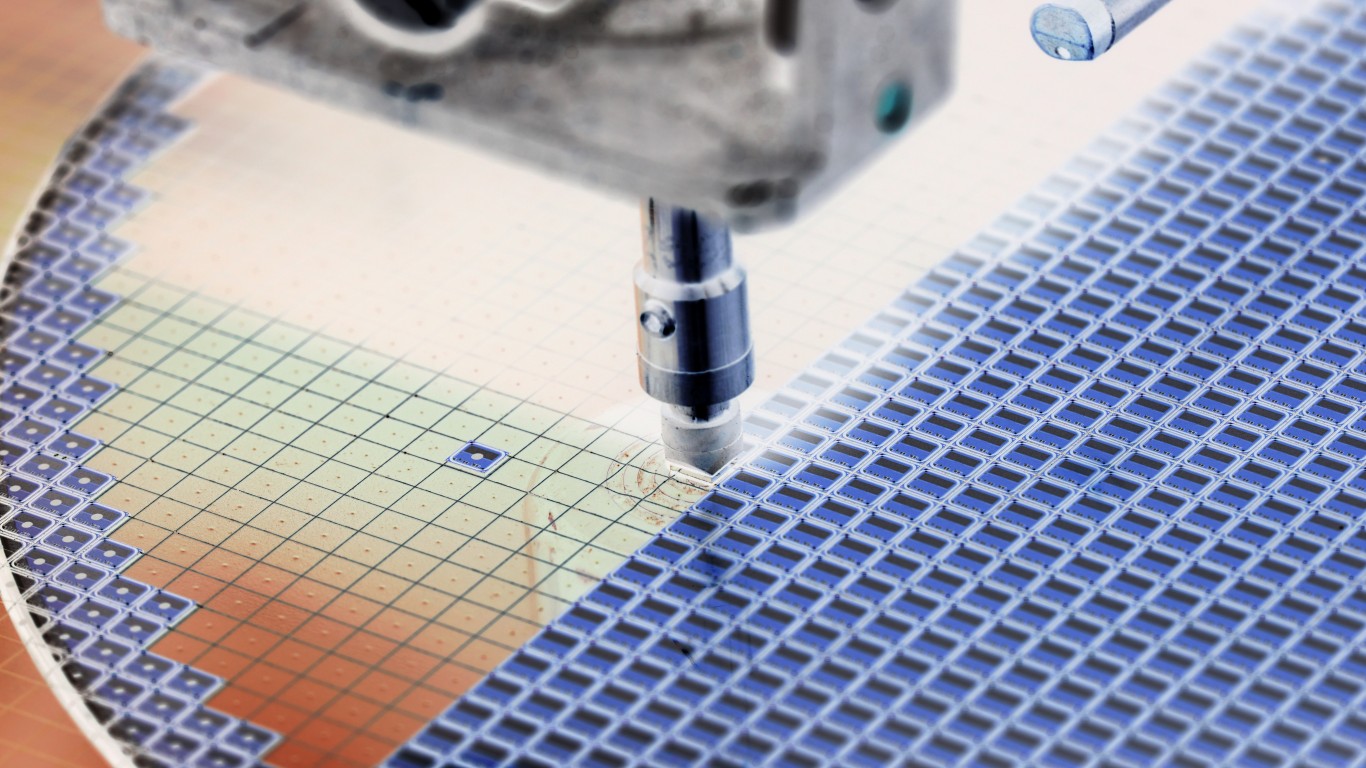
ASML occupies a unique position in the semiconductor industry. The company is the world’s dominant supplier of extreme ultraviolet lithography, or EUV, machines, which are required to manufacture the most advanced chips. Without ASML’s equipment, the leading processors powering artificial intelligence systems would be far more difficult to produce.
ASML reported Q1 2026 revenue of $10.3 billion in revenue, delivered a 53.0% gross margin, and reported diluted earnings per share of $8.43. Net income increased to roughly $3.25 billion, up from $2.78 billion a year earlier.
CEO Christophe Fouquet directly linked the outlook to AI demand: “The semiconductor industry’s growth outlook continues to solidify, driven by ongoing AI-related infrastructure investments. Demand for chips is outpacing supply. In response, our customers are accelerating their capacity expansion plans for 2026 and beyond.” That demand is increasingly concentrated among the companies building AI infrastructure. During the second half of 2025, logic customers accounted for the majority of bookings and system sales, reflecting the industry’s shift toward AI-focused chip production.
ASML closed at $1,612.76 on May 29, 2026, up 51.28% year-to-date and 117.59% over one year. Shares trade at a trailing P/E of 54 and a forward P/E of 44, with the analyst consensus target sitting at $1,667.45.
Visser’s Three Contrarian Arguments
Visser argued that several commonly cited warning signals that the market could be overvalued are being interpreted too pessimistically by investors.
First, the Buffett indicator. He called it “more of a bullish thing than a bearish thing” in a financialized economy. His logic: “We’re a financialized economy, and if we want to help, which we do through transfer payments, it’s a major voting block. We can’t allow people to lose their jobs. We can’t allow gas to go up to $10 a gallon.” Total transfer receipts ran at $5,087.8 billion in Q1 2026, with Social Security alone at $1,629.6 billion.
Second, the savings rate. “One of the big mistakes that people make is the savings rate should decline when people are feeling optimistic about their jobs, the stock market, whatever the case is,” Visser said. The personal savings rate has slid from 6.2% in Q1 2024 to 3.7% in Q1 2026, while per capita disposable income climbed from $63,638 to $68,359 over the same window. Visser reads that as capital deployment by optimistic households.
Third, the global tilt. He pointed to the MSCI World Index ex-US recently hitting all-time highs, Johnson Redbook consumer spending up 9% year over year, and a US savings rate around 3%. The yield curve remains positive, with the 10Y-2Y spread at 0.47% on May 29, 2026, well clear of inversion.
What Investors Should Watch
ASML’s long-term opportunity remains closely tied to the pace of AI infrastructure spending, but there are risks. Management has warned that export restrictions could reduce sales to China compared with peak levels seen in recent years. At the same time, ASML entered 2026 with a backlog exceeding €45 billion and continues to return capital through a €12 billion share repurchase program running through 2028.
If Visser’s “first or second inning” analogy proves accurate, those orders may offer one of the clearest windows into how much demand remains ahead. For a company at the center of the global semiconductor supply chain, the backlog may matter as much as earnings themselves.
Contact [email protected] for any questions or corrections.
Thomas Richmond is a financial writer and content strategist with 5+ years of experience covering stocks and financial markets. He has published over 500 articles focused on individual stock analysis, helping investors better understand business fundamentals, stock valuations, and long-term opportunities.
Thomas previously served as a Content Lead at TIKR, a stock research platform, where he helped scale the company’s blog to hundreds of articles per month and contributed to a weekly newsletter reaching more than 100,000 investors.
Outside of work, Thomas enjoys weight lifting and soccer.