Prediction: Unilever’s Turnaround Could Drive Shares to $75
Our Unilever (NYSE:UL | UL Price Prediction) call lands on the cautious side of fair value. After a brutal stretch that has erased 18.4% over the past year and 12.19% year to date, the stock is oversold, but our proprietary…

Our Unilever (NYSE:UL | UL Price Prediction) call lands on the cautious side of fair value. After a brutal stretch that has erased 18.4% over the past year and 12.19% year to date, the stock is oversold, but our proprietary model sees a small step backward over the next 12 months.
The 24/7 Wall St. Price Target for Unilever
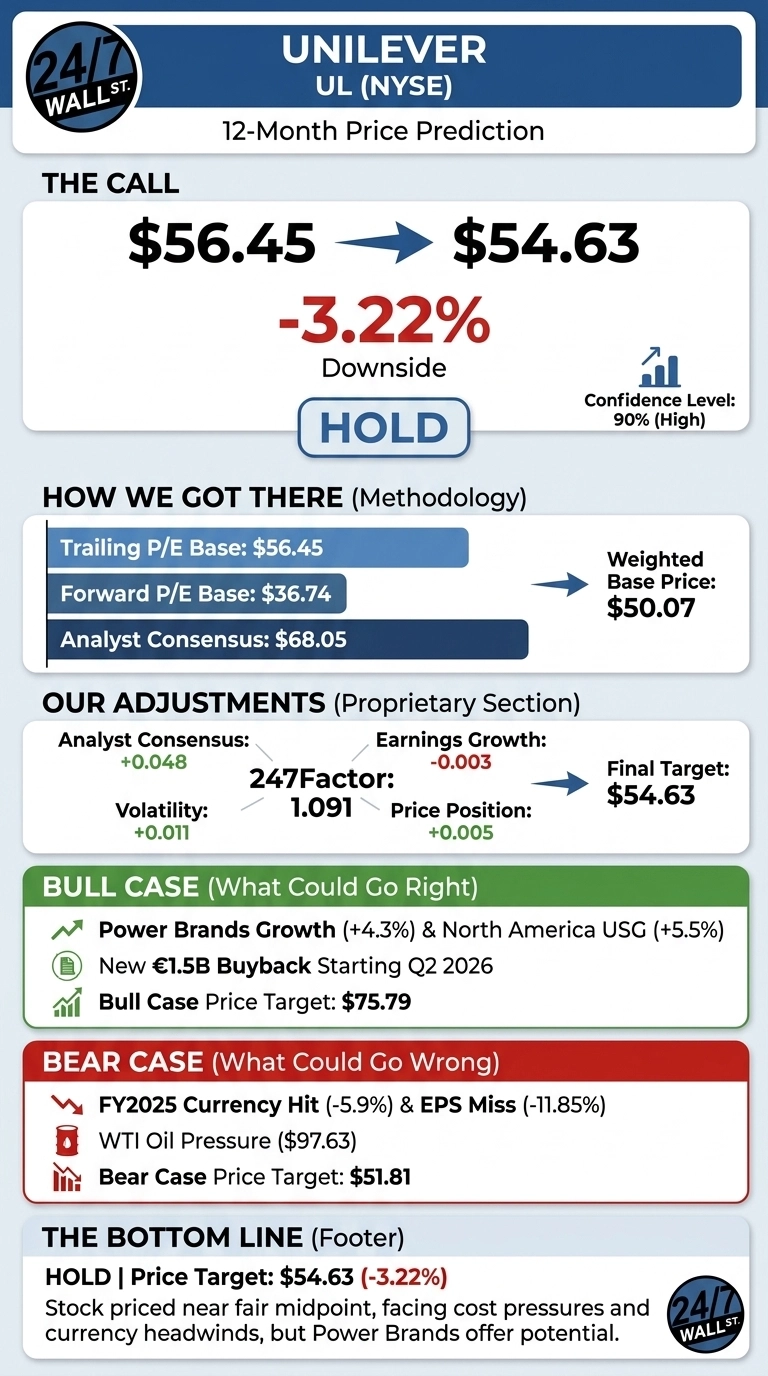
Our 24/7 Wall St. price target for Unilever is $54.63, modestly below the current $56.45 quote. The implied move is -3.22%, and we rate UL a hold with high (90%) confidence. With a forward P/E of 16 and a defensive beta of 0.452, this stock is priced near its fair midpoint.
| Metric | Value |
|---|---|
| Current Price | $56.45 |
| 24/7 Wall St. Price Target | $54.63 |
| Upside/Downside | -3.22% |
| Recommendation | HOLD |
| Confidence Level | 90% |
Why We Could Be Wrong
Our $54.63 target sits just under current levels. UL is deeply oversold, and real upside could come from a margin beat tied to the new €1.5 billion buyback starting Q2 2026 or faster traction from premium acquisitions like Dr. Squatch and Liquid I.V. Our bull case below outlines why UL could outperform.
A Brutal Slide From February Highs
UL peaked near $73.96 in mid-February 2026 before unwinding to the mid-$50s. The weekly RSI sits at 37.95, with the stock spending 8 of the last 12 weeks in oversold territory.
FY2025 underlying operating margin came in at 20% (+60bps), but reported EPS of $2.59 missed the $2.9383 consensus by 11.85%. WTI crude sits at $97.63, in the 85th percentile of its 12-month range, pressuring input costs heading into 2026 guidance set at the bottom end of the 4% to 6% underlying sales growth band.

How We Calculated $54.63
The 24/7 Wall St. Price Target blends trailing P/E, forward P/E, and analyst consensus, then applies our 247Factor adjustment for sector momentum, growth, volatility, and sentiment. The trailing P/E approach implied $56.45, while forward P/E pointed to $36.74 on a $2.35 forward EPS estimate. The blended pre-adjustment price landed at $50.07.
We applied a 247Factor of 1.091, lifted by an 80% bullish analyst consensus and low beta, but dampened by negative earnings growth of -3.4% YoY and a 30% large-cap dampener, producing our $54.63 target.
The Case for $75 and Higher
Bulls argue UL is mispriced after the Ice Cream demerger left a cleaner, higher-margin business. Power Brands now contribute 78% of turnover and grew 4.3%. North America posted 5.5% USG with 5.4% volume in Q3, and Indonesia returned to 12.7% growth.

The Wall Street consensus target is $68.05 with 1 Strong Buy, 3 Buy, 1 Hold. Our bull-case scenario projects UL at $75.79 by June 2027 if premium beauty acquisitions accelerate and oil retreats below $80.
The Risks Worth Watching
The bear case starts with currency. FY2025 reported turnover took a 5.9% currency hit, Latin America remains weak, and China demand is soft.
EPS missed by nearly 12%, which bulls counter reflects one-time costs from the Ice Cream separation and stranded overhead that should normalize through 2026. Our bear scenario sees UL at $51.81 by mid-2027 if volume growth slips below the company’s 2% floor and WTI stays above $100.

Hold for Now, With a Buyer’s Eye
I rate Unilever a hold with high confidence. The $54.63 target says the easy money has been made on the way down, but premium recovery requires execution proof. The setup turns more constructive on a confirmed Q1 2026 revenue beat versus the $12.45 billion consensus paired with stable volume.
The thesis weakens if oil holds above $100 and the buyback fails to support the share count. The 4.04% dividend yield pays you to wait.
Unilever Price Prediction 2026-2030
Here is where our model projects UL could trade, assuming current growth trajectories and margin recovery hold.
| Year | 24/7 Wall St. Price Target |
|---|---|
| 2026 | $55.06 |
| 2027 | $55.02 |
| 2028 | $55.20 |
| 2029 | $56.23 |
| 2030 | $58.56 |
These projections assume Unilever executes on its Power Brand strategy and US/India focus. Significant upside or downside could result from oil normalization, accelerated premium beauty M&A, or a sharper-than-expected slowdown in emerging market demand.
Contact [email protected] for any questions or corrections.
Vandita Jadeja is a financial publisher with over a decade of experience writing about financial topics, including investment, savings, retirement, insurance and banking. Vandita is a Chartered Accountant who loves to debunk financial concepts for readers.
Her work has appeared on sites that include The Motley Fool, InvestorPlace, and Benzinga. She covers investing and focuses on stock picks and price prediction for 24/7 Wall St.
When not looking for the next stock investment opportunity, she can be found traveling, reading, chasing sunsets and enjoying her iced latte.


![The Micron Technology logo in blue is centered on a dark green background with lighter green grid lines and glowing green line and bar charts. A black box at the bottom displays white text: '129.49 +3.22 [2.55%]'. A '24/7 WALL ST' logo is in the top right corner.](https://247wallst.com/wp-content/uploads/2024/05/Postive-1-200x113.jpg)