$1k in ASML Smashed The S&P at Every Milestone
Ten years ago, ASML (NASDAQ:ASML | ASML Price Prediction) was a respected Dutch equipment maker quietly perfecting a technology most investors had never heard of: extreme ultraviolet lithography. Today, it is the sole supplier of EUV machines required to print…

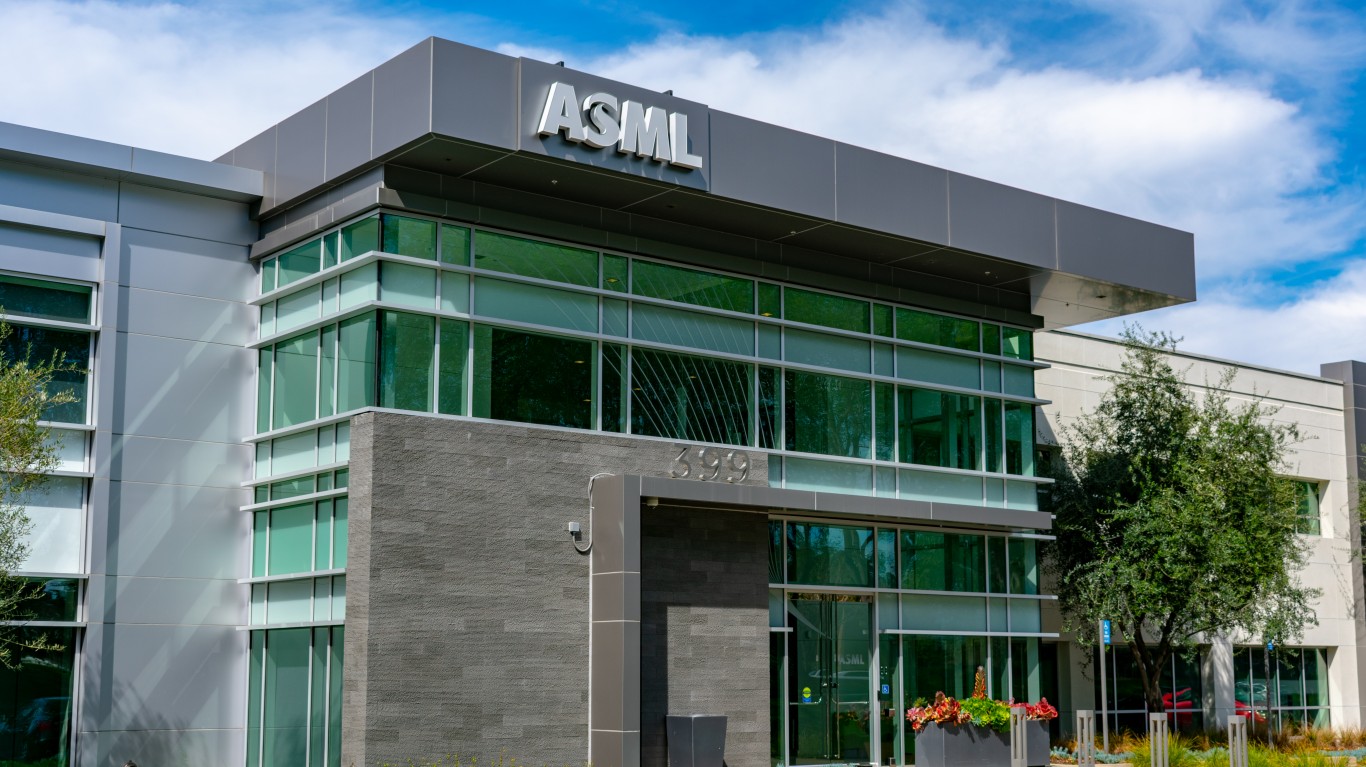
Ten years ago, ASML (NASDAQ:ASML | ASML Price Prediction) was a respected Dutch equipment maker quietly perfecting a technology most investors had never heard of: extreme ultraviolet lithography. Today, it is the sole supplier of EUV machines required to print transistors smaller than 7 nanometers, and every cutting-edge chip from TSMC, Samsung, and Intel runs through its tools.
The journey was bumpy. ASML rode the smartphone cycle, then the cloud cycle, then a brutal 2022 to 2023 downturn, then the AI capex explosion. CEO Christophe Fouquet spooked the market in July 2025 when he said he “cannot confirm” 2026 growth, only to deliver record Q4 2025 net bookings of €13.2 billion six months later. The story since: AI customers accelerating capacity plans, a $45.06 billion backlog, and the first High NA EUV system (EXE:5200B) shipped.
Your $1,000 Became $19,297
1-Year Return
- Initial Investment: $1,000
- Current Value: $2,384.80
- Total Return: 138.48%
- S&P 500 (same period): roughly $1,130 (about 13%)
5-Year Return
- Initial Investment: $1,000
- Current Value: $2,705.20
- Total Return: 170.52%
- S&P 500 (same period): roughly $1,900 (about 90%)
10-Year Return
- Initial Investment: $1,000
- Current Value: $19,297.20
- Total Return: 1,829.72%
- S&P 500 (same period): roughly $3,500 (about 250%)
The decade math is the headline. A grand turned into nearly twenty, crushing the index by a factor of more than five. Most of that compounding came from a single insight playing out over ten years: every node shrink raises lithography intensity, and ASML is the only vendor that can sell the required tool. Holding through the 2022 drawdown and the mid-2025 guidance scare was the price of admission. Both felt awful at the time. I’d put $1,000 into ASML today if I believed in the long-term setup.
The Case Today, With Open Eyes
The bull case rests on AI capex continuing to pull forward and customers staying desperate for EUV slots. The Q1 2026 setup supports that: revenue of $10.34 billion, 53.0% gross margin, raised guidance, and JP Morgan arguing 2027-2028 consensus is too low.
The bear case centers on the China revenue cliff hitting harder than guided, or the 57 trailing P/E compressing on any AI digestion. Morningstar moved to Sell on valuation in May 2026, and the stock has run 64.86% year to date.
The monopoly is real, the backlog is real, and the next decade of advanced chips literally cannot exist without these machines. I just refuse to pretend the entry price does not matter.
Contact [email protected] for any questions or corrections.
Alex Sirois is a financial writer with experience spanning both retail and institutional investing. He has written for InvestorPlace and held roles at BNY Mellon and Bernstein, giving him a perspective that bridges Main Street portfolios and Wall Street analysis.
Alex holds an MBA from George Washington University and has built his career across multiple industries, including e-commerce, education, and translation — a breadth of experience that informs how he breaks down complex financial topics for everyday investors. His writing is conversational, actionable, and grounded in long-term, buy-and-hold investing principles.
At 247 Wall St., Alex focuses on delivering analysis that is both accessible and useful, with a clear emphasis on helping readers make more informed decisions with their money.