The Next Quantum Computing IPO CEO Just Told CNBC ‘It Is Not 10 to 15 Years Out. It’s Very Much Now’
Quantinuum, the Honeywell-backed trapped-ion quantum computing company, began trading on the NASDAQ today after pricing its IPO at $60 per share and raising $1.68 billion. On CNBC’s Squawk Box this morning, CEO Rajeeb Hazra delivered the line that will define…


Quantinuum, the Honeywell-backed trapped-ion quantum computing company, began trading on the NASDAQ today after pricing its IPO at $60 per share and raising $1.68 billion. On CNBC’s Squawk Box this morning, CEO Rajeeb Hazra delivered the line that will define the debut: “It is not 10 to 15 years out. It’s very much now. And we will only see acceleration going forward.”
That is a bold framing on a day when investors are also digesting the company’s early-stage financials. It is also a direct challenge to the long-running skeptic view that quantum is still a science project.
The Debut
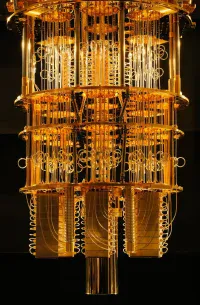
Quantinuum was spun out of Honeywell, which remains a majority shareholder post-IPO. The company builds trapped-ion quantum computers, including hardware called Helios. Trapped-ion systems use charged atoms held in electromagnetic fields as qubits, an approach valued for high gate fidelity and accuracy. It is the same broad architecture used by IonQ (NYSE:IONQ | IONQ Price Prediction), making IonQ the closest public comparable for investors trying to triangulate Quantinuum’s positioning.
The “Very Much Now” Thesis
Hazra’s pitch leans on customers rather than theory. “We have customers today that are using our commercially available hardware and software, our full stack, to get started with their quantum journey on transforming, whether it’s their product set is pharma, their product set is financial instruments, their product set is new chemicals,” he said. He also tied quantum directly to the AI buildout: “We are in a transformative moment for the computing industry as AI and workloads take over and drive increasing amounts of value.”
He acknowledged the stage of the market, calling it “early days of a massive industry,” where the KPIs are hardware performance and accuracy.
The Profitability Question
Here is where investors will scrutinize the story. Quantinuum reported 2025 revenue of $31 million and 2025 bookings of $79 million, but Q1 2026 revenue was only $1.3 million. The gap between booked commitments and recognized revenue is the central tension. Lumpy revenue is typical for pre-mass-commercialization deep tech, and the public comps show the same pattern in different forms. IonQ posted Q1 FY26 revenue of $64.67M, up 755% YoY, while D-Wave Quantum (NYSE:QBTS) reported Q1 FY26 revenue of $2.86M, down 81% YoY against a tough prior-year system-sale comp.
Government Validation and the Quantum IPO Wave
Hazra confirmed Quantinuum has signed a Department of Commerce LOI: “This R&D grant is intended to allow us to be able to scale those technologies, including supply chain onshore in the US.” That ties into a broader theme. The Commerce Department’s $2 billion quantum initiative, announced May 21, 2026, included $100 million planned for D-Wave, $100 million for Quantinuum, and up to $100 million for Rigetti. Washington is treating quantum as strategic infrastructure.
For investors who want exposure today, the public comps are the established route. IonQ trades at roughly a $26.65 billion market cap with a P/E of 183 and an analyst consensus target of $67.64 ( 11 Buy, 2 Hold, 0 Sell). Polymarket assigns a 53.5% probability that the US federal government takes a stake in IonQ by year-end.
D-Wave runs both annealing and gate-model systems and is up 31.69% over the past month. Rigetti Computing (NASDAQ:RGTI) pursues superconducting chiplet architecture and has gained 100.12% over the past year. These are different architectures with different risk profiles, not equivalents to Quantinuum. For deeper background on how the architectures compare, see our coverage of the D-Wave vs. IonQ matchup.
The Takeaway
Quantinuum’s listing is a real milestone. A well-funded, Honeywell-backed, government-validated trapped-ion company is now public, and its CEO insists the commercial era has started. The number to watch is the conversion of bookings into recognized revenue. CEO Hazra is asking investors to believe in acceleration. The financials say it is still early days. Quantum is moving from lab to market, and investors should size positions with that distinction in mind.
Contact [email protected] for any questions or corrections.
Thomas Richmond is a financial writer and content strategist with 5+ years of experience covering stocks and financial markets. He has published over 250 articles focused on individual stock analysis, helping investors better understand business fundamentals, stock valuations, and long-term opportunities.
Thomas previously served as a Content Lead at TIKR, a stock research platform, where he helped scale the company’s blog to hundreds of articles per month and contributed to a weekly newsletter reaching more than 100,000 investors.
He specializes in breaking down complex companies into clear, actionable insights for everyday investors, with a focus on fundamentals-driven research.
His work has also been featured on platforms including Seeking Alpha and Sure Dividend.
Outside of work, Thomas enjoys weight lifting and soccer.