Top Wall Street Strategist: AI ‘Reality Check’ Is Coming as Bond Market Flashes Warning Signs
The market is on its longest winning streak since 1985, AI enthusiasm is running at levels one strategist calls “unbelievable,” and the IPO window has cracked open wide. Into that backdrop, Robert Teeter, Chief Investment Strategist at Silvercrest Asset Management,…

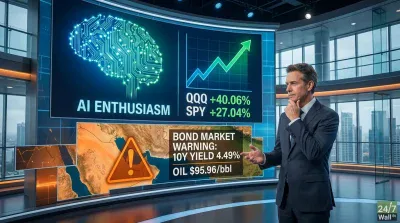
The market is on its longest winning streak since 1985, AI enthusiasm is running at levels one strategist calls “unbelievable,” and the IPO window has cracked open wide. Into that backdrop, Robert Teeter, Chief Investment Strategist at Silvercrest Asset Management, walked onto CNBC on June 5, 2026, with a measured message: a reality check would be the healthiest thing that could happen next.
The AI Enthusiasm and the Question It Raises
Teeter acknowledges the strength of the AI rally. “It’s one of the most fascinating times we’ve had in a while with just absolutely unbelievable enthusiasm around the AI theme and the AI trade,” he said. The numbers back the mood. The Invesco QQQ Trust (NASDAQ:QQQ) is up 40.06% over the past year, while the broader SPDR S&P 500 ETF Trust (NYSEARCA:SPY) has climbed 27.04%.
His framing of the next leg is the question every investor should be asking: “The way we map it out over the next few months is how do those expectations collide with reality? Where do we draw the demand from for investors to come in here and boost stocks higher?” After a historic run, the marginal buyer gets harder to find. That is when consolidation in the sector could become the path of least resistance.
The Healthy Rotation Scenario
Teeter’s constructive base case calls for a pause. “We’d expect to see maybe a little bit more of that, some consolidation, a time to digest these big gains, digest the IPOs that are coming up, maybe get some rotation into other areas. That would be the healthiest path forward,” he said.
That rotation has already begun. Yesterday’s session saw healthy rotation into health care, financials, and small caps. The iShares Russell 2000 ETF (NYSEARCA:IWM) is up 18.63% year-to-date, a sign that capital is starting to look beyond the AI mega-caps. With a heavy IPO calendar still to absorb, money leaving crowded growth names has somewhere to go.
The Bond Market Is the Real Wild Card
This is where Teeter’s caution sharpens. “I think bonds have actually been reasonably complacent given what’s gone on in the Gulf,” he said. “But it seems like the pressure point is building to if we don’t get traffic flowing in the next few weeks, bonds are likely to go through another round of price down yields up, and more expectations for FED potentially having to respond at some point.”
The 10-year Treasury yield sits at 4.49%, with a 12-month high of 4.67% set on May 19, 2026. The 10Y-2Y yield curve spread has compressed to 0.42%, near the bottom of its 12-month range. WTI crude is at $95.96 per barrel, after spiking as high as $114.58 in early April amid Strait of Hormuz disruptions.
Rising yields raise borrowing costs and make bonds more competitive with stocks, which can accelerate the rotation out of high-multiple equities. The Fed Funds upper bound has eased to 3.75%, but an oil-driven inflation shock could halt or reverse that path.
What It Means for Investors
The VIX is sitting at just 15.40, which the data provider classifies as a zone of market complacency. That is the gap Teeter is pointing at. Equity markets continue to price in a relatively smooth outlook, while the bond market is showing early signs of caution.
For investors, the practical takeaways are clear. Expect more volatility in the most-loved AI names. Watch the rotation into health care, financials, and small caps as a sign the market is broadening in a healthy way. And keep an eye on the bond market and the Strait of Hormuz as an external risk that drive something sharper.
Teeter’s message is measured. If bond yields remain contained and energy markets stay stable, the market may simply work through its recent gains with a period of consolidation and sector rotation. If geopolitical tensions escalate or yields move sharply higher, volatility could increase and the rotation away from crowded trades could accelerate.
Contact [email protected] for any questions or corrections.
Thomas Richmond is a financial writer and content strategist with 5+ years of experience covering stocks and financial markets. He has published over 250 articles focused on individual stock analysis, helping investors better understand business fundamentals, stock valuations, and long-term opportunities.
Thomas previously served as a Content Lead at TIKR, a stock research platform, where he helped scale the company’s blog to hundreds of articles per month and contributed to a weekly newsletter reaching more than 100,000 investors.
He specializes in breaking down complex companies into clear, actionable insights for everyday investors, with a focus on fundamentals-driven research.
His work has also been featured on platforms including Seeking Alpha and Sure Dividend.
Outside of work, Thomas enjoys weight lifting and soccer.