AGQ Crashed 16% Before Anyone Realized What Was Happening
A $10,000 position in ProShares Ultra Silver (NYSEARCA:AGQ) at Friday’s open was worth roughly $8,376 by the closing bell. The fund opened June 5, 2026 around $109.85 and closed at $92.01, a single-session drop of 16.24%. Over the same day,…

This post may contain links from our sponsors and affiliates, and Flywheel Publishing may receive compensation for actions taken through them.
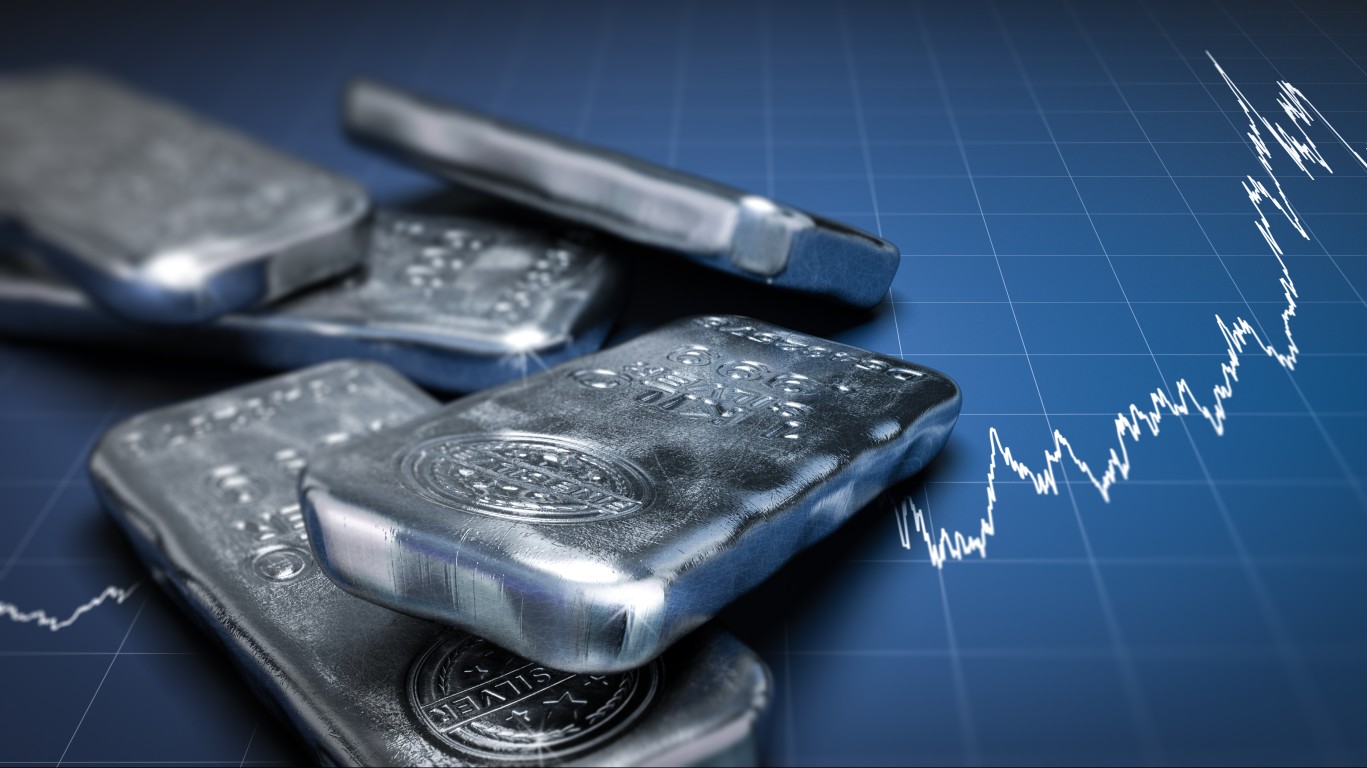
A $10,000 position in ProShares Ultra Silver (NYSEARCA:AGQ) at Friday’s open was worth roughly $8,376 by the closing bell. The fund opened June 5, 2026 around $109.85 and closed at $92.01, a single-session drop of 16.24%. Over the same day, silver itself, as measured by the unleveraged iShares Silver Trust (NYSEARCA:SLV), fell 8.08%, from $66.98 to $61.57. That ratio, a 2x leveraged product moving roughly twice the daily change of its benchmark, is exactly what AGQ’s prospectus promises on any given day, and it is exactly what tripped people up.
Zoom out to the move investors actually felt. From the May 19 yield peak through Friday’s close, AGQ is down 16.10% while SLV is down 7.97%. Year to date, the gap widens further. SLV has slipped 4.42% while AGQ has shed 40.68%, a divergence that has very little to do with silver’s direction and almost everything to do with the way 2x daily leverage compounds across choppy tape.
The 172K Print That Cracked the Trade
The proximate cause sits in a single data release. May payrolls came in at 172K against an 80K expectation, and the 2-year Treasury yield jumped to 4.16%, a 16-month high. Fed funds futures repriced toward the possibility of another hike rather than a cut. The dollar index added 0.65%, gold fell 3.27%, and silver dropped 7.17%. Three headwinds hit precious metals in the same session, and silver, which carries a higher beta than gold because of its industrial demand component, took the hardest punch.
The Fed backdrop matters here. The Federal Reserve has held the upper bound of the target range at 3.75% since December 11, 2025, after cutting 75 basis points over the prior 12 months. A blowout jobs print into a paused cutting cycle is exactly the configuration that pushes real yields higher, and real yields, more than nominal yields, are what silver responds to.
Why Real Yields Are the Lever
Silver pays no coupon. When the real yield on a 10-year TIPS rises, the opportunity cost of holding a non-yielding asset goes up in lockstep. As of June 5, the 10-year real yield closed at 2.19%, up from 2.07% earlier in the week. The nominal 10-year sits at 4.47%, in the 93rd percentile of its trailing 12-month range. That is the kind of environment where a thoughtful allocator asks why she should own an ounce of silver that yields zero when a 5-year TIPS pays her 1.81% above CPI.
Layer the leverage mechanics on top. AGQ resets to 2x silver every day, which means a single 7% down day in the underlying mechanically maps to a roughly 14% drop, and once you add in a small amount of futures roll and tracking friction, you get to 16%. Over multi-day stretches, the math gets uglier still. A 7.97% decline in SLV from May 19 produced a 16.10% decline in AGQ, not the 15.94% a naive doubling would imply. That extra slippage is volatility decay, and it grows with every choppy session. It is the tax leveraged-ETF holders pay for the right to take a directional view in a wrapper that does not require a margin account.
What Has to Change for Silver to Find a Floor
The honest forward look starts with the indicators that drove the move. Real yields are the first one. If the 10-year TIPS yield rolls back below 2%, the opportunity-cost argument softens and silver gets room to breathe. Right now, it is moving in the wrong direction. The second is the dollar. DXY strength on the back of a strong U.S. labor market is a direct headwind for any commodity priced in dollars, and Friday’s 0.65% move is the kind of single-day shift that usually requires a soft data point to reverse. The third is the Fed funds futures strip, which now contains real probability of a hike rather than the next cut. Watch the front-end pricing into the next FOMC.
The fourth indicator is the one most AGQ holders ignore at their peril, which is industrial demand. Roughly half of silver’s annual use is industrial, with photovoltaic cells the fastest-growing slice. Solar capex commentary from First Solar (NASDAQ:FSLR | FSLR Price Prediction) and Enphase Energy (NASDAQ:ENPH), along with the Silver Institute’s quarterly demand updates, is where the secular bid lives. If that softens alongside the macro headwind, silver has a problem that real yields cannot explain.
The Read
The setup that crushed AGQ on Friday is broadly intact this morning. Real yields are near cycle highs, the dollar is firm, the Fed is on hold with a hawkish tilt, and the bar for the next hike just got lower. None of that is fatal for silver as a long-run asset, but it is hostile for a 2x daily product whose worst enemy is choppy tape. The fund did exactly what it is engineered to do. The question for anyone looking at AGQ today is whether they want to own the leverage into a regime where the 2-year yield is still climbing and the underlying just had its worst week of the year. The number to watch is the 10-year TIPS yield. Until it turns, the wind is still in silver’s face, and AGQ feels it twice.
Contact [email protected] for any questions or corrections.
Austin Smith is a financial publisher with over two decades of experience as an investor, analyst, and advisor. He covers stocks, ETFs, Artificial intelligence and personal finance for 24/7 Wall St. Previously, he spent over a decade at The Motley Fool as a senior editor for Fool.com, portfolio advisor for Millionacres, and launched The Ascent to help reader take control of their personal finances.
His work has been featured on Fool.com, NPR, CNBC, USA Today, Yahoo Finance, MSN, AOL, Marketwatch, and many other publications. He is as an advisor to private companies, and co-hosts The AI Investor Podcast with Eric Bleeker.
When not looking for investment opportunities, he can be found skiing, running, or playing soccer with his children. Learn more about Austin's investment approach here.