Rocket Lab CEO: Only Two Companies Have Successfully Scaled Space Launch
On a recent episode of Prof G Markets titled “The Space Boom Is Just Beginning,” Rocket Lab (NASDAQ: RKLB | RKLB Price Prediction) CEO Peter Beck pushed back against host Ed Elson’s skepticism about space industry economics. All with a…

This post may contain links from our sponsors and affiliates, and Flywheel Publishing may receive compensation for actions taken through them.

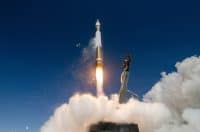
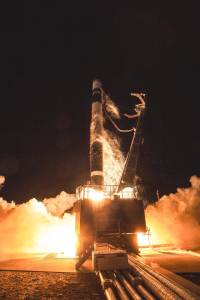
On a recent episode of Prof G Markets titled “The Space Boom Is Just Beginning,” Rocket Lab (NASDAQ: RKLB | RKLB Price Prediction) CEO Peter Beck pushed back against host Ed Elson’s skepticism about space industry economics. All with a blunt assessment of the competitive landscape. “Right now, there are two companies on this planet that have successfully scaled launch to any level of frequency and reliability. And, you know, that’s SpaceX and us,” Beck said.
That claim lands as Rocket Lab trades near record highs. Shares are up 316.18% over the past year. They’re up 57.8% year to date through June 5. All of which gives the company a market capitalization of roughly $68.8 billion. The stock changed hands at $113.80 midday Monday.
The 142 Companies That Never Got There
Beck’s argument rests on a number he has repeated for years. When Rocket Lab began developing its Electron vehicle, the team was tracking 142 competing small-launch companies. “Where are the 142 companies?” he asked Elson. His go-to example of capital failing to translate into capability: Virgin Orbit. “Richard Branson had funded that business to the tune of $1.2 billion to do the same thing that, you know, Electron does today. And it wasn’t successful.”
The financial scoreboard backs up the moat thesis. Rocket Lab’s Q1 FY2026 revenue hit $200.35 million, up 63.5% year over year. Its non-GAAP gross margin expanded to 43% from 33.4%. Backlog climbed to $2.2 billion, and the company signed 31 new Electron and HASTE contracts plus 5 Neutron missions in the quarter.
Why the Defense Primes Aren’t in Beck’s Two-Horse Race
Beck’s framing implicitly excludes the giants. Northrop Grumman (NYSE: NOC) and Lockheed Martin (NYSE: LMT) both run massive space businesses focused on payloads, satellites, and crewed spacecraft like Lockheed’s Orion capsule, while orbital launch sits outside their current portfolios.
The numbers show why launch cadence matters. Northrop’s Space Systems segment generated $2.48 billion in Q1 2026 revenue, down 3% year over year, as the NGI program winds down. Lockheed’s Space segment posted $3.43 billion, up 7%, driven by Fleet Ballistic Missile and Next Generation Interceptor work. Both are sizable space franchises anchored in payloads and spacecraft. Northrop shares are down 3.78% year to date, while Lockheed is up 9.57%.
SpaceX’s own pre-IPO S1 filing confirms how thin the field is. The company lists Rocket Lab by name as competition, noting it “operates in the small-lift launch market but is expanding into medium-lift payloads.” SpaceX flew 165 Falcon launches in 2025, up from 134 in 2024, a cadence no other Western provider approaches.
The Valuation Question Beck Acknowledges
Beck conceded on the podcast that some space valuations are “completely untethered to reality” while arguing the survivors deserve premium multiples. The market is wrestling with that question in real time. Analyst consensus targets sit at $105.28, implying 7.49% downside, with 14 Buy and 4 Hold ratings. Polymarket traders are more optimistic, pricing the most likely June close at $136 with 48% probability.
Reddit chatter captures the tension. A widely shared WallStreetBets post titled “If space X is overvalued then RKLB is 5x worse” pulled 901 upvotes and 372 comments, while a separate thread about a “$1,300,000 Gain in 2 Weeks” cleared 2,597 upvotes.

What to Watch Next
Beck’s two-company thesis gets its biggest test in Q4 2026, when the medium-lift Neutron rocket attempts its debut launch following a tank test failure that pushed the timeline back. A successful flight would validate the moat. A second slip would hand skeptics ammunition. Layer in SpaceX’s expected IPO, fresh Department of War contracts, including the $816 million Space Development Agency Tracking Layer Tranche 3 award, and the FY 2027 Pentagon budget request of $59.7 billion for space-based systems, and the next two quarters will determine whether Beck’s exclusive club stays at two members or starts admitting new entrants. For more on Rocket Lab’s IR disclosures, see investors.rocketlabcorp.com.
Contact [email protected] for any questions or corrections.
Ian Cooper is a veteran market analyst and investment strategist with more than 20 years of experience covering stocks, commodities, and macro trends. Since 1999, he has helped investors identify market opportunities using a blend of technical analysis, fundamental research, and market sentiment.
He is the creator of the ADD News Flow Strategy, which focuses on trading market reactions to major news events and investor psychology. Cooper was also among the analysts who warned about the 2008 financial crisis and major financial institution collapses ahead of the broader market.
Before joining 247 Wall St., Cooper wrote extensively for InvestorPlace and other financial publications, covering market trends, trading strategies, and investment opportunities.