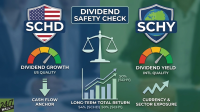
Dividend Safety Check: SPDV and the High-Dividend Value Approach
SPDV screens the S&P 500 for high-yield value stocks and has returned 27% over the past year, but one top holding just posted negative free cash flow while writing dividend checks. Here is what the fund's largest positions reveal about…


The AAM S&P 500 High Dividend Value ETF (NYSEARCA:SPDV) screens the S&P 500 for stocks combining the highest yields with the strongest value characteristics, then caps sector exposure to prevent concentration in utilities and REITs. For income investors, the question is whether that rules-based screen surfaces companies that can sustain payouts, or whether yield chasing pulls in names with deteriorating fundamentals. The data on SPDV’s current holdings suggests the methodology works, with some caveats worth understanding.
How SPDV builds its income stream
SPDV ranks S&P 500 stocks by dividend yield and value metrics, applying sector diversification caps to limit concentration risk. The fund has returned 14% year to date through June 8, 2026, and 27% over the past year. Income comes entirely from dividends paid by underlying companies, so safety analysis means examining whether the largest contributors can sustain distributions through a credit-tightening cycle. With the 10-year Treasury near 4.6% and sitting in the 97th percentile of its 12-month range, dividend payers face stiffer competition from risk-free yield than a year ago.
The blue-chip core looks durable
Johnson & Johnson (NYSE:JNJ | JNJ Price Prediction) is the safety anchor. The board raised the quarterly payout to $1.34, its 64th consecutive annual increase, and JNJ carries one of only two AAA corporate credit ratings in the U.S. Q1 net income fell 52% on litigation charges and STELARA biosimilar erosion, but management raised full-year guidance to adjusted EPS of $11.45 to $11.65, which comfortably covers the roughly $5.20 annualized dividend.
Microsoft (NASDAQ:MSFT) and Visa (NYSE:V) are the low-yield, high-coverage names. Microsoft pays $0.91 quarterly against $16.79 in trailing EPS, a payout ratio so light the dividend would survive a deep earnings recession. Visa’s $0.67 quarterly dividend is backed by a 67% operating margin and Q1 operating cash flow of $6.78 billion, up 26% year over year. Both contribute the dividend growth that protects SPDV’s distribution over time.
Broadcom (NASDAQ:AVGO) is the growth engine. Free cash flow hit $10.26 billion in Q2 FY26, 46% of revenue, and the dividend climbed from $0.59 to $0.65 quarterly in late 2025. AI semiconductor revenue is guided to $16 billion in Q3, up more than 200% year over year. Leverage from past acquisitions exists, but free cash flow comfortably covers the dividend.
The one name that bears watching
Lockheed Martin (NYSE:LMT) is where SPDV holders should focus. Q1 operating cash flow collapsed to $220 million, down 84% year over year, while the company paid $816 million in dividends. Free cash flow was negative $291 million after charges on F-16, C-130, CH-53K, and Seahawk programs. Q1 is seasonally the weakest quarter for LMT, and management reaffirmed full-year free cash flow guidance of $6.5 billion to $6.8 billion against an annualized dividend bill near $3.3 billion. The payout covers, but the cushion is thinner than it appears.
Total return and the verdict
SPDV’s five-year price gain of 48% trails broad-market growth funds, the trade investors make when choosing a value-tilt income screen. The methodology delivers on its core promise: top holdings are dominated by dividend growers with real free cash flow rather than stretched payers reaching for yield. JNJ’s Dividend King status, Microsoft and Visa’s low payout ratios, and Broadcom’s expanding AI cash flow give the fund a durable income foundation. Lockheed’s Q1 stumble reminds investors that even quality names hit air pockets, but the broader portfolio’s diversification absorbs that risk. For investors wanting dividend income screened for value rather than maximum yield, SPDV’s distribution looks sustainable heading into the back half of 2026.
Contact [email protected] for any questions or corrections.
After 15 years on Wall Street with 7 of them as Director of Corporate and Municipal Bond Trading for a NYSE member firm, I started my own project and corporate finance consultancy. Much of the work involves writing business plans, presentations, white papers and marketing materials for companies seeking budgetary allocations for spinoffs and new initiatives or for raising capital for expansion or startup companies and entrepreneurs. On financial topics, I have been published under my own byline at The Motley Fool, 247wallst.com, DealFlow Events’ Healthcare Services Investment Newsletter and The Microcap Newsletter, among others. Additionally, I have done freelance ghostwriting writing and editing for several financial websites, such as Seeking Alpha and Shmoop Financial. I have also written and been published on a variety of other topics from music, audiophile sound and film to musical instrument history, martial arts, and current events. Publications include Copper Magazine, Fidelity (Germany), Blasting News, Inside Kung-Fu, and other periodicals.