Dividend Safety Check: Domestic vs International Dividend Quality (SCHD, SCHY)
SCHD and SCHY both apply the same rigorous quality screen to filter out yield traps, but one carries hidden risks that could quietly shrink your paycheck even when the underlying companies keep raising their dividends.

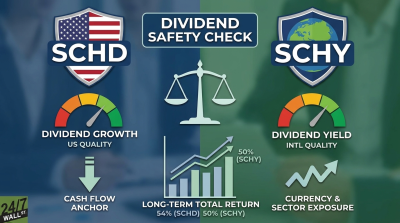
Investors seeking a dividend stream that grows rather than just survives often turn to two Schwab funds: the Schwab U.S. Dividend Equity ETF (NYSEARCA:SCHD) for domestic income and the Schwab International Dividend Equity ETF (NYSEARCA:SCHY) for the same approach overseas. Both apply a quality screen to weed out yield traps and pay quarterly. The question is whether that screen actually works and whether one fund is currently a stronger guardian of your distribution.
The shared quality screen, applied two ways
Both ETFs track Dow Jones indexes that start with a 10-year history of consecutive dividend payments, then rank survivors on cash-flow-to-debt, return on equity, dividend yield, and 5-year dividend growth. SCHD applies that filter to U.S. payers; SCHY applies it to developed-market companies outside the United States. The methodology favors financial durability over the highest headline yield, which is why neither fund tops yield-screen lists yet both have held up through credit cycles.
SCHD: cash flow doing the heavy lifting
SCHD manages $71.6 billion in assets at a rock-bottom 0.06% expense ratio, with concentration in cash-generative blue chips. Top positions like Bristol-Myers Squibb, Merck, ConocoPhillips, Lockheed Martin, and Chevron each sit near 4% of the fund, and are not stretching to pay shareholders. Three pharma names sit alongside two energy majors, a defense prime, a telecom, a networking incumbent, and two consumer staples giants. These businesses fund dividends from operating cash flow, the single most important sustainability test for any equity income fund.
SCHD’s Q1 2026 distribution was $0.2569, following $0.2782 in Q4 2025 and $0.2604 in Q3 2025. Earlier 2024 payouts ran higher as calendar artifacts of how Schwab smoothed distributions. The normalized cadence today is the baseline holders should plan around.
SCHY: same screen, different risk vectors
SCHY pulls from European, Japanese, and other developed-market dividend payers. Distributions arrive in a wider band because foreign companies often pay semi-annually and currency translation moves the dollar amount each quarter. SCHY paid $0.1818 in Q1 2026, $0.3199 in Q4 2025, $0.2495 in Q3 2025, and $0.3486 in Q2 2025. That swing is normal for international dividend funds and does not signal stress.
Italian energy major Eni illustrates the kind of name SCHY’s methodology targets. Its quarterly payment rose from $0.51864 in Q1 2024 to $0.613652 in Q1 2026 and $0.631314 in Q2 2026. That upward path, even through softer crude prices, reflects the cash-flow-backed growth the screen rewards. The catch is currency: when the dollar weakens, as Morningstar notes the DXY fell nearly 10% through September 2025, including almost 14% against the euro, dollar-denominated payouts from SCHY benefit. When the dollar strengthens, they shrink even if the underlying euro or yen dividend is unchanged.
Total return reality check
Yield without price performance is a mirage. SCHD trades at $32 and has returned about 24% over the past year and roughly 17% year to date. SCHY sits at $32 with a roughly 22% one-year return and almost 8% year to date. Neither fund shows NAV erosion that would undermine the income story. Five-year totals of roughly 54% for SCHD and about 50% for SCHY confirm both have compounded alongside their distributions.
The verdict
Both distributions look safe. SCHD’s income is anchored to U.S. cash flow leaders with decades of payment history, and the screen rotates out names whose fundamentals deteriorate before the dividend gets cut. SCHY carries the same methodology overseas, with two added wrinkles: lumpier quarterly amounts and dollar-translation risk. Used together, SCHD as the core and SCHY as a 20% to 30% sleeve form a global dividend allocation with diversified currency and sector exposure.
Contact [email protected] for any questions or corrections.
After 15 years on Wall Street with 7 of them as Director of Corporate and Municipal Bond Trading for a NYSE member firm, I started my own project and corporate finance consultancy. Much of the work involves writing business plans, presentations, white papers and marketing materials for companies seeking budgetary allocations for spinoffs and new initiatives or for raising capital for expansion or startup companies and entrepreneurs. On financial topics, I have been published under my own byline at The Motley Fool, 247wallst.com, DealFlow Events’ Healthcare Services Investment Newsletter and The Microcap Newsletter, among others. Additionally, I have done freelance ghostwriting writing and editing for several financial websites, such as Seeking Alpha and Shmoop Financial. I have also written and been published on a variety of other topics from music, audiophile sound and film to musical instrument history, martial arts, and current events. Publications include Copper Magazine, Fidelity (Germany), Blasting News, Inside Kung-Fu, and other periodicals.