Earn $5,000+ Yearly With These 4 Dividend Stocks
Earned income has a ceiling. Hours in a day, headcount budgets, layoff cycles, and corporate restructurings all cap how much a paycheck can deliver. Passive income flips that dynamic. A properly built dividend portfolio pays you on a schedule independent…

This post may contain links from our sponsors and affiliates, and Flywheel Publishing may receive compensation for actions taken through them.

Earned income has a ceiling. Hours in a day, headcount budgets, layoff cycles, and corporate restructurings all cap how much a paycheck can deliver. Passive income flips that dynamic. A properly built dividend portfolio pays you on a schedule independent of whether you showed up to work or whether your employer hit its quarter.
Real estate dominates the passive income conversation but carries baggage: tenants, repairs, illiquidity, and concentration risk. High-yield dividend stocks deliver comparable cash yields with daily liquidity, fractional position sizing, and the ability to redeploy capital in minutes. The trade-off is share price volatility, which matters far less when the goal is the coupon, not the exit.
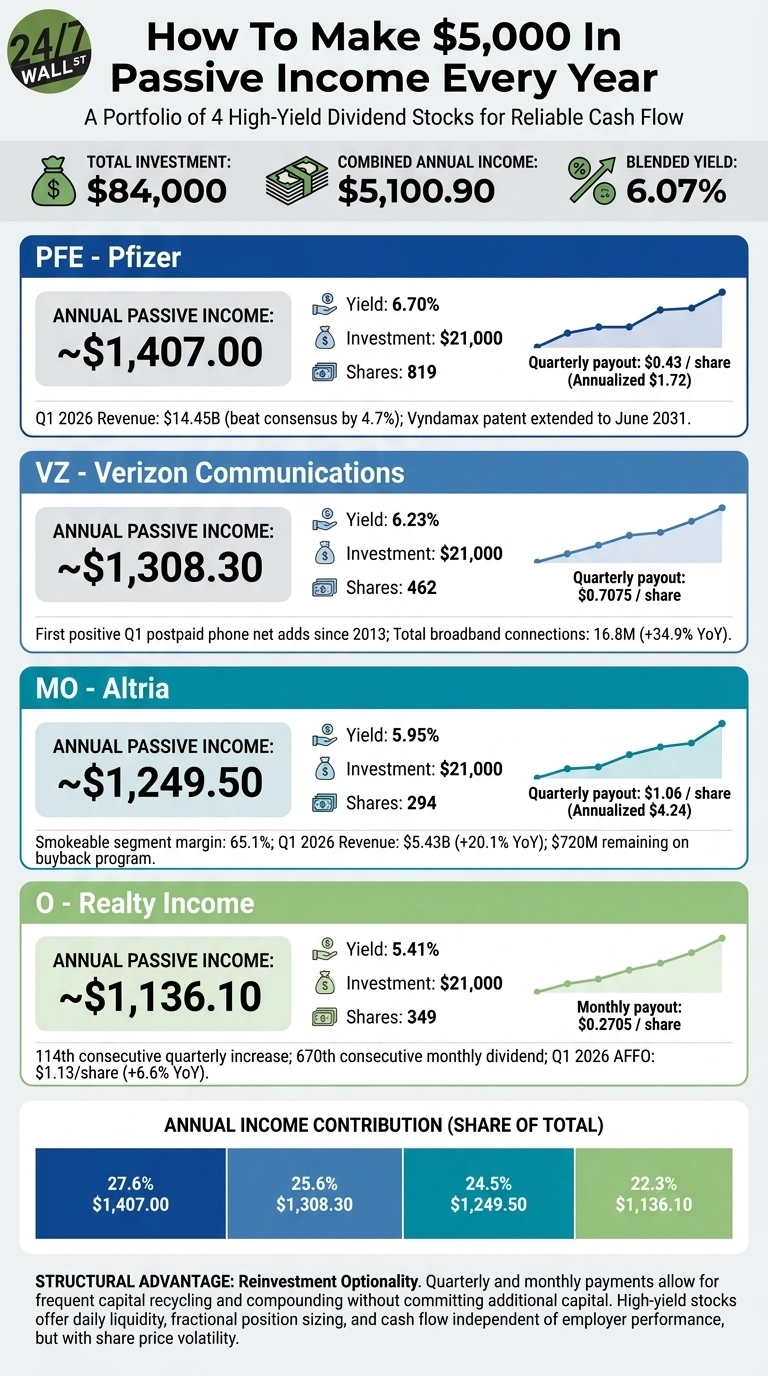
The four high-yield names below, combined, can generate over $5,000 a year in passive annual income if you invest $21,000 in each stock at the time of this writing.
Realty Income
- Yield: 5.41%
- Shares for $21,000: 349
- Annual Passive Income: $1,136
Realty Income (NYSE:O) is the flagship net-lease REIT, owning free-standing, single-tenant commercial properties leased on long-term triple-net contracts. As a REIT, the company must distribute at least 90% of taxable income to shareholders, which is why the dividend hits investor accounts monthly rather than quarterly.
The current monthly payout sits at $0.2705, the 114th consecutive quarterly increase and the 670th consecutive monthly dividend. Q1 2026 AFFO came in at $1.13 per share, up 6.6% year over year, and management raised full-year investment guidance to $9.5 billion from $8 billion. Institutional ownership runs at 79.4%, with Truist Financial recently adding to its position.
Altria
- Yield: 5.95%
- Shares for $21,000: 294
- Annual Passive Income: $1,250
Altria (NYSE:MO | MO Price Prediction) is a cash machine built around the Marlboro franchise, with Black & Mild, Copenhagen, Skoal, on!, and NJOY rounding out the portfolio. Declining cigarette volumes are a known headwind, but pricing power and a smokeable segment operating margin of 65.1% continue to generate the free cash flow that funds the dividend.
The current quarterly dividend is $1.06, an annualized $4.24 per share. Q1 2026 revenue rose 20.1% to $5.43 billion and adjusted EPS of $1.32 beat consensus. The company is also returning capital via buybacks, with $720 million remaining on the current authorization. Institutional ownership stands at 63.6%.
Verizon Communications
- Yield: 6.23%
- Shares for $21,000: 462
- Annual Passive Income: $1,308
Verizon Communications (NYSE:VZ) is the textbook telecom utility: capital-intensive, slow-growth, and engineered to convert ARPU into free cash flow that lands in shareholder accounts quarterly. The yield is structurally high because the business carries $172.5 billion in total debt against a capex profile that limits buybacks, leaving the dividend as the primary return vehicle.
The latest quarterly payout was raised to $0.7075. Q1 2026 delivered the first positive Q1 postpaid phone net adds since 2013, and the closed Frontier acquisition pushed total broadband connections to roughly 16.8 million, up 34.9% year over year. Management raised 2026 guidance to adjusted EPS of $4.95 to $4.99 with free cash flow north of $21.5 billion.
Pfizer
- Yield: 6.70%
- Shares for $21,000: 819
- Annual Passive Income: $1,407
Pfizer (NYSE:PFE) carries the highest yield because the share price is digesting post-COVID revenue normalization and patent-cliff anxiety around Eliquis and Vyndaqel. The dividend has continued to creep higher, with the current quarterly payout at $0.43, an annualized $1.72 per share.
Q1 2026 revenue of $14.45 billion beat consensus by 4.7%, and management reaffirmed full-year guidance of $59.5 billion to $62.5 billion. The Vyndamax patent was extended to June 2031, easing a key cliff concern.
The Combined Income Picture
Combined, these four positions generate $5,100.90 in annual passive income on an $84,000 investment, a blended yield of 6.07%. Pfizer contributes $1,407, Verizon adds $1,308, Altria delivers $1,250, and Realty Income rounds out the portfolio with $1,136.
| Ticker | Annual Income | Share of Total |
|---|---|---|
| PFE | $1,407.00 | 27.6% |
| VZ | $1,308.30 | 25.6% |
| MO | $1,249.50 | 24.5% |
| O | $1,136.10 | 22.3% |
The structural advantage is reinvestment optionality. Pfizer and Verizon pay quarterly, Altria pays quarterly with a long history of mid-summer raises, and Realty Income pays monthly, meaning capital recycles back into the portfolio twelve times a year rather than four.
Investors who reinvest those payments back into the same positions, or sweep them into a money market sleeve and redeploy opportunistically, see the compounding curve steepen without committing additional capital.
Contact [email protected] for any questions or corrections.
Vandita Jadeja is a financial publisher with over a decade of experience writing about financial topics, including investment, savings, retirement, insurance and banking. Vandita is a Chartered Accountant who loves to debunk financial concepts for readers.
Her work has appeared on sites that include The Motley Fool, InvestorPlace, and Benzinga. She covers investing and focuses on stock picks and price prediction for 24/7 Wall St.
When not looking for the next stock investment opportunity, she can be found traveling, reading, chasing sunsets and enjoying her iced latte.