Wall Street CIO: The AI Trade is “Technically Unsustainable.” Buy These Two Industries Instead.
Peter Boockvar, Chief Investment Officer at One Point BFG Wealth Partners, told CNBC on June 10 that the technical setup under the AI trade has gotten silly. “Stocks in the AI trade got so far above their moving averages that…


Peter Boockvar, Chief Investment Officer at One Point BFG Wealth Partners, told CNBC on June 10 that the technical setup under the AI trade has gotten silly. “Stocks in the AI trade got so far above their moving averages that you just knew that usually chart patterns like that are unsustainable,” he said. His call is to trim stretched semiconductor and hyperscaler exposure and rotate into two industries that have spent most of the cycle out of favor.
The Technical Case: Why AI Looks “Unsustainable”
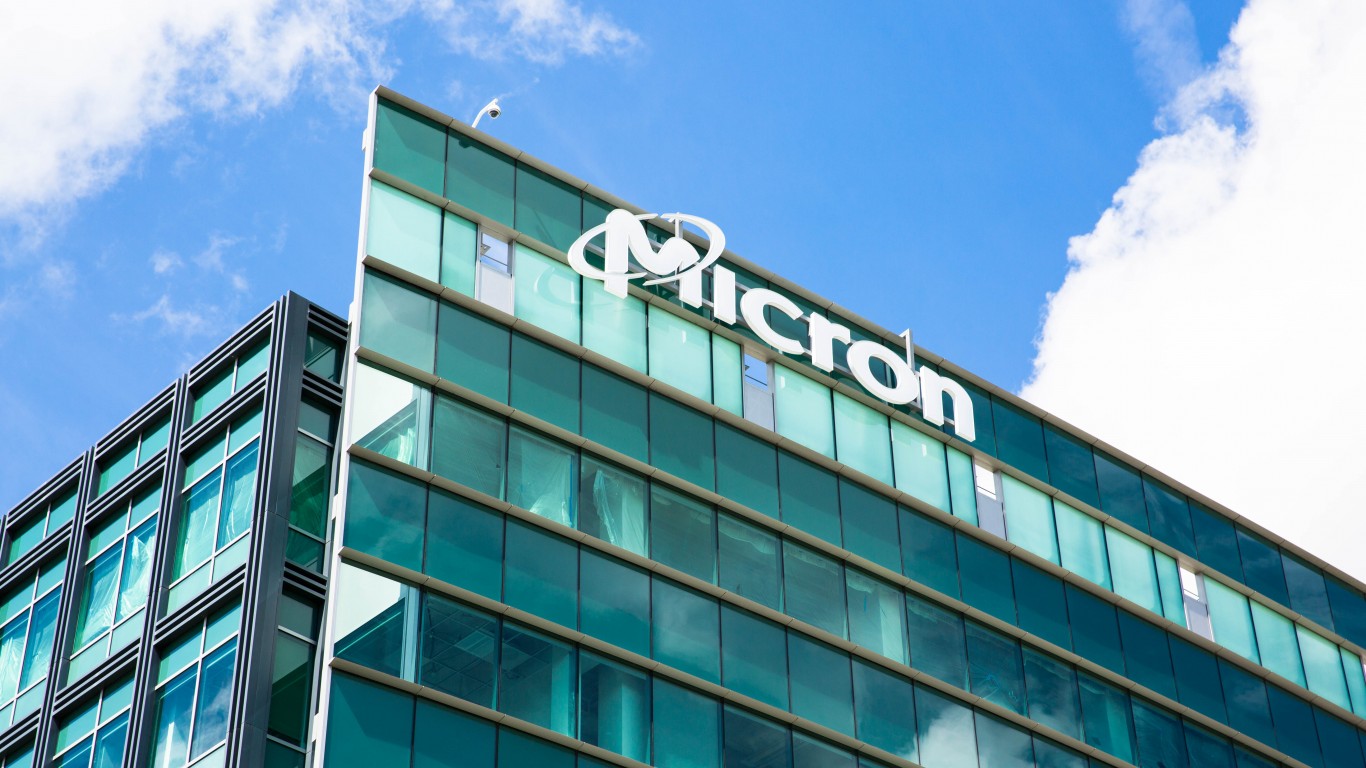
Boockvar points to Micron Technology (NASDAQ:MU | MU Price Prediction). “Micron at its peak was 200% above its 200-day moving average. It was 73% above its 50-day moving average,” he noted. MU is up 228.06% year-to-date and 745.57% over the past year, with its 14-day RSI peaking at 82.3684 on June 3, deep into extreme-overbought territory.
Micron has strong fundamentals, even though it looks overbought. Micron posted Q2 FY26 revenue of $23.86 billion, up 196.3% year over year, with GAAP gross margin expanding to 74.4%. CEO Sanjay Mehrotra said, “In the AI era, memory has become a strategic asset for our customers,” in the company’s Q2 FY26 press release filed with the SEC.
Broadcom’s Selloff and Google’s Rare Equity Raise
Broadcom (NASDAQ:AVGO) stock fell 18.57% in the past week, despite CEO Hock Tan guiding for AI semiconductor revenue to “grow over 200 percent year-over-year to $16.0 billion” in fiscal Q3. The chip selloff erased roughly $1.3 trillion in market value on June 5, the PHLX semiconductor index’s deepest one-day loss since March 2020.
The more revealing signal came from Alphabet (NASDAQ:GOOGL). “Google had to tap the equity market for the first time in 21 years after being such a cash gusher. I think it was a reminder of the state of things,” he said. Capex at Google more than doubled to $35.67 billion in the most recent quarter, and free cash flow fell 46.63% year over year. When the most reliable cash compounder of the past two decades is raising outside capital, the buildout has become genuinely expensive.
The Two Industries Boockvar Favors Instead
His pitch: “My two favorite parts of the market are commodities, particularly energy, but also uranium and agriculture through fertilizer stocks, and also consumer staples stocks, and food and products like Reynolds consumer products, Kimberly Clark, Nestle, Campbell’s Soup.”
On the commodities side, Exxon Mobil (NYSE:XOM) is up 25.4% year-to-date, with a forward P/E of 15. Uranium producer Cameco (NYSE:CCJ) is up 11.78% YTD. WTI crude last traded at $95.96 per barrel.
On staples, U.S.-listed names trade at multiples that are a fraction of what we’re seeing in the AI industry. While this is mostly deserved, many investors would argue they’ve become overlooked today. Kimberly-Clark (NASDAQ:KMB) carries a 5.11% dividend yield and a forward P/E of 13. Campbell’s (NASDAQ:CPB) is down 18% YTD and yields 1.8%. Reynolds Consumer Products (NASDAQ:REYN) yields 4.1%.
The Takeaway
Boockvar’s argument is straightforward: stock valuations are stretched, companies are taking advantage by raising capital, inflation remains stubborn, and interest rates are staying higher than many investors expected. He is not predicting an imminent market crash, and upcoming CPI and PPI reports could still surprise to the upside or downside. Instead, he is suggesting that investors consider a more defensive approach if they believe the biggest gains from the AI-driven rally may already be behind us. Commodities and consumer staples are among the areas he favors, though they come with risks of their own.
Contact [email protected] for any questions or corrections.
Thomas Richmond is a financial writer and content strategist with 5+ years of experience covering stocks and financial markets. He has published over 250 articles focused on individual stock analysis, helping investors better understand business fundamentals, stock valuations, and long-term opportunities.
Thomas previously served as a Content Lead at TIKR, a stock research platform, where he helped scale the company’s blog to hundreds of articles per month and contributed to a weekly newsletter reaching more than 100,000 investors.
He specializes in breaking down complex companies into clear, actionable insights for everyday investors, with a focus on fundamentals-driven research.
His work has also been featured on platforms including Seeking Alpha and Sure Dividend.
Outside of work, Thomas enjoys weight lifting and soccer.