The ‘Buy Everything AI’ Strategy: Is AIQ Your Ticket to the $2.5 Trillion Supercycle?
AIQ has quietly outperformed QQQ this year while charging triple the fee, an inversion of the usual thematic-ETF trap where investors pay up for a story and underperform the index. The Global X Artificial Intelligence & Technology ETF (NASDAQ:AIQ) is…


AIQ has quietly outperformed QQQ this year while charging triple the fee, an inversion of the usual thematic-ETF trap where investors pay up for a story and underperform the index. The Global X Artificial Intelligence & Technology ETF (NASDAQ:AIQ) is one of the rare ones doing both. AIQ is up 20.6% year-to-date through June 10, and it pulled in $3.8 billion of inflows earlier this spring, which is what happens when a fund’s supercycle narrative actually shows up in the returns.
What you own when you buy AIQ
The Global X pitch is straightforward. Own 95 companies building, supplying, or deploying AI, and let the index decide which layer of the stack matters most. The return engine is plain equity exposure, no options overlay or leverage, so the fund lives or dies by what its holdings do. And the holdings skew well past the Magnificent Seven concentration you might expect. AIQ’s largest position is SK Hynix, followed by Micron (NASDAQ:MU | MU Price Prediction) and Samsung. NVIDIA (NASDAQ:NVDA), the stock most retail investors think of as the AI trade, sits at just 2.8%.
That distribution matters. AIQ is structurally a bet that memory and foundry capacity in Korea and Taiwan count as much as hyperscaler capex in Redmond. Roughly 35% of the book sits in Asia-Pacific names, and that weighting is what differentiates it from a Nasdaq 100 tracker.
The strategy is beating its cheap alternative
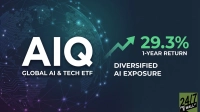
Now the test. Over the past year, AIQ returned 46%. Invesco QQQ Trust (NASDAQ:QQQ), the obvious lower-cost stand-in for big-cap tech, returned 31%. Over five years, both are tied at 112% each.
The thematic premium is earning its keep. Long-horizon snapshots show 10-year annualized returns near 21% to 23%. The honest read is that AIQ’s Korean and Taiwanese memory exposure caught the high-bandwidth memory cycle that QQQ underweights, and the broader basket has compounded faster than the megacap index. The 68 basis point expense ratio is roughly three times what you pay for QQQ, but the return spread has more than covered the drag.
The discomforts you sign up for
Three real ones. Concentration in Asian fabs cuts both ways, so any escalation of US-China export controls, or a roll in HBM memory pricing, hits AIQ harder than a US-only tech index. The long tail of the portfolio also carries speculative names in software AI and quantum computing. Tiny weightings, but they exist because the index includes pure-play AI names regardless of profitability. You are buying some lottery tickets stapled to the back of the fund.
Volatility is the third tax. AIQ fell 9% in the past five days ending, while QQQ dropped 5.7%. Higher beta is the cost of the higher returns, and when AI sentiment wobbles, this fund wobbles harder.
Who AIQ fits
This works as a 5% to 10% satellite for an investor who already owns broad US equity beta and wants targeted exposure to the global AI supply chain, especially the Asian memory and foundry layer that QQQ does not capture cleanly.
If you want one ticker that bundles NVIDIA, TSMC (NYSE:TSM), Samsung, and Palantir (NASDAQ:PLTR), AIQ does the job, and the performance has so far validated the 68 basis point fee. If your core tech exposure is already heavily Asian, or you want pure US megacap AI, QQQ at a fifth the expense covers most of what you need. And if you cannot stomach an AIQ that drops 7% in a week without flinching, the supercycle thesis is not your trade no matter how persuasive the slide deck.
Contact [email protected] for any questions or corrections.
Omor Ibne Ehsan is a writer at 24/7 Wall St. He is a self-taught investor with a focus on growth, cyclical, and dividend equities that have strong fundamentals, value, and long-term potential. He also has an interest in high-risk, high-reward investments such as penny stocks.