Could This Single AI ETF Turn $10,000 Into a Fortune by 2030?
A $10,000 stake in the Roundhill Generative AI & Technology ETF (NYSEARCA:CHAT) at its May 18, 2023 launch is sitting on a 262% gain. This is a return that makes the 2030 question feel almost rhetorical. Almost. The real question…


A $10,000 stake in the Roundhill Generative AI & Technology ETF (NYSEARCA:CHAT) at its May 18, 2023 launch is sitting on a 262% gain. This is a return that makes the 2030 question feel almost rhetorical.
Almost.
The real question with CHAT is whether the next four years can deliver another run like that, or whether the fund has already collected most of the easy money from the generative AI trade and the harder part starts now.
What CHAT actually owns
Roundhill runs CHAT as an actively managed, concentrated bet on companies that derive at least 50% of revenue from AI or generative AI, holding 25 to 50 stocks with roughly 30% international exposure including Chinese AI names. The top holdings read like the AI greatest hits album. Six of the Magnificent Seven are there. CHAT owns the picks-and-shovels names (chips, hyperscaler cloud, memory) plus the application-layer winners, and it rebalances actively as the AI value chain shifts.
You pay 0.75% annually for that active hand, which is roughly four times what a Nasdaq-100 tracker charges. Whether that fee is worth it depends entirely on whether the fund manager picks better AI exposure than a passive index already gives you.
Does the active premium actually show up
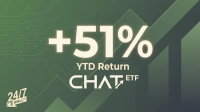
So far, yes, and decisively. Over the past year, CHAT returned 111% against 36% for QQQ and 25% for SPY. Year to date the gap is similar, with CHAT up 58% versus 17.6% for the Nasdaq-100 and 8% for the S&P 500. The pure-play concentration has paid for itself many times over.
The catch is that concentration cuts both ways. CHAT dropped 8% in the past week alone, more than double QQQ’s slide. When the AI trade wobbles, this fund wobbles harder. Michael Burry called AI “fundamentally not reliable” in January, betting against NVIDIA on suspicious revenue recognition concerns. You do not have to agree with him to acknowledge that a 111% one-year return invites mean reversion.
The IPO pipeline question
There is a structural problem with using CHAT as your 2030 vehicle. The most valuable generative AI companies on the planet, OpenAI and Anthropic, are still private. CHAT can only hold public names, so the fund is exposed to the AI buildout (chips, cloud, memory) without owning the model labs themselves. If Anthropic or OpenAI go public between now and 2030, CHAT’s active mandate likely adds them quickly, expanding the investable universe in a way passive AI ETFs cannot easily replicate.
SpaceX is the recent template. Its S-1 discloses an AI segment that burned $7.7 billion in capital expenditures in Q1 2026 alone, on top of $12.7 billion in 2025. That is a private company spending hyperscaler money on AI infrastructure, currently invisible to any public-market AI ETF. Each major AI IPO is a chance for CHAT’s active managers to add genuine differentiation versus QQQ. It is also a chance to overpay at the open.
What you give up
- Cost drag. 0.75% compounded to 2030 is a real haircut against cheaper tech vehicles.
- Concentration whiplash. Heavy mega-cap tech overlap means CHAT will not save you in a Magnificent Seven drawdown.
- Valuation risk. Morningstar flags AI-linked price-to-sales ratios nearing tech-bubble levels, and CHAT sits at the center of that exposure.
Who this fund actually suits
CHAT works as a 5% to 10% thematic sleeve for investors who already own a broad index and want concentrated, actively managed AI exposure that can pivot into IPO names like Anthropic or OpenAI when they list. As a single vehicle to turn $10,000 into a fortune by 2030, it asks you to bet that the next four years of AI compound at the rate of the last three. Possible. Not the base case any honest planner would underwrite.
Contact [email protected] for any questions or corrections.
Omor Ibne Ehsan is a writer at 24/7 Wall St. He is a self-taught investor with a focus on growth, cyclical, and dividend equities that have strong fundamentals, value, and long-term potential. He also has an interest in high-risk, high-reward investments such as penny stocks.