Forget the Chip Itself. Nvidia’s Own CEO Says the Real Moat Is Somewhere Else
Jensen Huang spent most of NVIDIA (NASDAQ:NVDA | NVDA Price Prediction)’s Q1 FY27 earnings call on May 20, 2026 doing something unusual for a chip CEO: arguing that the chip itself is no longer the company’s most important asset.His core…

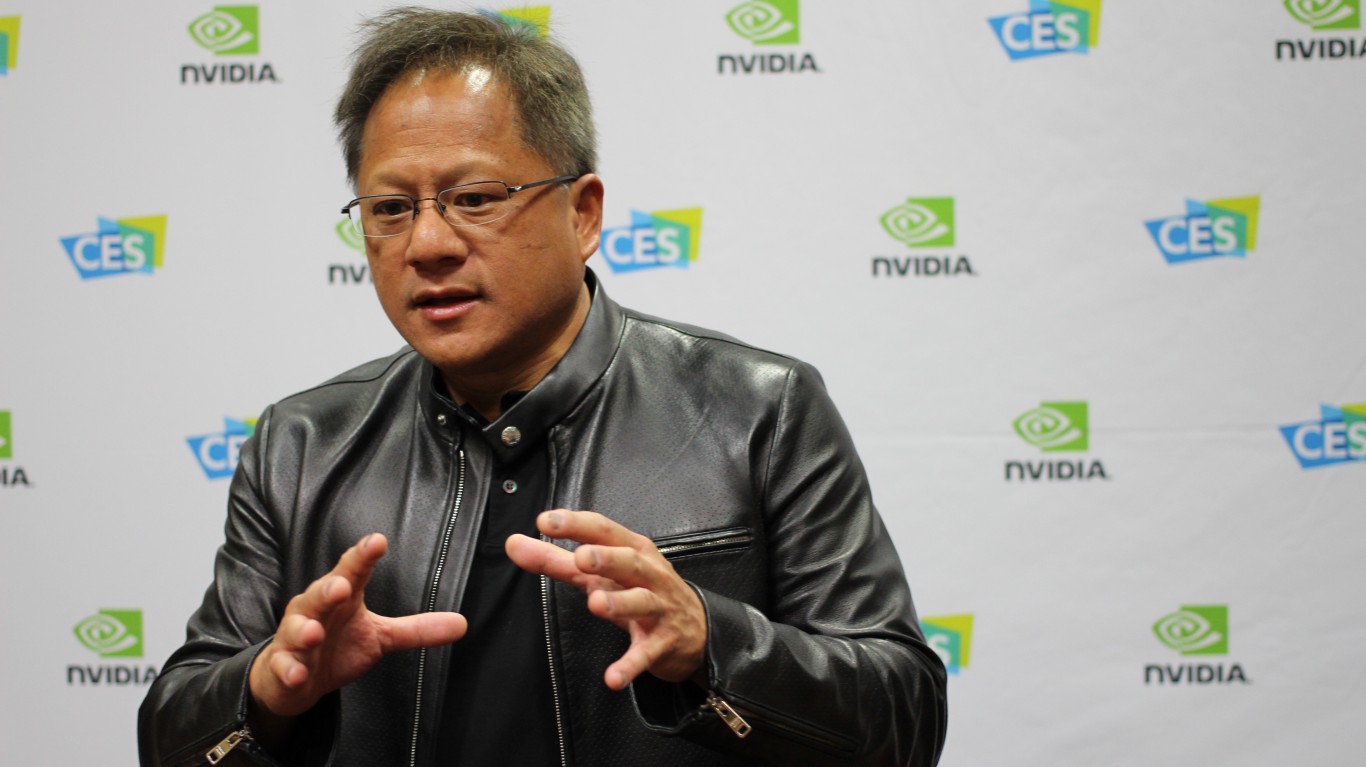
Jensen Huang spent most of NVIDIA (NASDAQ:NVDA | NVDA Price Prediction)’s Q1 FY27 earnings call on May 20, 2026 doing something unusual for a chip CEO: arguing that the chip itself is no longer the company’s most important asset.
His core line: “Agentic AI has arrived, doing productive work, generating real value and scaling rapidly across companies and industries. NVIDIA is uniquely positioned at the center of this transformation as the only platform that runs in every cloud, powers every frontier and open source model, and scales everywhere AI is produced, from hyperscale data centers to the edge.”
The word that carries weight is “platform.” Huang argues competitors can copy a transistor pattern, but not the surrounding stack: CUDA software, NVLink scale-up networking, Spectrum-X scale-out Ethernet, BlueField control plane, and the manufacturing choreography that turns silicon into a working AI factory.
The Quote That Sums Up the Thesis
He said it more bluntly on the prior cycle’s call: “The AI race is not just about chips. It’s about which stack the world runs on.” And: “The platform that wins the AI developers wins AI.”
The numbers back the framing. Q1 FY27 revenue hit $81.61 billion, up 85% year over year, with non-GAAP EPS of $1.87 and non-GAAP gross margin of 75.0%. Most revealing: Data Center Networking at $14.8 billion, up 199% YoY. Networking would not exist if NVIDIA were just selling chips into a commodity market. InfiniBand, NVLink, and Spectrum-X demand tripled because customers buying GPUs are buying them inside rack-scale systems that depend on NVIDIA’s fabric.

Why Customers Keep Coming Back
Software does similar work. CFO Colette Kress noted that software optimizations have already improved Blackwell’s performance by 1.5x in the last month alone, with Hopper having seen a 4x inference performance increase over two years through software alone. Customers who switch chips lose that compounding curve.
On China, Huang has been explicit about why silicon dominance alone is fragile: “The U.S. has based its policy on the assumption that China cannot make AI chips. That assumption was always questionable and now it’s clearly wrong. China has enormous manufacturing capability.” If chips were the moat, export controls would be the strategy. Instead, NVIDIA defends ground at the developer and ecosystem layer.
What the Guide Says About Lock-In
The Q2 FY27 guide is $91.0 billion plus or minus 2%, with non-GAAP gross margin holding at 75.0% and no China data center compute revenue assumed. Total supply-related commitments now sit at $119.0 billion, and multi-year cloud service commitments expanded to $30.0 billion. Those numbers, signed before the chips exist, are practical evidence of platform lock-in. The board raised the dividend from $0.01 to $0.25 per share and authorized an additional $80 billion buyback.
I have owned NVIDIA for over 15 years. What has actually changed in the last two cycles is how complete the surrounding stack has become, while the GPU lead has held steady. Shares closed at $205.19 on June 12, up 10% year to date, with the prediction-market crowd pricing a June range of $192 to $240. Keep an eye on networking growth and the China carve-out next quarter. Both will tell you whether Huang’s platform story holds when chip headlines do not.

Contact [email protected] for any questions or corrections.
I've been writing about stocks and personal finance for 20+ years. I believe all great companies are tech companies in the long run, and I invest accordingly.