Can Amazon Reach $300 Per Share Before Year-End 2026?
Amazon (NASDAQ:AMZN | AMZN Price Prediction) just posted its fifth straight earnings beat, yet the stock is up just 3.35% year to date despite AWS posting its fastest growth in 15 quarters and a chips business running at a $20…


Amazon (NASDAQ:AMZN | AMZN Price Prediction) just posted its fifth straight earnings beat, yet the stock is up just 3.35% year to date despite AWS posting its fastest growth in 15 quarters and a chips business running at a $20 billion revenue run rate.
CEO Andy Jassy says Amazon is “in the middle of some of the biggest inflections of our lifetime.” Can shares climb from $238.55 to $300 before year-end?
Why Amazon Shares Are Stuck Despite a Blowout Quarter
The problem is capex, not the business. Amazon plans to spend roughly $200 billion in 2026 on data centers, custom silicon, and Project Kuiper satellites. Trailing twelve-month free cash flow has cratered to $1.2 billion, and long-term debt has ballooned to $119.1 billion from $65.6 billion. The market is choking on the bill.
AMZN is down 3.04% over the past week and 11.69% over the past month, pulling back from a May high near $264. With a beta of 1.44, this stock swings harder than the S&P, and tariff and recession headlines have not helped. The AI infrastructure spend is real; the returns are still a promise.
Wall Street Sees 31% Upside. Our Model Says 35%
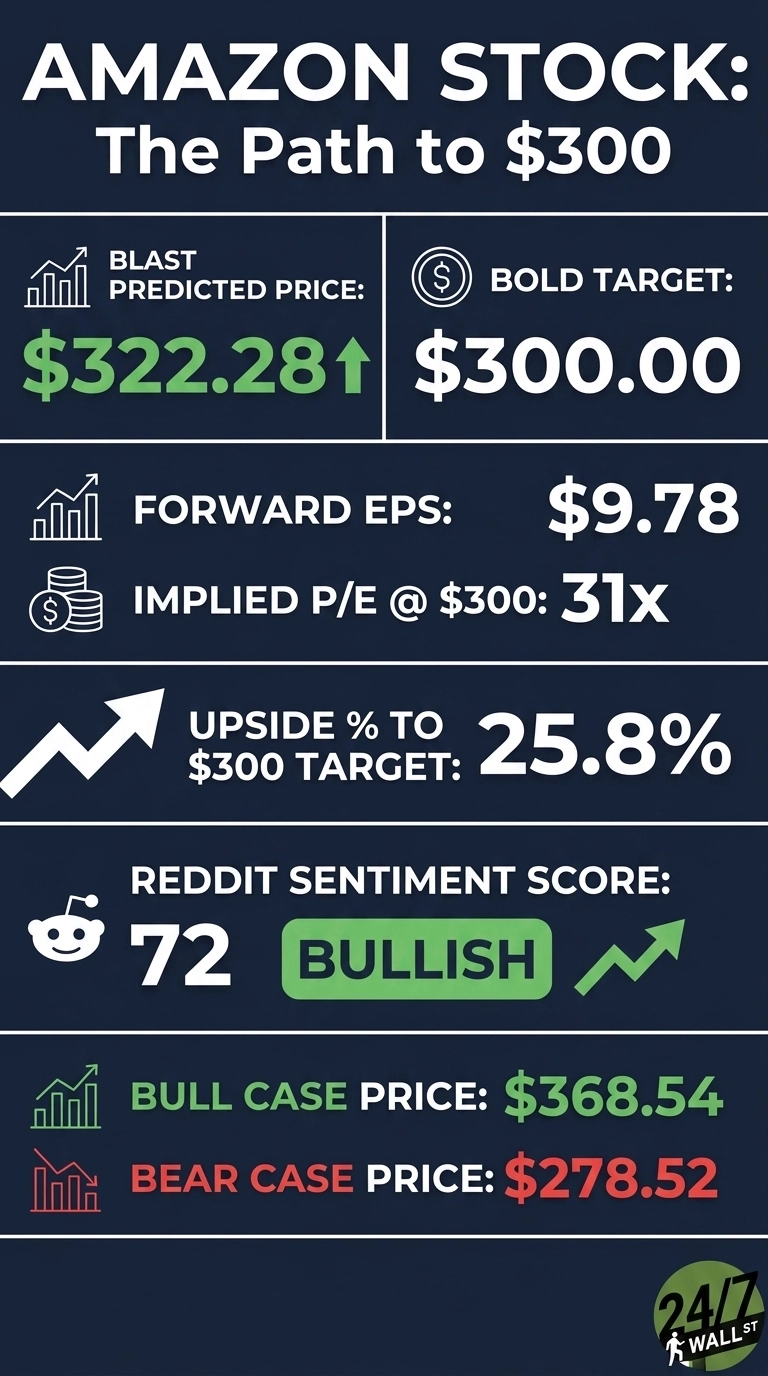
The Street is loaded up. 15 strong buys, 47 buys, 4 holds, and zero sells, with 94% bullish consensus and an average target of $312.51. Our internal model projects $322.28 over the next twelve months for 35.1% upside at 90% confidence, with a bull case of $368.54 and a bear case of $278.52.
The Street anchors on $312 even though Amazon just posted 74.8% YoY earnings growth. That math does not square. If AWS holds 28% growth and advertising compounds at 24%, $312 looks lazy. Consensus is too low.
The Path to $300 Per Share
Reaching $300 from today’s $238.55 requires a gain of 25.8%. With forward EPS of $9.78, a $300 print implies a forward P/E of 31x. Our base case of $322.28 already implies 29x, meaning $300 needs only about 2 turns of additional multiple expansion.
Three catalysts support multiple expansion. First, the $10 billion Canadian bond raise funds AI capacity that monetizes through OpenAI’s 2 GW Trainium commitment and Anthropic’s up to 5 GW.
Second, the new LTL freight service for all U.S. businesses turns Amazon’s logistics network into a third-party revenue line.
Third, Bedrock processed more tokens in Q1 than all prior years combined, with customer spend up 170% QoQ. Jassy’s framing is direct: “our chips business topped a $20 billion revenue run rate.” The primary risk is a sharp AI capex unwind that punishes the multiple instead of expanding it.

Where Amazon Trades Today vs Its Earnings Power
At $238.55 against forward EPS of $9.78, AMZN trades at a forward P/E near 24x. For a business compounding earnings at 75% and growing AWS 28%, that is not a premium multiple.
Shares sit 12% below the 52-week high of $278.56 and well above the low of $196.00. The 10-year return is 563.28%. The valuation case is straightforward: at 24x forward earnings, the multiple is modest for the most aggressive AI buildout in tech, with earnings growth doing the heavy lifting.
Is $300 Realistic?
$300 by year-end requires a 25.8% gain. It is a stretch, but credible.
Three things need to go right: AWS holds 28% growth into the second half, advertising keeps printing 24%, and the market credits capex as investment, not waste. A recession that forces Amazon to defend the multiple while spending $200 billion derails it.
Prediction markets currently assign only a 7.8% probability to a $300+ print in June. That gap is the opportunity. Returns at this level shouldn’t be expected every year, but we’ve outlined the blueprint for how Amazon could reach $300 in 2026.
Contact [email protected] for any questions or corrections.
Vandita Jadeja is a financial publisher with over a decade of experience writing about financial topics, including investment, savings, retirement, insurance and banking. Vandita is a Chartered Accountant who loves to debunk financial concepts for readers.
Her work has appeared on sites that include The Motley Fool, InvestorPlace, and Benzinga. She covers investing and focuses on stock picks and price prediction for 24/7 Wall St.
When not looking for the next stock investment opportunity, she can be found traveling, reading, chasing sunsets and enjoying her iced latte.