Moderna Is Up 94% This Year: Is It Outperforming Other Vaccine Stocks Like Pfizer and Novavax?
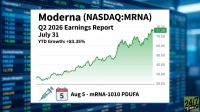
Moderna (NASDAQ:MRNA | MRNA Price Prediction) stock is jumping again. Shares are up 9% today, trading near $57 in the Tuesday afternoon session. That extends a remarkable 2026 run for the mRNA pioneer. The move pushes Moderna stock to +94%…

Moderna (NASDAQ:MRNA | MRNA Price Prediction) stock is jumping again. Shares are up 9% today, trading near $57 in the Tuesday afternoon session. That extends a remarkable 2026 run for the mRNA pioneer.
The move pushes Moderna stock to +94% year to date (YTD), easily the best performance in the major vaccine cohort. By comparison, Pfizer (NYSE:PFE) stock is up 4% YTD, and Novavax (NASDAQ:NVAX) stock sits at 41%. Moderna is decisively ahead of both peers.
Today’s catalyst is corporate, not clinical. Moderna announced a leadership restructuring to prepare for a wave of planned product launches in 2027 and 2028, and traders are treating it as a credibility signal for the pipeline.
Restructuring Frames a 2027-2028 Launch Pipeline
Moderna disclosed an expanded role for President Stephen Hoge and named Ester Banque as Chief Commercial Officer. Hoge now oversees R&D, Manufacturing, and Commercial operations across three franchises, a structure designed for commercial scale rather than research-stage biotech.
The reorganization lines up with a planned slate of up to three product launches by 2027-2028, including a flu-plus-COVID combination vaccine, a seasonal flu vaccine, and a norovirus vaccine. Investors are reading the move as Moderna preparing the operational backbone needed to commercialize multiple vaccines simultaneously.
The day’s enthusiasm also rides on a recently approved EU label for mCOMBRIAX, the world’s first flu-plus-COVID combo vaccine, and a key upcoming Prescription Drug User Fee Act (PDUFA) date of August 5 for the seasonal flu candidate mRNA-1010. Both reinforce the narrative that 2026 is the setup year and 2027-2028 is the payoff window.
Moderna Versus Pfizer and Novavax: The 2026 Scoreboard
The YTD scoreboard answers the headline question directly. Moderna stock at +94% is ahead of Novavax stock and crushing Pfizer stock in 2026 so far. The dispersion reflects three very different business profiles within one industry label.
Pfizer is a diversified pharma giant where vaccines are one slice of a large revenue book. The company’s Q1 2026 revenue was $14.45 billion, up 5% year over year (YoY), with Comirnaty revenue down 59% and Paxlovid revenue down 63%, offset by launched and acquired products. Pfizer’s 7% dividend yield anchors a steadier, lower-beta profile, which limits both upside and downside in a momentum tape.
Meanwhile, Novavax is in transition. The company is leaning on a Matrix-M adjuvant licensing model, including a $30 million upfront payment from Pfizer with up to $500 million in milestones, and Q1 2026 revenue of $139.51 million easily topped consensus. However, that royalty-driven model carries lower revenue scale than Moderna’s product-led path.
The Caution Inside a 94% Rally
Moderna stock isn’t without baggage. The company’s Q1 2026 included an $878 million non-recurring litigation charge tied to the Arbutus/Genevant patent settlement, which widened the GAAP loss to $1.34 billion. Wall Street has been slow to embrace the rebound, with an analyst average 1-year MRNA price target of $37 and a consensus rating of Reduce.
Zoom out and Moderna stock is still down 74% over five years, well below its pandemic-era peaks. The 2026 run is a rebound, not a return to those highs, and the 2027-2028 launch slate carries real execution and regulatory risks.
What to Watch Next
The near-term event to look for is the FDA advisory committee vote scheduled for June 18 on mFlusiva for adults 50 and older. A constructive panel readout could reinforce today’s bid, while a mixed verdict may test how much of the 94% YTD gain is priced for perfection.
Investors can watch whether Moderna stock holds the $50 zone into the June 18 advisory committee vote and the August 5 PDUFA decision. Until then, feel free to size your share vaccine-stock positions with due caution and moderation.
Contact [email protected] for any questions or corrections.
David Moadel is financial writer specializing in stocks, ETFs, options, precious metals, and Bitcoin. David has written well over 1,000 articles for leading online publications, helping investors understand markets, income strategies, and risk.His work has appeared in The Motley Fool, InvestorPlace, U.S. News & World Report, TipRanks, ValueWalk, Benzinga, Market Realist, TalkMarkets, Finmasters, 24/7 Wall St., and others.With a master’s degree in education, David has taught at the elementary, high school, and college levels. That teaching background shapes his writing style: clear, educational, and practical. David has also built a loyal social-media audience by providing trustworthy financial content on YouTube, X/Twitter, and StockTwits.