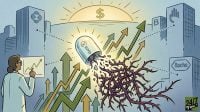
After Apogee, 3 More Biotech Buyout Targets Wall Street Can’t Stop Watching
Big Pharma's patent cliffs are forcing acquirers to hunt for revenue-producing biotech assets before rivals snap them up, and three names keep surfacing in deal speculation. One already has a natural buyer embedded in its business and a share price…


Biotech M&A is back in the spotlight. Big Pharma faces patent cliffs over the next several years, and recent dealmaking, including the AbbVie (NYSE: ABBV | ABBV Price Prediction) acquisition of Apogee Therapeutics, signals buyers are willing to pay up for de-risked clinical assets in oncology, obesity, and cell therapy. With flush balance sheets and widening growth gaps, acquirers are scanning for companies combining breakthrough data, large addressable markets, and clean strategic fit.
No deal has been announced for the three names below. This is a takeover-setup analysis. Rankings are based on valuation, cash runway, growth stage, ownership dynamics, and acquirer fit, counting down from least to most actionable target.
3. Revolution Medicines
Revolution Medicines (NASDAQ: RVMD) is the most strategically coveted name on this list and the hardest to buy. The clinical-stage oncology company is building a RAS(ON) inhibitor franchise around daraxonrasib. Its Phase 3 RASolute 302 trial in second-line metastatic pancreatic cancer delivered median overall survival of 13.2 months versus 6.7 months for chemo (HR 0.40; p<0.0001). CEO Mark Goldsmith called the readout “an unprecedented improvement in overall survival in patients with previously treated metastatic pancreatic cancer.”
The problem for an acquirer is price. Shares closed at $169.51 on June 23, up 323.4% over the past year and 112.8% year to date. That lifted the market cap to roughly $36.0 billion. The analyst consensus target is $187.29, which would be a 10.5% gain in the next 12 months. An existing Bristol Myers Squibb collaboration provides relationship logic, but a full takeout at a premium would rank among the largest oncology deals on record. Revolution Medicines also has around $4.0 billion in pro forma cash after April financings, meaning it faces no pressure to sell.


2. Structure Therapeutics
Structure Therapeutics (NASDAQ: GPCR) plays in the hottest M&A category in pharma: oral GLP-1 obesity. Lead asset aleniglipron posted placebo-adjusted weight loss of 16.3% at 180 mg and 16.0% at 240 mg at 44 weeks in the Phase 2 ACCESS II study, and CEO Raymond Stevens said the company is “well positioned to start our Phase 3 registrational program for chronic weight management in the third quarter.”
The setup is more attractive than Revolution Medicines because the valuation has reset. Shares trade at $45.61, down 32.7% year to date, with a market cap of about $3.2 billion against roughly $1.50 billion in cash, funded through end of 2028. The analyst target stands at $104.59. Pfizer, Roche, and AstraZeneca have all signaled appetite for an oral GLP-1, and Structure’s amylin programs add combo optionality. The catch: this remains a clinical-stage bet on data, not cash flow.
1. Legend Biotech
Legend Biotech (NASDAQ: LEGN) is the cleanest takeover setup of the three. Carvykti, the BCMA CAR-T for multiple myeloma co-developed with Johnson & Johnson, generated $1,028.90 million in full-year 2025 revenue, up 64.04% year over year, and reached franchise profitability with more than 10,000 patients treated. Q1 2026 revenue came in at $305.10 million, up 56.42% year over year, with adjusted EPS of −$0.03 versus the −$0.17 consensus, an 82.35% beat. Carvykti net trade sales grew 62% globally, with ex-U.S. sales up 222%.
CEO Ying Huang told investors that “as scale continues to build, we are seeing operating leverage translate into improving margins, supporting our path toward sustainable profitability.” Management expects company-wide adjusted net income profitability in 2027 or later, backed by roughly $834.6 million in cash. Manufacturing runs at a 99% success rate with more than 95% on-time releases, and the expanded Raritan facility can support 10,000 patients annually.
Crucially, the share price is depressed. Legend Biotech closed at $29.30, down 13.44% over the past year, against an analyst target of $57.59 and a market cap of $5.45 billion. J&J already commercializes the product, knows the asset well, and would face minimal integration friction. That combination, a de-risked revenue-producing CAR-T plus a natural strategic buyer already embedded, is why Legend Biotech tops this list.


The Takeaway
Revolution Medicines has the best data but the heaviest price tag. Structure Therapeutics has the right category but still needs to clear Phase 3. Legend Biotech has the revenue, the partner, the compressed valuation, and the manufacturing scale. Of the three, it is the one to watch as biotech M&A accelerates.
Contact [email protected] for any questions or corrections.
Trey has been an editor and author at 24/7 Wall St. for more than a decade, where he has published thousands of articles analyzing corporate earnings, dividend stocks, short interest, insider buying, private equity, and market trends. His comprehensive coverage spans the full spectrum of financial markets, from blue-chip stalwarts to emerging growth companies.
Beyond 24/7 Wall St., Trey has created and edited financial content for Benzinga and AOL's BloggingStocks, contributing additional hundreds of articles to the investment community. He previously oversaw the 24/7 Climate Insights site, managing editorial operations and content strategy, and currently oversees and creates content for My Investing News.
Trey's editorial expertise extends across multiple publishing environments. He served as production editor at Dearborn Financial Publishing and development editor at Kaplan, where he helped shape financial education materials. Earlier in his career, he worked as a writer-producer at SVE. His freelance editing portfolio includes work for prestigious clients such as Sage Publications, Rand McNally, the Institute for Supply Management, the American Library Association, Eggplant Literary Productions, and Spiegel.
Outside of financial journalism, Trey writes fiction and has been an active member of the writing community for years, overseeing a long-running critique group and moderating workshop sessions at regional conventions. He lives with his family in an old house in the Midwest.