Despite Franchisees Struggling, McDonald’s Dividend Keeps Rising
McDonald’s (NYSE:MCD | MCD Price Prediction) just paid its latest quarterly dividend of $1.86 per share on June 16, extending one of the most reliable income streams in the Dow. Yet the same company sending checks to shareholders is presiding…

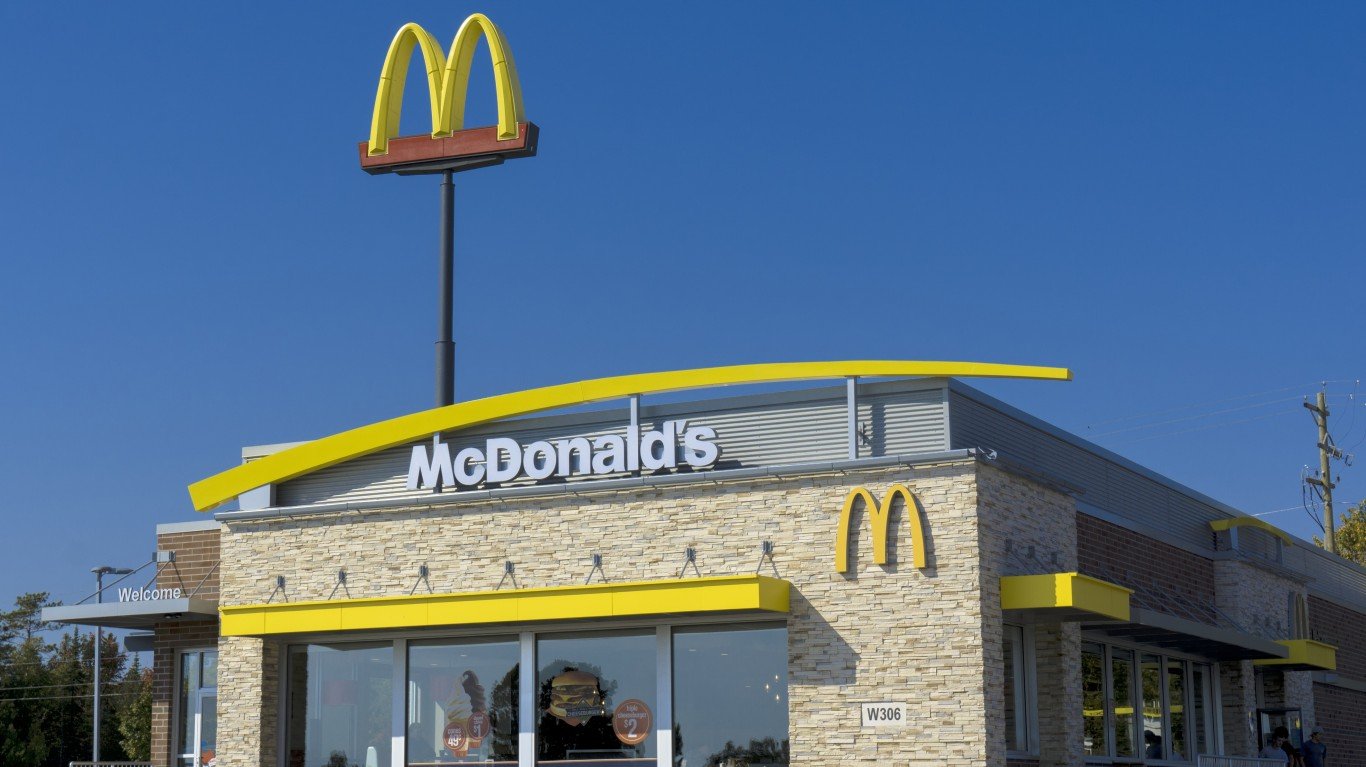
McDonald’s (NYSE:MCD | MCD Price Prediction) just paid its latest quarterly dividend of $1.86 per share on June 16, extending one of the most reliable income streams in the Dow. Yet the same company sending checks to shareholders is presiding over a franchisee system buckling under inflation, tariff disruption and the weakest consumer sentiment reading in years. Both stories are true, and the reason has everything to do with how McDonald’s actually makes money.
The Q1 2026 payment alone totaled roughly $1.3 billion, and the company has now raised its dividend at the corporate level even as operators in the field absorb the brunt of higher costs. This is the cleanest case study in corporate America of how an asset-light royalty model insulates the parent from the operating pain felt at the unit level.
The Dividend Itself: A Quiet 5% Raise Into a Tough Environment
McDonald’s lifted its quarterly payout from $1.77 to $1.86 in Q4 2025, a roughly 5% bump declared in October 2025. That new rate has now carried through three consecutive quarters, and at the current share price of $267.18, the trailing yield sits at 3% on an annualized $7.26 per share.
For context, the dividend has climbed from 4 cents in 1999 to $1.86 in 2026. That is a Dividend Aristocrat track record built across recessions, commodity shocks, and three CEO transitions. The most recent raise landed despite a stock that has fallen 12% year to date and 6% over the past year.

Why the Dividend Keeps Rising: The Royalty Engine
The franchise model is the entire answer. Roughly 90% of McDonald’s restaurant margin dollars come from franchised stores, and in Q1 2026 those franchised restaurants generated $4.007 billion in revenue, up 9% year over year. Corporate collects royalties and rent off the top, before the operator pays a single employee or buys a single case of beef.
The downstream math is striking:
- FY2025 revenue: $26.885 billion
- FY2025 operating income: $12.393 billion
- FY2025 net income: $8.563 billion
- Operating margin: 46%
- Gross margin: 57%
A 46% operating margin reflects a real-estate and royalty business. Cost of revenue in 2025 was just $11.45 billion against nearly $27 billion in top line, because the company is not paying franchisee labor or food costs. Those expenses sit on the operator’s P&L.
The Cash Flow Backing the Payout
Dividend sustainability comes down to free cash flow, and on this metric McDonald’s has rarely looked stronger. Operating cash flow hit $10.551 billion in 2025, up 12% year over year, against capital expenditures of $3.365 billion. That leaves $7.186 billion in free cash flow to cover the $5.115 billion sent to dividend recipients last year.
The Q1 2026 snapshot confirms the trend held: operating cash flow of $2.412 billion, free cash flow of $1.730 billion, and a dividend distribution of $1.323 billion. Buybacks added another $393 million in the quarter, on top of $2.056 billion repurchased across 2025.
Where the Operator Pain Lives
The franchisee struggle is structural. Three forces are squeezing unit-level economics at the same time:
- Consumer sentiment collapse: The University of Michigan Consumer Sentiment Index printed 44.8 in May 2026, down from 49.8 in April, and is now well below the 60-point recessionary threshold. The 12-month peak was 61.7 in July 2025. That deterioration directly hits low-income traffic, the demographic most exposed to value menus.
- Cost stack pressure: Management has flagged inflationary cost pressures, supply chain interruptions, and tariff/trade policy disruptions, along with restructuring charges from the “Accelerating the Organization” program running through 2027.
- Flat food-services wallet share: Food services PCE has only crept from $1,491.4 billion in May 2025 to $1,538.3 billion in May 2026, holding at roughly 10% of total services spending. The category is not expanding fast enough to lift all operators.
Reddit picked up on the disconnect. In early June, r/wallstreetbets ran a sustained bearish cluster on MCD with sentiment scores of 22 to 28 and an activity score peaking at 73 on June 5, the highest in the dataset. By June 26, sentiment had stabilized to neutral in the 45 to 52 range, but the franchisee angle clearly hit a nerve with retail investors.

Corporate Results Say the Model Is Still Working
For all the franchisee pressure, Q1 2026 corporate results were strong: EPS of $2.83 beat by 3%, revenue of $6.517 billion grew 9% year over year, and global comparable sales rose 4% with U.S. comps at 4%. The loyalty program is doing real work here, with systemwide sales to members exceeding $9 billion in Q1 2026 and trailing twelve-month loyalty sales topping $38 billion across 70 markets.
Prediction markets confirmed the operational momentum. Polymarket’s Q2 2026 earnings beat contract resolved YES at 99 cents on May 7, the third straight beat in a row for MCD on the platform.
The Dividend Scorecard
| Metric | Value | Read |
|---|---|---|
| Yield | 3% | Above 10-year average |
| P/E (Trailing) | 22 | Reasonable for quality |
| Forward P/E | 21 | Modest growth priced in |
| FCF Coverage | $7.19 billion FCF vs. $5.12 billion dividends | Comfortable |
| Payout vs. Net Income | $5.12B of $8.56B | Healthy |
| Beta | 0.414 | Defensive profile |
| Dividend Aristocrat Streak | Decades of consecutive annual increases | Elite tier |
On the data above, this is an A-grade dividend payer. Coverage is wide, the growth streak is long, and the cash engine that feeds the payout is structurally separated from the unit-level pressure that dominates headlines.
What to Watch Next
The real risk lives in the franchisee feedback loop. If sentiment stays sub-60 into the back half of 2026 and operators pull back on remodels, hiring, or new-build commitments, corporate’s 2026 plan for roughly 2,600 new restaurant openings and $3.7 to $3.9 billion in capex gets harder to execute. Management guided to an operating margin in the mid-to-high 40% range for the year, with free cash flow conversion in the low-to-mid 80% range. Those are the numbers that ultimately fund the next raise.
The next dividend declaration should land in late October 2026 based on prior cadence. Given the cash coverage and management’s stated capital return posture, another mid-single-digit raise is the base case. Franchisees may keep struggling. The dividend keeps rising. Both will remain true as long as the royalty model holds.
Contact [email protected] for any questions or corrections.
Joel South covers large-cap stocks, dividend investing, and major market trends, with a focus on earnings analysis, valuation, and turning complex data into actionable insights for investors.
He brings more than 15 years of experience as an investor and financial journalist, including 12 years at The Motley Fool, where he served as an investment analyst, Bureau Chief, and later led the Fool.com investing news desk. He has also co-hosted an investing podcast and appeared across TV and radio discussing market trends.