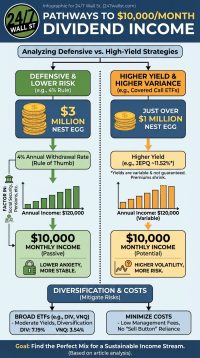
Why Retirees Choose 4% Income (or 2% income post forward split) Over 10% Growth in One ETF
The ProShares S&P 500 Dividend Aristocrats ETF (NYSEARCA:NOBL) is built for one job: deliver a slowly rising income stream from companies that have raised their dividends every year for at least a quarter century. NOBL trades near $57.60 at the…


The ProShares S&P 500 Dividend Aristocrats ETF (NYSEARCA:NOBL) is built for one job: deliver a slowly rising income stream from companies that have raised their dividends every year for at least a quarter century. NOBL trades near $57.60 at the time of this writing (had 2-for-1 forward split on May 28) and pays a quarterly distribution that has compounded steadily for more than a decade, which is why income-focused readers keep asking the same question about NOBL: is the payout actually safe, or is the “aristocrat” label doing more marketing work than financial work? The short answer is that the distribution is unusually well-protected, but total return is the catch.
How NOBL Turns 25-Year Track Records Into Income
NOBL tracks the S&P 500 Dividend Aristocrats Index, which only admits S&P 500 companies that have increased their dividend in each of the past 25 consecutive years. The fund equal-weights every qualifying name and rebalances quarterly, so no single holding can dominate the payout. Income flows through to shareholders as quarterly cash distributions funded entirely by the dividends those underlying companies pay, with the fund’s 0.35% expense ratio skimmed off the top.
That structure has two safety consequences worth understanding. First, a single dividend cut anywhere in the basket barely moves the distribution because the offender is roughly 1/65th of the portfolio and gets ejected at the next reconstitution. Second, the 25-year rule is a brutal filter that screens out almost every high-yield trap, every recent IPO, and effectively the entire mega-cap tech complex, which is the trade-off behind NOBL’s limited upside relative to the NASDAQ and broader S&P 500.
The Distribution Is Doing What It Was Designed To Do
The dividend record is the cleanest part of the story. NOBL paid $0.465379 in Q1 2025, $0.550012 in Q2, $0.548744 in Q3, and $0.661188 in Q4, and just declared $0.512242 for Q1 2026, with a $0.3037 last month for Q2. That puts 2025’s total payout meaningfully above 2024’s roughly $2.05. For a holder, the practical takeaway is that income has grown, with quarter-to-quarter wobble but no annual cut, across two recessions and a pandemic.
The macro backdrop also reduces stress on the underlying companies. The Fed Funds rate sits at 3.75% after 75 basis points of cuts since September 2025, lowering refinancing costs for the consumer-staples, industrial, and healthcare names that dominate the aristocrat list. Cheaper debt service preserves the free cash flow that funds these dividends.
The Total Return Tax On Safety
The price chart is where holders pay for that safety. NOBL is up about 12% year to date, while the SPDR S&P 500 ETF Trust (NYSEARCA:SPY) has gained roughly 9.80% over the same stretch. The gap widens with the lens: NOBL is up around 32% over five years versus SPY’s roughly 74.40% on a five-year basis, and the 10-year spread is even wider.
Safe Income, Capped Upside
The NOBL distribution is about as safe as ETF income gets in U.S. equities. Equal-weighting, the 25-year screen, and quarterly reconstitution mean a single corporate stumble cannot break the payout, and dividend totals have grown through every market regime since 2013. The honest caveat is that the same screen excludes the megacap growth names that have driven index returns, so holders trading SPY for NOBL are buying durability and giving up upside. Retirees and income-first allocators tend to value that trade-off. For investors who need their equity sleeve to compound aggressively, NOBL is a complement, not a replacement.
Contact [email protected] for any questions or corrections.
After 15 years on Wall Street with 7 of them as Director of Corporate and Municipal Bond Trading for a NYSE member firm, I started my own project and corporate finance consultancy. Much of the work involves writing business plans, presentations, white papers and marketing materials for companies seeking budgetary allocations for spinoffs and new initiatives or for raising capital for expansion or startup companies and entrepreneurs. On financial topics, I have been published under my own byline at The Motley Fool, 247wallst.com, DealFlow Events’ Healthcare Services Investment Newsletter and The Microcap Newsletter, among others. Additionally, I have done freelance ghostwriting writing and editing for several financial websites, such as Seeking Alpha and Shmoop Financial. I have also written and been published on a variety of other topics from music, audiophile sound and film to musical instrument history, martial arts, and current events. Publications include Copper Magazine, Fidelity (Germany), Blasting News, Inside Kung-Fu, and other periodicals.