Why Retirees Love This $6.7 Billion Value ETF (and What Could Wreck It)
The Vanguard S&P 500 Value Index Fund ETF Shares (NYSEARCA:VOOV) distributes income four times a year from the dividend-paying half of the S&P 500, and at roughly $223 a share it has quietly compounded into a serviceable income vehicle. VOOV's…

This post may contain links from our sponsors and affiliates, and Flywheel Publishing may receive compensation for actions taken through them.

The Vanguard S&P 500 Value Index Fund ETF Shares (NYSEARCA:VOOV) distributes income four times a year from the dividend-paying half of the S&P 500, and at roughly $223 a share it has compounded quietly into a serviceable income vehicle. VOOV’s trailing four quarterly payments work out to about $3.75 per share, a payout that has roughly doubled over the past decade. For investors leaning on VOOV as a low-cost core income holding, the key question is whether the underlying dividends keep growing through a less forgiving cycle.
How VOOV Generates Its Income
VOOV tracks the S&P 500 Value Index, which selects names from the broader S&P 500 based on book-to-price, earnings-to-price, and sales-to-price ratios. Income flows exclusively from straight cash dividends paid by the underlying companies, with no options premiums or synthetic income layers. The fund charges a 0.07% expense ratio, which puts it among the cheapest options in the value category. Total net assets have grown to roughly $6.7 billion, up from $5.85 billion when this fund first drew wider attention earlier in 2026.
The sector mix shapes the income profile in ways that often surprise investors. Technology sits at roughly 22% of the fund, which challenges the picture of value as a financials-and-utilities bucket. Mature large-cap technology names now screen as value on price-based metrics and carry meaningful dividends. Financial Services is next at about 14%, followed by Health Care at 12% and Energy near 7%. All three sectors operate under explicit and reasonably predictable payout policies, giving the fund a real income foundation rather than a yield mirage.
The Two Engines Driving Income
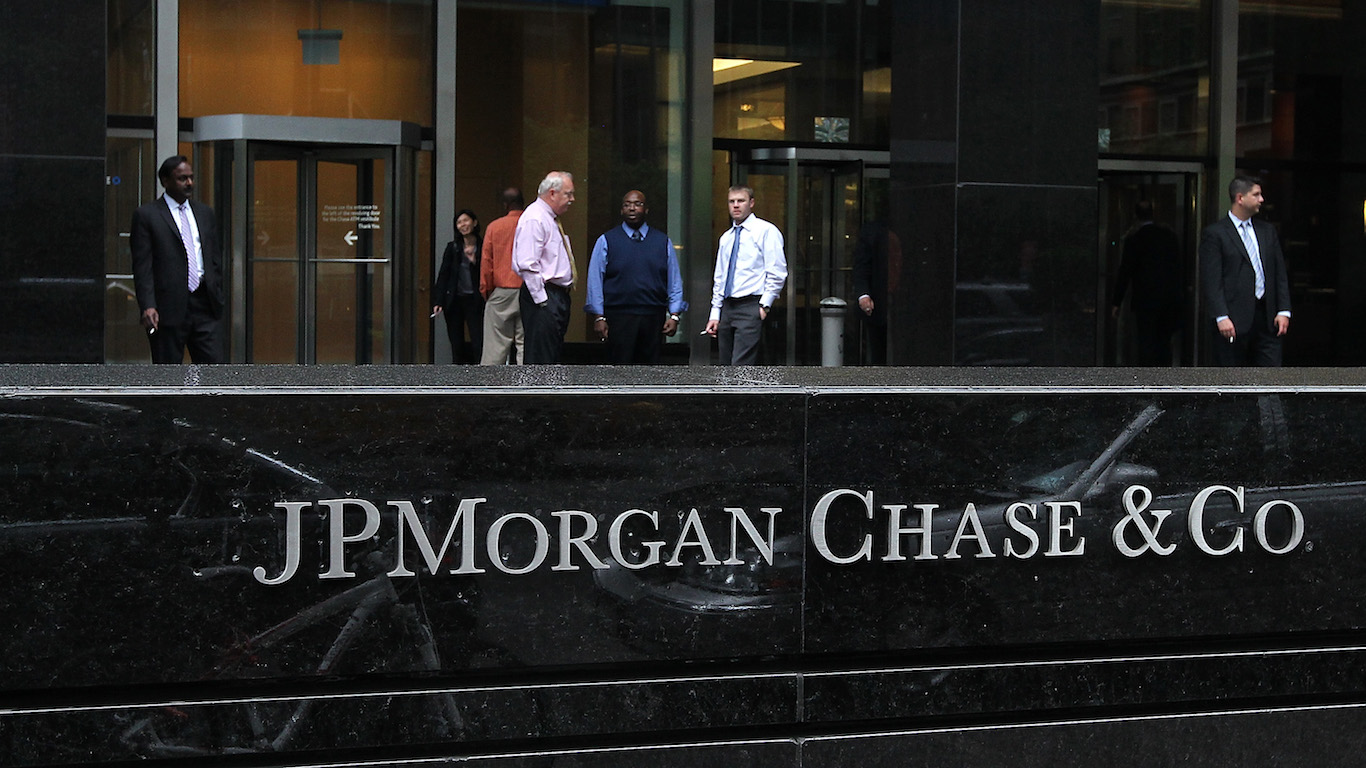
JPMorgan Chase (NYSE:JPM | JPM Price Prediction) is the largest financial holding in the index and a foundational dividend payer. In Q1 2026, JPMorgan earned $5.94 per share while paying a $1.50 quarterly dividend, a payout ratio near 25%. That leaves an unusually wide cushion for a megabank. The standardized CET1 capital ratio stands at 14.3%, well above regulatory minimums, and the bank holds $291 billion in CET1 capital alongside $1.5 trillion in high-quality liquid assets. Notably, JPMorgan raised its quarterly dividend 7% in April 2026 to the current $1.50 level, extending a 14-year run of consecutive annual increases. For VOOV holders, that distribution looks built to survive a bad year.
ExxonMobil (NYSE:XOM) carries an even longer track record. Management has grown the dividend for 43 consecutive years, with the current payment at $1.03 per share quarterly. Full-year 2025 shareholder distributions totaled $37.2 billion, including $17.2 billion in dividends and a $20 billion buyback program, even as capital expenditures stepped up to fund Guyana, the Permian, and Golden Pass LNG. Q1 2026 free cash flow narrowed on Middle East supply disruptions, but underlying earnings remained solid. The dividend is not at risk on a single challenging quarter.
The Single Risk That Could Break It
The one risk worth examining carefully is cyclical concentration. VOOV’s two reliable dividend engines, banks and oil majors, share an unfortunate trait: they tend to weaken at the same time. A recession that drives credit losses at JPMorgan also tends to crater the oil price that funds Exxon’s payout. While JPMorgan’s Q1 2026 provisions for credit losses actually fell to $2.5 billion from $3.3 billion a year earlier, the card services net charge-off rate remains in the low-to-mid single digits. Both metrics move quickly when unemployment rises, and any macro deterioration would test both engines simultaneously.
The macro overlay sharpens this picture further. The 10-year Treasury yield has been hovering around 4.6%, near its 52-week highs, driven partly by renewed inflation concerns tied to Middle East oil supply disruptions and uncertainty about Federal Reserve policy direction. Risk-free cash now competes directly with VOOV’s yield, and value indices historically derate when rates climb on inflation rather than growth. That is the channel through which dividend safety becomes price pain even when the underlying payouts hold.
Total Return Context
The price chart has cooperated over longer periods. VOOV delivered a total return of roughly 18% over the trailing year through mid-2026, with a five-year cumulative total return near 101% and a ten-year figure near 197%, dividends included. By comparison, the broader S&P 500 has compounded more rapidly over those windows, reflecting the substantial drag that growth-heavy technology names applied to value indices during the post-2015 era. The most recent distribution did soften modestly, with the Q1 2026 payment near $0.93 coming in below Q4 2025’s roughly $0.95 and the $1.06 peak in Q3 2024. Quarterly distributions fluctuate with the timing of underlying ex-dividend dates, so a single lighter quarter is noise rather than a trend.
The Verdict
VOOV’s distribution is safe in the sense that matters most to income-oriented holders: the top dividend payers in the index are funding their payouts out of real cash flow with conservative payout ratios. The honest caveat is that the income stream is more cyclical than the headline S&P 500 because banks and oil majors carry a heavier combined weight, and a recession would compress both engines at once. For long-term holders comfortable riding through one or two earnings cycles, VOOV’s dividend is durable. For investors who require their distribution to never wobble in a downturn, the cyclicality is the factor to underwrite honestly before adding a position.
Editor’s note: This article has been updated to reflect VOOV’s current total net assets of approximately $6.7 billion (up from $5.85 billion), its revised expense ratio of 0.07%, an updated share price of roughly $223, corrected sector weights as of May 31, 2026, the 14.3% CET1 ratio and JPMorgan’s April 2026 dividend increase to $1.50 per share, and refreshed total-return figures of approximately 18% over one year and 197% over ten years for VOOV.
Contact [email protected] for any questions or corrections.
Austin Smith is a financial publisher with over two decades of experience as an investor, analyst, and advisor. He covers stocks, ETFs, Artificial intelligence and personal finance for 24/7 Wall St. Previously, he spent over a decade at The Motley Fool as a senior editor for Fool.com, portfolio advisor for Millionacres, and launched The Ascent to help reader take control of their personal finances.
His work has been featured on Fool.com, NPR, CNBC, USA Today, Yahoo Finance, MSN, AOL, Marketwatch, and many other publications. He is as an advisor to private companies, and co-hosts The AI Investor Podcast with Eric Bleeker.
When not looking for investment opportunities, he can be found skiing, running, or playing soccer with his children. Learn more about Austin's investment approach here.