A Duke Professor Says China Could Disable Self-Driving Cars Across America. Nvidia Is Using the Sensors Anyway.
Editor’s note: Luminar Technologies filed for Chapter 11 bankruptcy and was delisted from Nasdaq. Its lidar business assets, including the Iris and Halo product lines, were subsequently acquired by MicroVision (NASDAQ:MVIS) in a bankruptcy auction. Original article references to Luminar…

Editor’s note: Luminar Technologies filed for Chapter 11 bankruptcy and was delisted from Nasdaq. Its lidar business assets, including the Iris and Halo product lines, were subsequently acquired by MicroVision (NASDAQ:MVIS) in a bankruptcy auction. Original article references to Luminar (LAZR) as an independent non-Chinese lidar alternative below were incorrect and have been updated to reflect these details. Contact [email protected] for any questions or corrections.
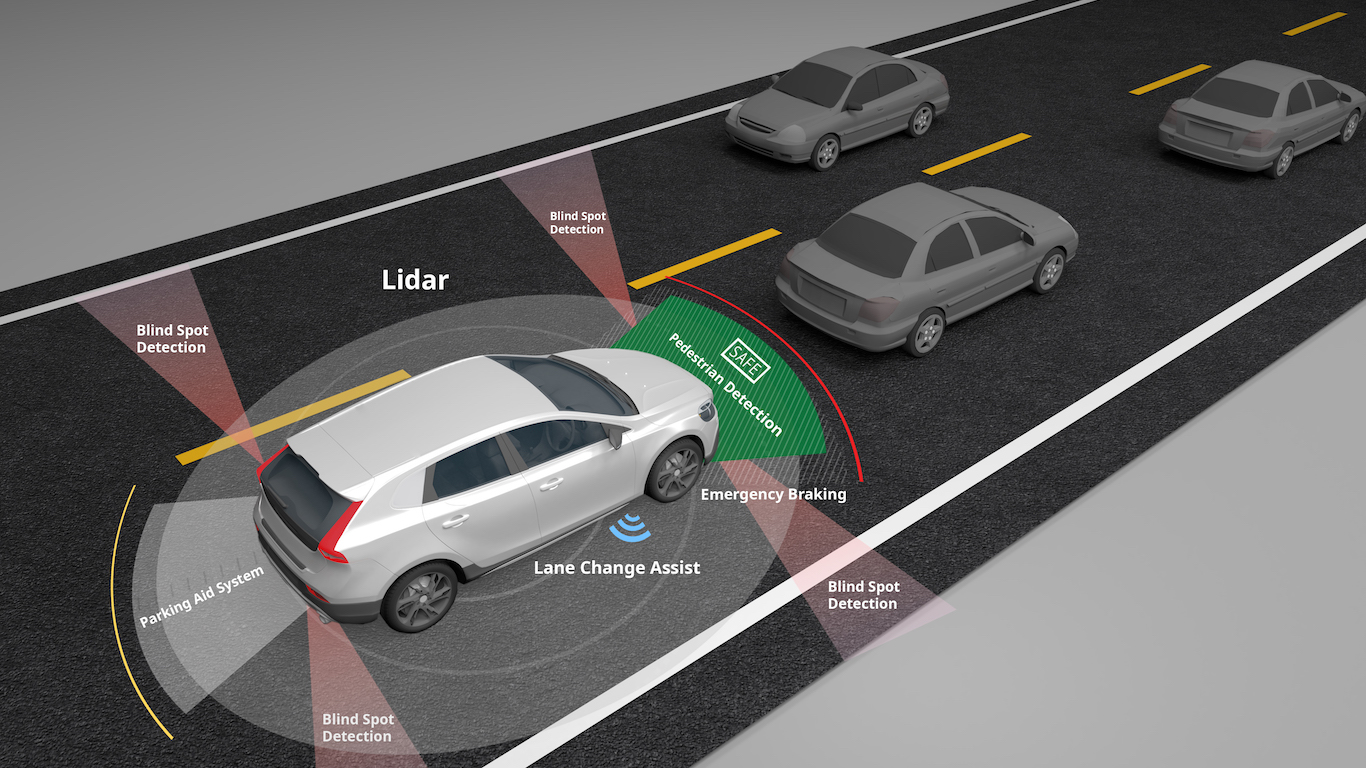
Duke University professor Miroslav Pajic recently demonstrated how brittle the sensors underneath America’s self-driving fleet are. In one attack, malware embedded in a lidar unit conjured a person in the sensor’s point cloud who was not physically present. In a second, a real physical obstacle was made to vanish entirely from the sensor output. Pajic told CNBC it is “easy to physically spoof lidar,” warning that malware inserted at the factory or via firmware updates can stay dormant until triggered, and that automakers usually cannot audit a lidar maker’s proprietary source code.
The company at the center of that risk is Hesai Group (NASDAQ:HSAI), a Shanghai-based lidar maker that commands roughly one-third of worldwide automotive lidar sales. The Pentagon blacklisted Hesai as a Chinese military entity in 2024, a designation that prohibits Pentagon contracts but does not ban commercial sales to US autonomous platforms. Hesai sensors are already inside Amazon’s Zoox robotaxis, trucking firms Waabi and Kodiak, AV company Nuro, and Agtonomy, and they monitor passenger and traffic flow at New York’s JFK Airport security checkpoints.
NVIDIA Doubles Down
NVIDIA (NASDAQ:NVDA | NVDA Price Prediction) selected Hesai as a lidar option for DRIVE Hyperion 10, its reference architecture for Level 4 autonomy, at CES in January 2026. In March, Hesai joined the Nvidia Halos AI Systems Inspection Lab, the first ANSI-accredited inspection lab for AI-driven physical systems. Jensen Huang framed the ambition simply: “Our vision is that some day, every single car, every single truck will be autonomous.” NVIDIA’s automotive revenue for fiscal year 2026 was up 39% year over year. Asked about security concerns, NVIDIA described Hyperion as an “open architecture” operating “in compliance with applicable regulations,” and did not address the exploit risk directly.
The National Security Case
Craig Singleton of the Foundation for Defense of Democracies told CNBC that Chinese law gives Beijing authority to demand companies like Hesai hand over whatever data they possess, making the sensors both an attack vector and a data-collection risk. At a Senate Commerce Committee hearing on February 4, 2026, Sen. Bernie Moreno pressed Waymo’s chief safety officer, who acknowledged Chinese-made components are present in the vehicles.
Hesai’s Defense
CEO David Li rejected the framing: “In the DOD case, I don’t feel there is sufficient evidence, and it’s not logical.” Li argues Hesai’s sensors have no onboard storage, that any data belongs to the partner, and that Hesai’s firmware is publicly available for outside scrutiny. Hesai reported Q1 2026 revenue of $98.66 million and holds a 55% market share in China’s long-range automotive lidar market.
Investor Exposure
HSAI carries the most direct risk: shares are down 27.9% year to date to $16.15, and forced removal from US AV platforms would be existential. NVDA faces near-term supply-chain and reputational risk if regulators close the commercial-sales gap. Non-Chinese alternatives MicroVision and Innoviz Technologies (NASDAQ:INVZ), the latter trading at $0.69, would benefit from any mandated fleet-wide swap, though both are financially fragile today.
Contact [email protected] for any questions or corrections.
I've spent more than 15 years inside enterprise software, working alongside the finance, sales operations, and HR leaders who run the revenue engines at some of the largest tech companies in the country.
My day job is helping enterprise executives make smarter decisions about retention, compensation, and growth. These are the same operational levers that show up in every earnings report investors actually read. That perspective shapes my writing for 24/7 Wall St.
The headline numbers are easy. The interesting stuff is underneath: how companies make money, what executives are worried about, and what any of it means for the person checking their 401(k) on a Sunday afternoon. I write about personal finance and business as someone who has spent her career inside the rooms where these decisions get made.