Have You Missed This New Multi Trillion-Dollar Market Opportunity? Nvidia Hasn’t.
The Ascent of Autonomous Vehicles The autonomous vehicle (AV) revolution is gaining momentum, with Tesla (NASDAQ:TSLA | TSLA Price Prediction) launching its robotaxi pilot in Austin this past Sunday. Despite some early hiccups, and Alphabet’s (NASDAQ:GOOG)(NASDAQ:GOOGL) Waymo already operating 250,000…

This post may contain links from our sponsors and affiliates, and Flywheel Publishing may receive compensation for actions taken through them.

The Ascent of Autonomous Vehicles
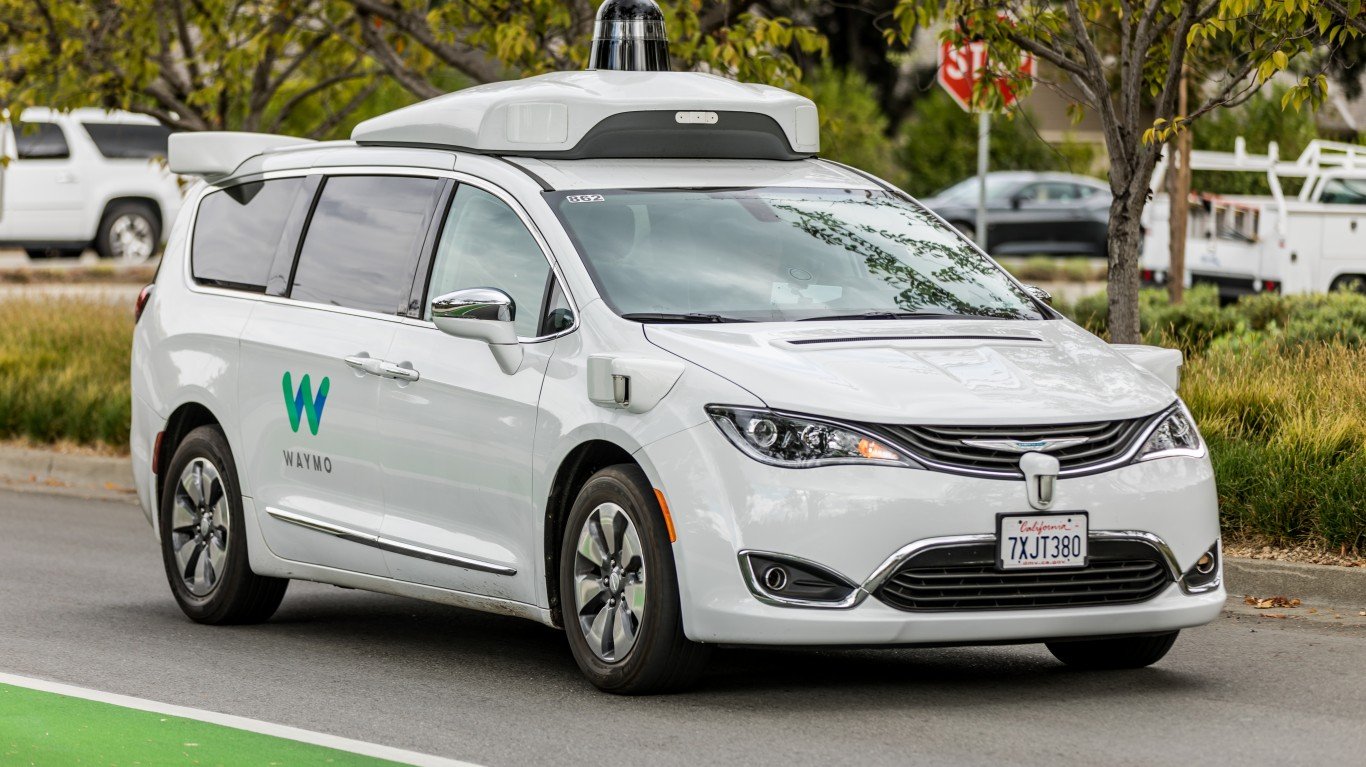
The autonomous vehicle (AV) revolution is gaining momentum, with Tesla (NASDAQ:TSLA | TSLA Price Prediction) launching its robotaxi pilot in Austin this past Sunday. Despite some early hiccups, and Alphabet’s (NASDAQ:GOOG)(NASDAQ:GOOGL) Waymo already operating 250,000 paid rides weekly across San Francisco, Los Angeles, Phoenix, and Austin, these milestones highlight the growing viability of self-driving technology.
Meanwhile, Nvidia (NASDAQ:NVDA), a leader in artificial intelligence (AI) chips, is positioning itself at the heart of this transformation. It reported $44.1 billion in revenue in the first quarter, a 69% year-over-year increase, driven by a $16.5 billion, 73% increase from its data center business, fueled by AI demand.
CEO Jensen Huang predicts AI data center spending will hit $1 trillion annually by 2028, but he also sees a potential multi trillion-dollar market in AVs. Nvidia’s advancements in AI hardware and software are poised to capitalize on this emerging sector.
Nvidia’s Vision for Autonomous Vehicles
At CES 2025 in January, Jensen Huang’s keynote address outlined Nvidia’s vision for “physical AI,” where AI systems perceive, reason, and act in real-world environments, with AVs as a cornerstone.
Huang described self-driving cars as the first multi trillion-dollar segment of the AI-powered robotics industry, a sentiment echoed in a CNBC interview this month where he declared this “the decade of autonomous vehicles.”
Nvidia’s Drive platform, featuring the Thor chip, integrates hardware and software to process sensor data for split-second driving decisions. Major automakers — including Mercedes-Benz, Toyota (NYSE:TM), General Motors (NYSE:GM), Rivian (NASDAQ:RIVN), and Volvo — have adopted it, underscoring its traction.
Additionally, Nvidia’s DRIVE Hyperion platform, built on the AGX Thor system-on-a-chip (SoC), combines advanced SoCs, sensors, and safety systems, already in use by Mercedes-Benz and Volvo. Huang emphasized the role of synthetic data via Nvidia’s Cosmos platform, which generates realistic driving scenarios to train AVs, scaling “hundreds of drives into billions of effective miles.”
Nvidia’s automotive segment, though just 1.3% of Q1 revenue at $567 million, is projected to reach $5 billion in fiscal 2026 — a 194% increase from $1.7 billion in 2025. This growth reflects partnerships with companies like Toyota, which will use Nvidia’s DRIVE AGX Orin for next-generation vehicles, and Tesla, which incorporates Nvidia chips into its supercomputers.
Huang’s vision extends beyond cars, foreseeing AI-driven robots in factories and homes, but AVs remain the most immediate opportunity.
Why Autonomous Vehicles Are a Trillion-Dollar Market
The AV market’s potential is vast, driven by the global transportation sector’s economic significance. Goldman Sachs estimates the U.S. ride-hailing market, currently $58 billion, could grow to $330 billion by 2030 with robotaxi expansion. Waymo’s 1,500-vehicle fleet and Tesla’s planned scaling to millions highlight the scale of this shift.
Nvidia’s role is pivotal, as many automakers lack the resources to develop proprietary AV systems. Unlike Tesla’s camera-only approach or Waymo’s multimodal sensors, Nvidia’s platform offers a standardized, scalable solution.
Huang predicts AVs will reduce accidents, traffic, and labor costs, transforming logistics and urban mobility.
Nvidia’s Stock: Opportunity and Risks
Nvidia’s stock, trading at an adjusted price-to-earnings ratio of 45 — a 28% discount to its five-year average of 63 — appears attractive. Wall Street forecasts earnings of $4.29 per share in fiscal 2026 and a one-year consensus price target of $174 per share, implying 17% growth. A $10,000 investment ten years ago would be worth over $2.9 million today, reflecting a near-29,000% return.
However, risks loom: competitors like Advanced Micro Devices (NASDAQ:AMD), Broadcom (NASDAQ:AVGO), and Intel (NASDAQ:INTC) are advancing in AI chips, and a broader market correction could hit Nvidia’s premium valuation.
Saturation in AI hardware demand is another concern, though AV growth helps offset this.
Key Takeaways
Nvidia’s strategic focus on AVs, backed by its Cosmos and DRIVE platforms, positions it to dominate an emerging multi trillion-dollar market. Its partnerships with top automakers and Tesla’s reliance on its chips for supercomputing underscore its centrality.
Despite competition and valuation risks, Nvidia’s innovation in physical AI and projected meteoric rise in automotive revenue growth make it a compelling long-term investment.
As AVs move toward mainstream adoption, Nvidia is not just selling chips, but building the infrastructure for an AI-driven future, offering investors a prime opportunity to ride the next trillion-dollar wave
Contact [email protected] for any questions or corrections.
After two decades of patrolling the dark corners of suburbia as a police officer, Rich Duprey hung up his badge and gun to begin writing full time about stocks and investing. For the past 20 years, he’s been cruising the markets looking for companies to lock up as long-term holdings in a portfolio while writing extensively on the broad sectors of consumer goods, technology, and industrials. Because his experience isn’t from the typical financial analyst track, Rich is able to break down complex topics into understandable and useful action points for the average investor. His writings have appeared on The Motley Fool, InvestorPlace, Yahoo! Finance, Money Morning, and, of course, 24/7 Wall St. He has been featured in both U.S. and international publications, including MarketWatch, Financial Times, Forbes, Fast Company, and USA Today.