JPMorgan, Morgan Stanley, Bank of America: Three Major Banks, Three Different Verdicts
JPMorgan, Morgan Stanley, and Bank of America all crushed Q1 earnings, but strong results and a strong stock are very different things, and right now these three banking giants sit at very different points on the risk-reward curve.


At current prices: JPMorgan Chase (NYSE:JPM | JPM Price Prediction) at $336.47 looks fully valued, Morgan Stanley (NYSE:MS) at $222.28 appears stretched, and Bank of America (NYSE:BAC) at $59.67 screens as the most attractive on valuation. Big-bank earnings power has expanded meaningfully into 2026, but the three sit at very different points on the risk-reward curve.
All three posted strong Q1 2026 results. JPMorgan grew EPS 17% year over year to $5.94, Morgan Stanley delivered record revenue of $20.58B with 27.1% ROTCE, and Bank of America grew EPS 25% to $1.11.
What separates them is valuation, analyst positioning, and how much good news is already priced in.
JPMorgan: Priced For Its Own Perfection
The bull case is clean. JPMorgan compounds book value while returning $12.2 billion in quarterly capital, Markets revenue hit a record $11.60B, and IB fees rose 28% as advisory activity re-accelerated. At a trailing P/E of 16 and forward P/E of 15, the multiple is reasonable for a bank earning 16.5% ROE.
The bear case: the stock has done the work already. Shares are up 18.97% over one year and sit near the 52-week high of $341.91. Consensus analyst target is $352.76, implying modest upside, and ratings skew cautious: 4 Strong Buy, 8 Buy, and 12 Hold.
At $336.47, JPMorgan screens as fully valued in our research view. The franchise is best-in-class, but with YTD gains of 5.89% and the target barely above spot, risk-reward looks symmetric. Existing holders may collect the 1.76% yield while monitoring for a pullback.
Morgan Stanley: Great Business, Stretched Stock
Morgan Stanley is executing beautifully. Wealth Management client assets reached $7.34T, equity trading grew 25%, and advisory revenue jumped 74%. EPS has beaten estimates in all five most recent quarters.
The problem: the market has priced all of it. Shares are up 26.55% YTD and 59.08% over one year, outrunning the broader market. Consensus analyst target of $216.48 now sits below current price, and ratings carry 1 Sell and 1 Strong Sell, unusual for a mega-cap bank. At a P/E of 20 and price-to-book of 3.4, Morgan Stanley is the most expensive of the three.
At $222.28, Morgan Stanley looks stretched in our research view. When analyst consensus prints a lower target than spot, when P/B pushes above 3x for a bank, and when a single soft Wealth quarter could reset the multiple, the setup argues for caution. A re-entry point closer to $190 looks more compelling on the numbers.
Bank of America: The Cheapest Compounding Story
Bank of America is the mirror image of Morgan Stanley. NII grew 9% to $15.74B, deposits notched an 11th straight quarter of growth, card charge-offs improved to 3.64%, and management guided FY2026 NII growth of 5% to 7%. The stock trades at a forward P/E of 13 and price-to-book of just 1.536.
Shares are up 10.47% YTD and 30.76% over one year, yet still leave room to run. Consensus target of $65.79 implies further upside, and ratings are the most bullish of the group: 6 Strong Buy, 15 Buy, 3 Hold, zero Sells. Goldman’s outlook backs the setup, noting “the US banking sector remains sound” with benign asset quality trends heading into 2026.
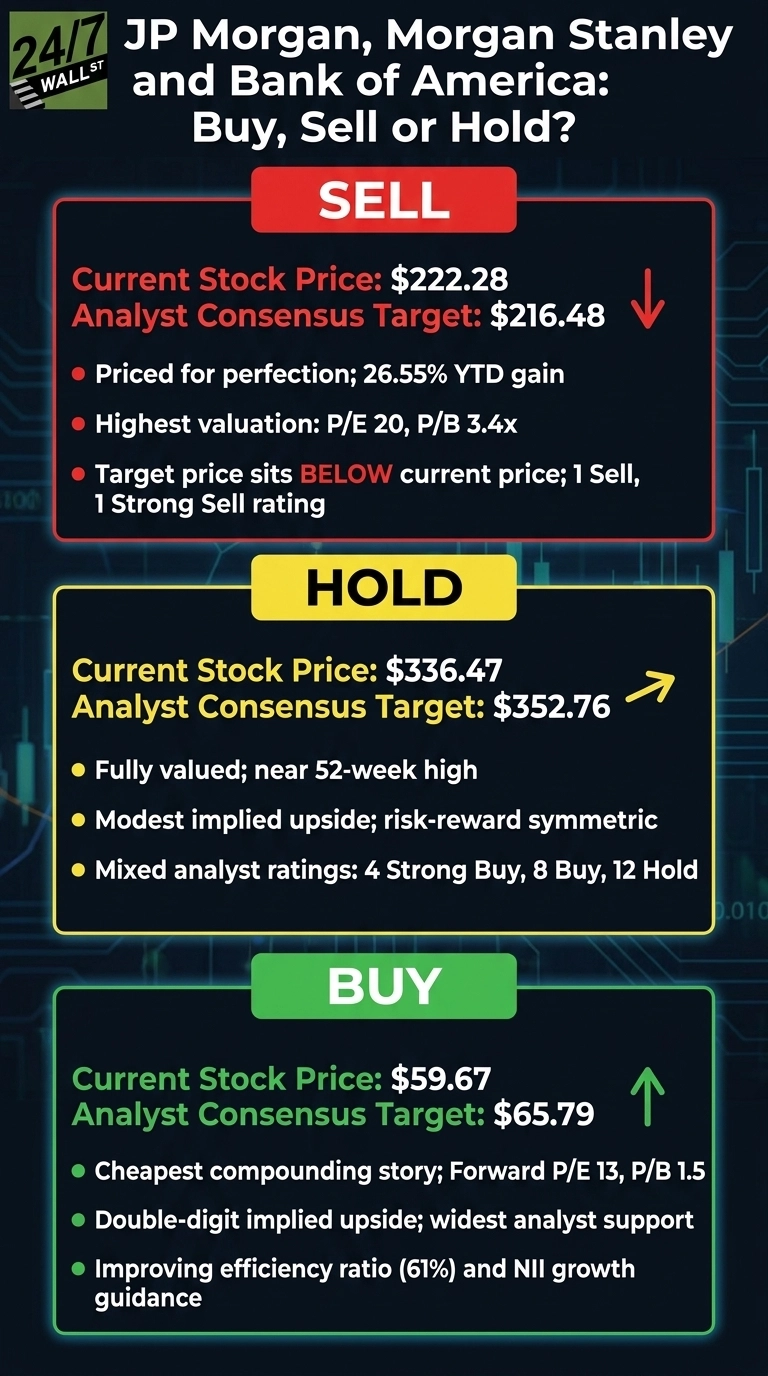
At $59.67, Bank of America screens as the most attractive of the three on valuation. It offers double-digit implied upside, the widest analyst support, an improving efficiency ratio of 61%, and a 1.86% dividend while investors wait. The main risk is a sharp rate cut, where 100bps would reduce NII by $2.0B, and it is a well-telegraphed sensitivity. Cheapest bank, best setup on the numbers.
Contact [email protected] for any questions or corrections.
Vandita Jadeja is a financial publisher with over a decade of experience writing about financial topics, including investment, savings, retirement, insurance and banking. Vandita is a Chartered Accountant who loves to debunk financial concepts for readers.
Her work has appeared on sites that include The Motley Fool, InvestorPlace, and Benzinga. She covers investing and focuses on stock picks and price prediction for 24/7 Wall St.
When not looking for the next stock investment opportunity, she can be found traveling, reading, chasing sunsets and enjoying her iced latte.