Alex Karp Thinks AI’s Irresponsibly Oversold, Critiques OpenAI and Anthropic — Is He Right?
Palantir's Alex Karp went on CNBC to blast OpenAI and Anthropic for overselling AI, and his frustration touches a real nerve as enterprises burn cash on tokens without clear returns. But his proposed fix raises bigger questions than the problem…


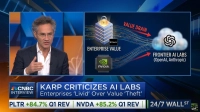
Palantir (NASDAQ:PLTR | PLTR Price Prediction) CEO Alex Karp has been making headlines for his heated rant on CNBC, critiquing OpenAI and Anthropic for how they’re selling AI. Indeed, it certainly feels like the wild west days as enterprises look to unlock value where possible from the leading AI models by using tokens in a way that’s not at all optimal.
The early scramble to spend money now (on tokens) while assessing value later might not seem logical, but in such a gold rush where earlier movers could unlock meaningful advantages, I do understand why some firms wouldn’t mind getting a bit ahead of their skis when it comes to spending on tokens.
As the trend of “tokenmaxxing” exhausts and naturally corrects itself, questions linger as to whether Mr. Karp’s frustrations are warranted and whether companies really are giving away their “alpha” when they run their proprietary data using models from frontier AI labs.
The “tokenmaxxing” era may have gone too far
Indeed, it seems like Mr. Karp’s argument is that enterprises, like the government, should seek to own, rather than rent, AI compute. While I understand where the man is coming from, I’d argue that it doesn’t make a ton of sense for a firm to allocate a significant amount of CapEx to own the “means of production” when you consider the steep CapEx that goes into building out all the infrastructure and what’s lost by not using the absolute best model at any point in time.
Why spend on owning if it’s going to cost a fortune, you might not get the best model, and tokens are already collapsing in price, thanks in part to more efficient models and better hardware? While moving to on-prem AI data centers might make sense for some firms, I do think that the rise of the private cloud stands out as providing the best of both worlds.
Any way you look at it, the price of cutting off the frontier AI labs may be too high, even as tokens generate suspect value in these earlier innings. Perhaps deliberate token budgeting and diversifying across multiple models (as many firms are already doing) is the best way to go.
So, in short, AI might be oversold, but, then again, making models at the frontier doesn’t come cheap, either — just look at OpenAI’s financials. Given this, maybe it’s what has to be done to keep the lights on.
Why renting AI compute is the way to go
In any case, getting into the business of building data centers seems more expensive and riskier than just renting AI compute from the hyperscalers, especially given the market isn’t all too fond of the amount of CapEx they’ve been posting this year. Arguably, it makes more sense to own the infrastructure once firms are able to extract serious value from every token. In these earlier experimental changes, the costs of owning versus renting, I think, are way too high.
Any way you look at it, I really don’t understand Alex Karp’s argument when it comes to the cost argument, at least from the perspective of everyday enterprise customers that might not want to raise the bar on CapEx and get punished for it by public market investors.
In my view, the “alpha leak” warning might raise red flags, especially following an Apple (NASDAQ:AAPL) lawsuit that alleged OpenAI tried to steal trade secrets. Either way, the hyperscalers have private clouds, which should ease the concerns of those worried about surrendering “alpha” to the landlords of AI compute.
Any way you look at it, it’s clear that the days of tokenmaxxing might be coming to an end. And it’s the perfect solution as firms look to shift gears in a way that ROI is taken into consideration.
Indeed, when it comes to how tokens are being spent, it looks like things are naturally correcting and nothing extreme, such as committing significant CapEx to build something massive, especially as a non-tech firm with no expertise in the area. Outside of governments and maybe a few big-league financial institutions, I think well over 90-95% of businesses will find it’s more economical to rent compute from the likes of a hyperscaler. But, of course, that’s my humble opinion.
The bottom line
Time will tell what the next market shift will be, but count me as a skeptic when it comes to Alex Karp’s case for owning the means of production rather than renting, especially at a time when we could see token costs collapse while closed-source intelligence skyrockets.
Contact [email protected] for any questions or corrections.
Joey is a 24/7 Wall St. contributor and seasoned investment writer whose work can also be found in publications such as The Motley Fool and TipRanks. Holding a B.A.Sc in Computer Engineering from the University of British Columbia (UBC), Joey has leveraged his technical background to provide insightful stock analyses to readers.
Joey's investment philosophy is heavily influenced by Warren Buffett's value investing principles. As a dedicated Buffett disciple, Joey is committed to unearthing value in the tech sector and beyond.