Palantir CEO: “Something Has Gone Completely Wrong” In AI. Alex Karp Says Enterprises Are Paying To Lose Their Competitive Edge
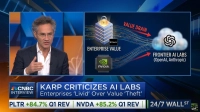
Palantir Technologies (NASDAQ:PLTR | PLTR Price Prediction) co-founder and CEO Alex Karp argued this week that generative AI sales to enterprises are structurally broken. In his words, “something has gone completely wrong” in the industry, and customers buying token-based access…


Palantir Technologies (NASDAQ:PLTR | PLTR Price Prediction) co-founder and CEO Alex Karp argued this week that generative AI sales to enterprises are structurally broken. In his words, “something has gone completely wrong” in the industry, and customers buying token-based access to frontier large language models are paying to expose their intellectual property and their “alpha” while getting little value back.
Karp is hardly a neutral observer. As the CEO of an AI infrastructure company competing for enterprise spending, he stands to benefit if businesses shift away from token-based AI services. But his criticism reflects a broader debate playing out across the industry over whether long-term value will accrue to frontier model providers or to companies that help enterprises securely deploy AI while maintaining control of their data, models, and compute.
Karp’s Says AI Profit Lives In The Compute And The Application Layer
Karp’s core claim is that durable profit pools in enterprise AI sit at two ends of the stack: the compute layer, where NVIDIA sells accelerators, and the application layer, where Palantir sells its ontology and AIP platform. Token-based access to frontier models is not one of them, he argues, because clients refuse to pay the true cost and the labs therefore carry “bad financials.”
His pitch to enterprise CIOs is that Palantir’s alignment with NVIDIA (NASDAQ:NVDA) is about letting customers control their own compute, models, and data stack, and “own the means of production” rather than renting cognition by the token from a third party. He credits Palantir’s five-year head start to years spent building for warfighter requirements and constructing the ontology application layer that sits on top of commodity models.
The ontology functions as a safeguard by preventing LLMs from caching customer data and replicating business secrets, and he says competitors are now copying the design.
Why Karp Says AI Is A National Security Issue
Karp pushed a national-security argument: overseas adversaries and competitors can access the same frontier models U.S. buyers use, so American critical infrastructure operators and warfighters need to restrict trust and control their own stack.
That framing dovetails with the FY 2027 Department of War budget, which requests $58.5 billion for AI investment, including $46.0 billion for a sovereign AI Arsenal and $2.3 billion for the Maven Smart System and the Joint Fires Network, programs in which Palantir is deeply embedded.
Palantir’s Incredible Results Back Up Karp’s Argument
Palantir’s financials support Karp’s talking points. In Q1 2026, reported May 4, 2026, revenue reached $1.632 billion, up 84.7% year over year, with adjusted EPS of $0.33 against a $0.28 estimate. U.S. commercial revenue grew 133% to $595 million, and GAAP operating income was $754 million, a 46% margin. Management raised full-year 2026 revenue guidance to $7.650 to $7.662 billion.
On the call, Karp said, “Palantir’s Rule of 40 score has soared to 145%. We have shattered the metric, a feat matched only by other fellow AI infrastructure companies: NVIDIA, Micron and SK Hynix.” That grouping links Palantir to compute-side winners rather than frontier labs whose economics he questions.

Investors Are Paying A Premium For Karp’s Vision
Karp’s argument ultimately comes down to trust. He believes enterprises will increasingly reject AI platforms that require them to hand over valuable data in exchange for token-based access, instead favoring solutions that let them control their models, compute, and intellectual property.
Investors are already paying a premium for Karp’s company. Palantir trades at a forward P/E of 80 and a price-to-sales ratio of 54, while NVIDIA trades at a forward P/E of 23. Analysts’ consensus price targets sit at $182.75 for PLTR vs. a current share price of $129.35 and $301.62 for NVDA vs. a current share price of $193.35. Investors betting the ontology moat holds are paying up front for a thesis that still needs proof against every generic AI vendor Karp says is on the wrong side of the profit pool.
Contact [email protected] for any questions or corrections.
Thomas Richmond is a financial writer and content strategist with 5+ years of experience covering stocks and financial markets. He has published over 500 articles focused on individual stock analysis, helping investors better understand business fundamentals, stock valuations, and long-term opportunities.
Thomas previously served as a Content Lead at TIKR, a stock research platform, where he helped scale the company’s blog to hundreds of articles per month and contributed to a weekly newsletter reaching more than 100,000 investors.
Outside of work, Thomas enjoys weight lifting and soccer.