AMD Falls 5%, Intel Drops 4%, NVIDIA Slides 3% Before Recovering as Rotation Hits Semiconductor Stocks
A wave of selling swept through semiconductor stocks Friday as investors began questioning whether the AI spending boom can justify chip valuations built on optimism alone. The forces driving this rotation reveal cracks in the narrative that sent some semis…

This post may contain links from our sponsors and affiliates, and Flywheel Publishing may receive compensation for actions taken through them.
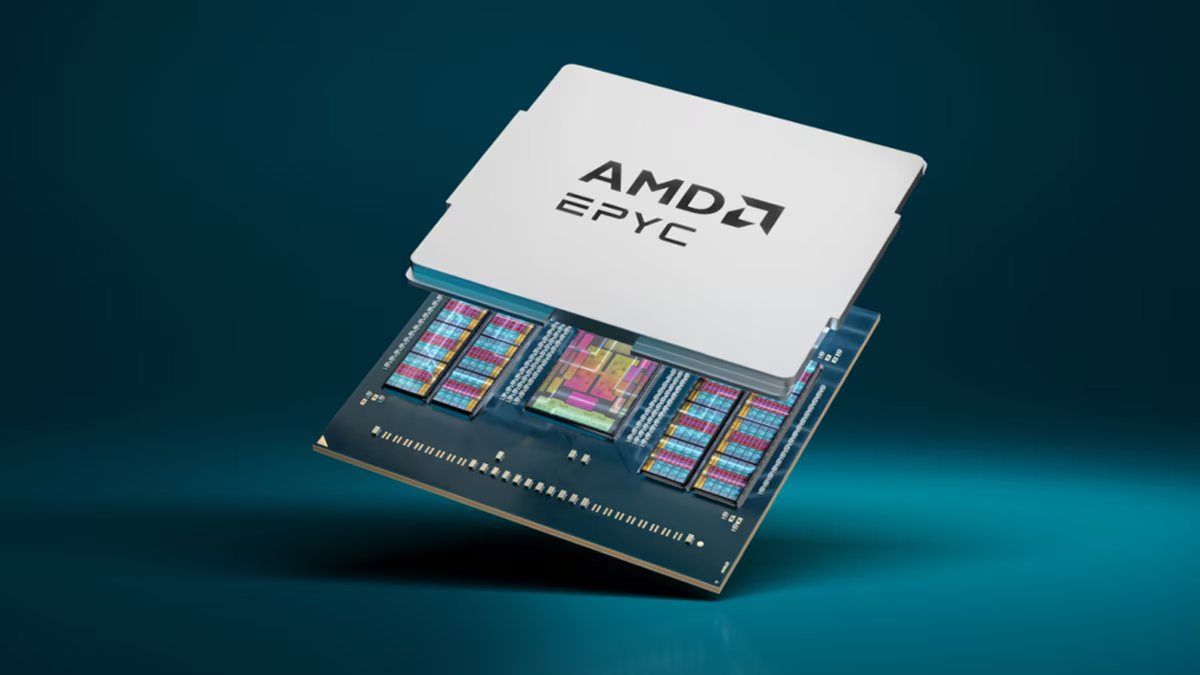
Shares of Advanced Micro Devices (NASDAQ:AMD | AMD Price Prediction) were down 5% Friday morning to $477.81, leading a selloff across semiconductor stocks. Intel (NASDAQ:INTC) stock was off 4% to $93.24, while NVIDIA (NASDAQ:NVDA) stock was down 3% to $201.60. Broadcom (NASDAQ:AVGO) stock slipped 2% to $366.51.
The iShares Semiconductor ETF (NASDAQ:SOXX), the sector’s most-watched basket, had slid 3% to $515.76 in early trading. The ETF move caps a rough stretch for the AI-hardware complex, with the most-extended names taking the deepest hits so far this session.
These stocks and the SOXX ETF recovered some of their losses within the first hour of trading, but traders still felt the effects of a rotation out of semiconductor stocks. As it turns out, there are a number of forces at work in this risk-off rotation.
Rotation Out of Semis on AI-Cost Worries
Per Yahoo Finance reporting, the move reflects a broad risk-off rotation as investors question the return on heavy AI-infrastructure spending. The move is a sector-wide, positioning-driven unwind hitting the most crowded corners of the AI trade, with no company-specific catalyst behind today’s drop in AMD stock.
Two threads are driving the anxiety. Chinese startup Moonshot unveiled Kimi K3, described as the world’s largest publicly available AI model that developers can download and run themselves, at the World Artificial Intelligence Conference in Shanghai. Cheaper open-weight models challenge the “more compute” thesis that underpins premium chip valuations.
Taiwan Semiconductor Manufacturing (NYSE:TSM) also guided this week to higher-than-anticipated capital expenditures, partly on higher tool prices. Taiwan Semiconductor’s Q3 2026 revenue outlook of $44.6 billion to $45.8 billion is strong, yet the capex guide is feeding worries about margin compression and AI-cost sustainability across the supply chain.
Sector Has Shed $3.3 Trillion Since June
The selloff is broad. Global semiconductor stocks have shed $3.3 trillion in market value since June 22, nearing bear-market territory. Equipment makers Applied Materials (NASDAQ:AMAT) and Lam Research (NASDAQ:LRCX) shares each fell more than 4% in Friday morning trading.
Memory is getting hit as well. Micron Technology (NASDAQ:MU), SanDisk (NASDAQ:SNDK), and Western Digital (NASDAQ:WDC) shares all declined in the session. Bloomberg reported that Alphabet‘s (NASDAQ:GOOGL) Gemini 3.5 Pro model is behind schedule, adding another crack to the AI timeline narrative.
Principal Asset Management chief global strategist Seema Shah has framed it this way: Wall Street is still positive on the AI trade but is watching hyperscaler capex and earnings as the foundation of the AI ecosystem. The most-extended semis are falling hardest, with Intel and AMD, both up triple digits YTD, dropping more than NVIDIA today.
Bull and Bear Cases on AMD
AMD’s fundamentals remain intact. The company’s first-quarter fiscal 2026 revenue hit $10.25 billion, up 38% year over year (YoY), and the Data Center segment grew 57% YoY to $5.78 billion. Furthermore, AMD’s Q2 2026 guidance calls for approximately $11.2 billion in revenue, and CEO Lisa Su has flagged accelerating customer engagement around MI450 and Helios.
The bear case is where today’s tape is trading. AMD stock carries a P/E ratio of 162.77x, leaving little cushion if AI capex expectations slip. Cheaper open models like Kimi K3 could pressure the “more compute” narrative, and the parabolic YTD run is exactly the kind of position traders unwind first in a risk-off tape.
What Investors Can Watch Now
Investors can watch for whether the SOXX ETF stabilizes into the close and whether upcoming hyperscaler earnings reaffirm 2026 AI capex plans. Given the volatility after such a large run, investors may want to size their AMD positions carefully and treat further weakness as rotation-driven rather than demand-driven.
Taiwan Semiconductor’s next monthly revenue update and NVIDIA’s Q2 FY2027 report could shape the trajectory of the bull-bear debate. Momentum traders may keep the semis active through the afternoon as positioning resets across the AI-hardware complex.
Contact [email protected] for any questions or corrections.
David Moadel is financial writer specializing in stocks, ETFs, options, precious metals, and Bitcoin. David has written well over 1,000 articles for leading online publications, helping investors understand markets, income strategies, and risk.His work has appeared in The Motley Fool, InvestorPlace, U.S. News & World Report, TipRanks, ValueWalk, Benzinga, Market Realist, TalkMarkets, Finmasters, 24/7 Wall St., and others.With a master’s degree in education, David has taught at the elementary, high school, and college levels. That teaching background shapes his writing style: clear, educational, and practical. David has also built a loyal social-media audience by providing trustworthy financial content on YouTube, X/Twitter, and StockTwits.