OpenAI Is on Pace to Miss Its Own Ad Revenue Forecast by 90%. Here’s What It Means For The AI Trade
A research firm just ran the numbers on one of OpenAI's boldest revenue promises, and the gap between what OpenAI is projecting and what independent analysts see coming raises serious questions about the financial foundation under the entire AI investment…


One of the load-bearing assumptions behind the AI investment story just got a hard sanity check, and the numbers do not add up.
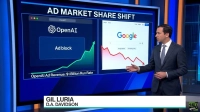
According to research firm eMarketer, OpenAI’s advertising business is on pace to miss the company’s own five-year revenue forecast by roughly 90%. OpenAI has projected $2.5 billion in OpenAI ad revenue in 2026, growing to $100 billion by 2030. eMarketer’s data tells a different story: standalone AI chatbots, including ChatGPT, Microsoft Copilot, Google AI Mode, and Amazon’s Alexa for Shopping combined, will generate less than $1 billion in ad revenue this year, and just $5.41 billion across the entire market by 2030.
OpenAI’s single-company 2030 target is roughly 20 times larger than eMarketer’s estimate for the entire U.S. chatbot ad market. That gap calls the whole projection into question and sits at the heart of the AI bubble debate.
What OpenAI’s Forecast Requires
For the number to hold, eMarketer argues, OpenAI would need to capture search advertising budgets en masse from traditional search, dominate a fully mature chatbot ad market, and outperform essentially every ad format in history simultaneously. Any one would be ambitious; requiring all three makes the forecast look less like a plan and more like a hope. OpenAI only began its advertising trial in February 2026, and was touting these projections barely two months in.
Why Ads Matter
Advertising is expected to make up roughly 36% of OpenAI’s total revenue by 2030, making it central to the revenue base OpenAI needs to fund multi-year compute commitments to partners like Oracle (NYSE:ORCL | ORCL Price Prediction), NVIDIA (NASDAQ:NVDA), and Microsoft. Oracle alone carries $75 billion in AI-linked performance obligations tied to prepaid or customer-supplied GPU arrangements, much reportedly connected to OpenAI. If the ad pillar comes in short, the foundation under those Oracle OpenAI deals looks shakier.
Market Sensitivity
Investors have shown how sensitive they are to cracks in OpenAI’s story. On April 28, 2026, a report that OpenAI was missing internal user-growth and revenue targets triggered a selloff across AI-linked stocks. Oracle fell more than 4%, NVIDIA, Broadcom, AMD, and Arm Holdings all dropped, and SoftBank fell as much as 11% in Tokyo trading. This ad-revenue analysis feeds the same skepticism. Oracle shares are now down 37.12% year to date.
The reach extends beyond dedicated AI investors. The “Magnificent Seven,” which includes Alphabet (NASDAQ:GOOG) and Meta Platforms (NASDAQ:META), plus Oracle and Broadcom, accounts for roughly a third of the S&P 500 by weight. OpenAI’s financial credibility exerts outsized influence on ordinary index funds and 401(k) accounts.
The Competitive Problem
OpenAI’s ad forecast assumes ChatGPT dominates the chatbot market. But ChatGPT’s share of generative AI web traffic has reportedly fallen from about 87% a year ago to roughly 65% in January 2026, as Google’s Gemini has gained ground. Alphabet’s AI investments are showing results: Google Cloud grew 63% in the first quarter, with backlog nearly doubling to over $460 billion. A shrinking market share makes capturing the vast majority of that market’s ad dollars harder to justify.
The Other Side
None of this means the projection will fail. OpenAI has pushed back forcefully on prior missed-target reporting, calling one instance “ridiculous”. Forecasts stretching to 2030 for a brand-new ad category are inherently uncertain in both directions, and eMarketer’s ceiling could prove low if chatbot advertising evolves faster than expected. This is a credible data point that warrants scrutiny rather than a verdict.
The AI trade is built on assumptions about future revenue justifying present-day spending. When an independent firm says one of those assumptions may be off by 90%, it gives investors reason to ask whether the math actually works.
Contact [email protected] for any questions or corrections.
I've spent more than 15 years inside enterprise software, working alongside the finance, sales operations, and HR leaders who run the revenue engines at some of the largest tech companies in the country.
My day job is helping enterprise executives make smarter decisions about retention, compensation, and growth. These are the same operational levers that show up in every earnings report investors actually read. That perspective shapes my writing for 24/7 Wall St.
The headline numbers are easy. The interesting stuff is underneath: how companies make money, what executives are worried about, and what any of it means for the person checking their 401(k) on a Sunday afternoon. I write about personal finance and business as someone who has spent her career inside the rooms where these decisions get made.