Why Google’s New AI Chip Is the Key to Unlocking Its Massive $462 Billion Backlog
Google Cloud is sitting on a backlog so enormous it had to turn away some of the biggest names in tech, and the company's answer to breaking that logjam starts not with more data centers but with a radical rethinking…

This post may contain links from our sponsors and affiliates, and Flywheel Publishing may receive compensation for actions taken through them.

The artificial intelligence boom continues to reshape the technology landscape in 2026. Demand for AI computing power has surged so dramatically that even industry giants struggle to keep pace.
Alphabet (NASDAQ:GOOG | GOOG Price Prediction), Google’s parent company, stands at the center of this shift. Its Google Cloud segment delivered standout results, posting roughly $22.8 billion in revenue in Q2 2026 — a 67% jump year-over-year — while the company’s overall revenue reached $116.91 billion, up 21.2%. Yet behind these gains lies a persistent challenge: compute capacity constraints that have forced tough choices.
The Compute Crunch Hits Home
Google Cloud has become Alphabet’s primary growth engine. In Q1 2026, the division generated $20 billion in revenue, up 63% year-over-year, with a backlog that swelled to $462 billion. CEO Sundar Pichai noted on the earnings call that revenue would have been higher without compute limitations. Reports indicate the company even had to turn down portions of major customer requests, including capacity Meta Platforms (NASDAQ:META) sought earlier this year, as infrastructure struggled to match explosive AI demand.
This shortage isn’t abstract. Capital expenditures climbed sharply, with Alphabet raising full-year 2026 guidance to $180 billion to $190 billion to expand data centers, servers, and custom chips. Free cash flow felt the pressure in earlier quarters, yet the $462 billion backlog — more than 10 times 2025’s full-year cloud revenue of $43.2 billion — signals customers stand ready to spend once capacity opens up.
For investors, this highlights both opportunity and execution risk. Alphabet’s ability to convert that backlog into sustained high-teens or better revenue growth will separate it from peers facing similar bottlenecks.
A New Targeted Efficiency Breakthrough
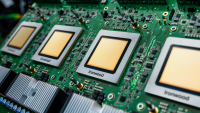
Enter Frozen v2, Google’s latest internal chip project. According to reports from The Information, this specialized server chip embeds key portions of the Gemini AI model’s architecture directly into silicon. Unlike general-purpose Tensor Processing Units (TPUs) that handle varied workloads, Frozen v2 hardwires Gemini’s underlying blueprint. This reduces unnecessary calculations and data movement during inference — the process of generating AI responses.
Engineers project Frozen v2 could deliver six to 10 times more tokens per unit of power than current TPUs. Deployment is targeted for 2028 as a specialized complement rather than a TPU replacement, with smaller production volumes initially. The approach evolved from an earlier concept of embedding model weights; the v2 version focuses on architecture for greater flexibility across Gemini iterations.
Imagine it like customizing the engine specifically for your most popular car model instead of using a versatile but less optimized one. By easing the load on existing infrastructure, Frozen v2 could unlock meaningful additional capacity without proportionally massive new builds. That directly addresses the shortages constraining Google Cloud today.
Efficiency as the Next Moat
Smart investors recognize Alphabet’s full-stack advantage here. The company designs its own chips, software, and models, then runs them at scale in its cloud. Frozen v2 builds on that integration. While risks remain — including the chip’s compatibility with future Gemini versions and the 2028 timeline — success would improve margins and let Google Cloud capture more of that $462 billion backlog.
Alphabet trades at a forward P/E of less than 24x with strong free cash flow generation historically. Compare that to peers pouring similar sums into AI infrastructure with less vertical control. Google Cloud’s operating margin expanded to 32.9% in recent quarters from 17.8%, showing leverage as utilization rises.
Key Takeaway
Frozen v2 won’t solve every capacity issue overnight, but it represents a pragmatic, high-impact step toward turning AI demand into reliable profits. For long-term shareholders, Alphabet’s ability to innovate its way through constraints — while generating $160 billion in trailing net income — reinforces its position as a core holding.
In the end, the companies that deliver efficient compute at scale will claim the biggest share of the AI prize.
Contact [email protected] for any questions or corrections.
After two decades of patrolling the dark corners of suburbia as a police officer, Rich Duprey hung up his badge and gun to begin writing full time about stocks and investing. For the past 20 years, he’s been cruising the markets looking for companies to lock up as long-term holdings in a portfolio while writing extensively on the broad sectors of consumer goods, technology, and industrials. Because his experience isn’t from the typical financial analyst track, Rich is able to break down complex topics into understandable and useful action points for the average investor. His writings have appeared on The Motley Fool, InvestorPlace, Yahoo! Finance, Money Morning, and, of course, 24/7 Wall St. He has been featured in both U.S. and international publications, including MarketWatch, Financial Times, Forbes, Fast Company, and USA Today.