Nvidia CEO Huang: Chips Industry Must Grow 10x Over The Next Decade To Power 100 Billion AI Agents
Jensen Huang just told the world that the entire semiconductor industry is not remotely built for what comes next, and his forecast for how much it needs to grow will reshape how investors think about every chip stock in the…

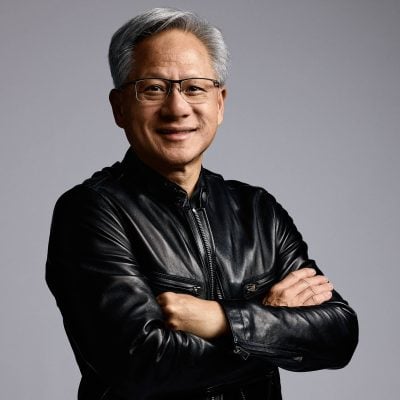
NVIDIA (NASDAQ:NVDA | NVDA Price Prediction) CEO Jensen Huang used an exclusive Bloomberg interview on July 27, 2026 to lay out one of the boldest forecasts yet for the AI buildout: a semiconductor industry that must expand roughly tenfold over the coming decade to serve a computing world dominated by autonomous machines rather than human users.
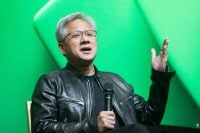
Speaking about the shift from human-driven computing to agentic systems, Huang argued that Nvidia’s addressable market is being redefined at the endpoint level. “These are now processing AI’s for humans to collaborate with. In the future we have AI agents and robots and they will be using computers. Instead of a billion people using computers we will have 100 billion agents and billions of robots all using computers. The computer industry built on top of the chip industry is certainly not big enough,” Huang said. His projection follows: “My guess is the semiconductor industry will probably have to be 10 times larger than it is today over the next decade or so. Working with our partners in Korea and around the world to scale up the supply chain of semiconductors so we are prepared for the AI future.” Huang framed the 10x figure explicitly as his personal guess, not a certainty.
Reframing The Addressable Market
The pitch aligns with themes Huang has hammered on recent earnings calls. On the fiscal Q1 2027 call in May 2026, he described “The transition from generative to agentic AI, AI capable of perceiving, reasoning, planning, and acting,” as a force that will reshape every industry. He has also flagged that reasoning models require “a hundred, a thousand times more” tokens per task than one-shot chatbots, a compute intensity that underpins his tenfold industry expansion thesis.
Nvidia reported fiscal Q1 2027 revenue of $81.61 billion, up 85.2% year over year, with data center revenue of $75.25 billion and non-GAAP earnings per share of $1.87, according to the company’s SEC 8-K filing. Q2 guidance called for approximately $91.0 billion in revenue.
The Korea Angle: SK Group And HBM
Huang leaned heavily into South Korea as a linchpin of the buildout. “It is the golden age for Korea, as you know. Their semiconductor and industrial business is booming. The country has the ability to help the world buildout AI infrastructure. They are incredibly adapt at adopting new technologies,” he told Bloomberg.
Nvidia announced a partnership with SK Group valued at over $500 billion in consumption and purchasing of memory and sales of AI supercomputers. The companies are collaborating on memory roadmaps spanning HBM3, HBM4, and beyond, and Nvidia is investing in Korea’s leading AI cloud with plans to scale 200 megawatts. Reports indicate Nvidia will invest $1 billion in Naver Corp to finance an AI data center expansion in the country. SK Group’s listed affiliates trade on the Korea Exchange rather than U.S. venues.
Capex Confidence, With Caveats
The 10x call gives investors a framework for interpreting Nvidia’s aggressive supply commitments. The company disclosed $119.0 billion in total supply-related commitments and authorized an additional $80 billion share buyback, alongside a dividend raise to $0.25 per share. Reports indicate Nvidia is in talks to provide a $250 billion financing guarantee for an OpenAI data center project in southern Ohio.
Nvidia carries a trailing P/E of 32 and a forward P/E of 24, with an analyst target price of $302.83 against a recent quote of $206.02. Shares are up 11.04% year to date and 19.21% over the past year.

Huang is arguing that AI infrastructure demand will run longer and deeper than current models assume because the number of compute endpoints jumps from roughly a billion humans to hundreds of billions of agents and robots. That is his projection, not a guarantee, and it hinges on the industry actually scaling supply chains across Taiwan, Korea, and the United States to meet it. Investors watching Nvidia should track hyperscaler capex commentary, HBM supply agreements, and the Vera Rubin ramp for evidence that Huang’s timeline is materializing.
Contact [email protected] for any questions or corrections.
AJ spent 10 years writing about financial markets at The Motley Fool. His coverage centers on technology stocks and the broader macroeconomic trends, from interest rates to geopolitics, that shape where markets are headed next. AJ is drawn to the stories where big-picture economics and individual companies collide.