




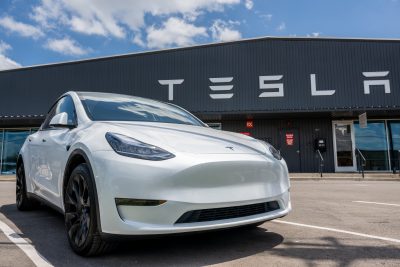
Tesla (NASDAQ:TSLA | TSLA Price Prediction) shares trade at $380.84 against an average Wall Street price target of $425.22. That works out to roughly 12% of implied upside from where the stock currently sits.
The gap hides a wider disagreement about what Tesla actually is. Buyers are underwriting Elon Musk’s roadmap for autonomous ride-hailing, humanoid robots, and vertically integrated AI silicon. Every quarter, the market decides how much of that future belongs in the price.
Wall Street is fractured on the answer. Consensus implies modest upside. Wedbush’s Dan Ives, the loudest bull on the name, has a $600 target anchored on FSD monetization, Robotaxi networks, and Optimus scale, with a bull case near $700 that would represent roughly 84% upside from today.
The 2026 Selloff Has Been a Slow Bleed
Tesla is down 15.32% year to date while the S&P 500 is up 9%. The stock has dropped 6.6% in the past week alone and trades below its 50-day moving average of $409.80.
Q1 26 results didn’t justify the selloff. Revenue hit $22.387B, non-GAAP EPS came in at $0.41 (beating by 17.78%), automotive gross margin recovered to 21.1% from 16.2%, and Services & Other revenue climbed 42% YoY on 1.28M FSD subscribers. Headwinds came from energy storage revenue slipping 12% YoY, opex jumping 37% on AI/R&D, and inventory building to 27 days from 22.
Sentiment is the bigger issue. Polymarket traders assign just a 16% probability that Optimus launches this year and 19% that Tesla runs robotaxis in California by year-end. Those two products explain why Tesla trades at a 167x forward P/E. When the crowd stops believing the timeline, the multiple compresses.
Why the Loudest Bull Is Not Blinking
Ives treats Tesla as a physical AI platform. His thesis rests on long-term monetization of Full Self-Driving subscriptions and autonomous Robotaxi networks, vertical integration into internal “Terafab” chip production, engineering synergies with SpaceX, and Optimus scaling toward the guided 1M robots per year capacity at Fremont.
Consensus is more measured. Of 47 covering analysts, 23 rate Tesla Buy or Strong Buy, 18 sit on Hold, and 6 rate it Sell or Strong Sell. Bank of America maintains a Buy with a $460 target. Morningstar calls the stock “fairly valued” at $450. Lower averages reflect analysts who see the AI ramp but won’t underwrite the Ives-style multi-trillion-dollar autonomy math.
Q2 earnings this week will move the debate. Analysts are watching FSD v14.3 uptake, Cybercab pilot production, Robotaxi expansion beyond Austin/Dallas/Houston, and the AI5 inference chip whose tape-out completed in April. If those items land on schedule, $425 stops being aspirational and $600 stops looking absurd.
Legacy Automakers Are Beating Tesla in 2026
Tesla is the outlier in its cohort. Ford and GM are priced as functional cash generators. Rivian trades on R2 launch momentum. None carry Tesla’s AI premium, and none share its 2026 underperformance.
General Motors (NYSE:GM) sits at $76.07 versus a $95.85 target, roughly 26% upside. The stock is down 6% YTD despite Q1 26 adjusted EPS beating estimates by 41% and management raising 2026 guidance. Of 27 covering analysts, 20 rate it Buy or Strong Buy with just 2 sells.
Ford (NYSE:F) trades at $14.23 against a $15.05 target, only about 6% upside. Ford is up 11% YTD on Q1 26 EPS of $0.66, but 15 of 21 analysts covering it sit on Hold, recognizing the quarter leaned heavily on a $1.3B one-time tariff benefit.
Rivian (NASDAQ:RIVN) at $17.45 carries an $18.77 target, roughly 8% upside. The stock is down 11% YTD even after R2 customer deliveries began and a $1B VW equity infusion. Recent share issuance has weighed on sentiment.
GM carries the largest consensus-implied upside at 26%. Take Ives seriously and Tesla dwarfs the entire cohort. The peer setup argues Tesla’s dislocation is about company-specific narrative execution, with sector-wide auto weakness ruled out by peer performance.
What the Consensus Actually Signals
Tesla trades at $380.84 against a $425.22 average target from 47 covering analysts, roughly 12% implied upside. Year to date the stock is down 15.32%, versus a 9% gain for the S&P 500. Over the past year, shares are up 19.23%.
The analyst ratings split:
- Strong Buy: 5
- Buy: 18
- Hold: 18
- Sell: 4
- Strong Sell: 2
Tesla trades below both its 50-day ($409.80) and 200-day ($417.05) moving averages, roughly 24% below its 52-week high of $498.83 and 28% above the 52-week low of $297.82. Forward P/E sits at 167x.
Where I Come Out on Tesla
The bull case strengthens if Q2 earnings confirm the Q1 gross margin recovery, if Robotaxi rolls out beyond current markets before year-end, and if AI5 silicon translates into a visible cost or performance edge. Under those conditions, $425 is easy math and the Ives $600 becomes defensible.
The bear case gains traction if Optimus and Cybercab slip into 2027, if FSD China approval stalls, and if energy storage revenue keeps shrinking. At 167x forward earnings, Tesla cannot afford another execution miss. Polymarket crowds, historically 75.8% accurate on prior TSLA questions, are already pricing skepticism into these near-term catalysts.
Consensus at $425 looks reachable if execution holds. The Ives $600 requires proof of execution.
Contact [email protected] for any questions or corrections.













 Top Gaining Stocks
 Top Losing Stocks