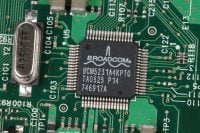
I’m Buying Broadcom This Week For One Powerful Reason
Every hyperscaler building AI infrastructure eventually needs a partner that can do something NVIDIA simply will not, and one company quietly collects every time that phone rings.


I keep buying Broadcom (NASDAQ:AVGO | AVGO Price Prediction) because every hyperscaler racing to build AI infrastructure eventually walks through Hock Tan’s showroom, and I want to own the toll booth. That is the reason my finger hovers over the buy button again this week, with the stock trading at $381.92 heading into another mega-cap earnings cycle.
The One Powerful Reason: Custom Silicon Is Eating the AI Buildout
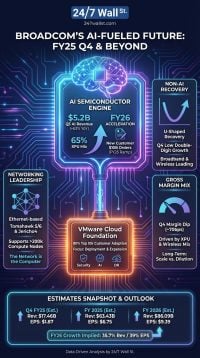
Broadcom’s AI semiconductor revenue climbed from $5.20 billion in Q3 FY2025 to $10.80 billion last quarter, up 143% year-over-year. Management guided Q3 FY2026 AI revenue to $16.0 billion, growth over 200%. Bookings for AI semiconductors reached over $30 billion against $10.8 billion shipped. Hock Tan told the Street plainly: “Demand for XPUs and networking is simply insatiable.”
That is the toll booth I want to own. When Google, Meta, OpenAI, and Anthropic want a custom accelerator built to their exact workload, they call Broadcom. The 10 gigawatts of shipments planned for 2027 and the reiterated goal of exceeding $100 billion in AI sales by 2027 reflect the arithmetic behind the current backlog.
The Cash Machine Behind the Story
The receipts back the excitement. Q2 FY2026 free cash flow hit $10.26 billion, or 46% of revenue. Adjusted EBITDA margin sat at 69%. Net income climbed 87.51% year-over-year, cash on the balance sheet doubled to $19.63 billion, and the company has now delivered eight consecutive quarters of EPS beats, most recently posting non-GAAP EPS of $2.44.
For a retirement-oriented account, capital return matters. Broadcom pays a $0.65 quarterly dividend, raised 10% in Q4 FY2025 and marking the 15th consecutive annual increase since fiscal 2011. Q1 FY2026 buybacks totaled $7.8 billion, another $600 million came in Q2, and a fresh $10 billion authorization runs through year-end.
Why Broadcom Wins the Custom Silicon Trade
I own some NVIDIA (NASDAQ:NVDA) and I have studied Advanced Micro Devices (NASDAQ:AMD). Both sell merchant GPUs. Broadcom does something structurally different: it builds the custom ASIC each hyperscaler uses to sidestep the $40,000 off-the-shelf NVIDIA GPU tax on their operating margins. When hyperscalers protect margins, capital flows from merchant GPUs into custom silicon and datacenter switches. That is Broadcom’s lane.
For an income portfolio, the dividend gap decides it. Broadcom’s 15 straight years of dividend raises far outpaces the payout records at NVIDIA and AMD. Broadcom also brings a subscription software business through VMware, contributing $7.18 billion in Q2 revenue at 93% gross margins. That mix gives me a cyclical growth engine bolted to a software annuity.
The Real Risk
Customer concentration is real. A handful of hyperscalers drive the AI line, and $91.47 billion in total liabilities demands steady cash generation to service. Volatility is real too: after the Q2 report, the stock dropped 12.59% on the day despite beating estimates.
My thesis holds because the multi-year commitments are contractual. Anthropic has locked in 5 gigawatts of next-generation TPU-based compute beginning 2027, OpenAI is contracted for 10 gigawatts by 2029, and Meta signed for 3 gigawatts through end of 2028. That visibility pays me to wait through any drawdown.
Why the Buy Button Stays Active
I keep buying because Broadcom sits at the chokepoint of the AI capex cycle, generates cash like a utility, and returns it like a compounder. Every quarter Hock Tan reports, the moat widens.
Contact [email protected] for any questions or corrections.
Alex Sirois is a financial writer with experience spanning both retail and institutional investing. He has written for InvestorPlace and held roles at BNY Mellon and Bernstein, giving him a perspective that bridges Main Street portfolios and Wall Street analysis.
Alex holds an MBA from George Washington University and has built his career across multiple industries, including e-commerce, education, and translation — a breadth of experience that informs how he breaks down complex financial topics for everyday investors. His writing is conversational, actionable, and grounded in long-term, buy-and-hold investing principles.
At 247 Wall St., Alex focuses on delivering analysis that is both accessible and useful, with a clear emphasis on helping readers make more informed decisions with their money.