The Single Biggest Reason to Buy Exxon Mobil Before July 31st
Exxon Mobil heads into its July 31 earnings report carrying a streak most energy companies can only dream about, and Wall Street is pricing in a very high chance it gets even better before summer ends.

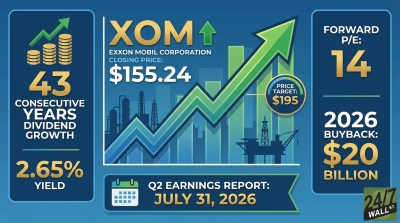
Exxon Mobil (NYSE:XOM | XOM Price Prediction) enters its July 31 earnings report with 43 consecutive years of dividend growth and a $20 billion annual buyback program. Strong production from Guyana and the Permian, combined with higher oil prices during Q2, could give the energy giant another opportunity to extend its four-quarter earnings-beat streak.

Higher Oil Prices Could Drive Another Earnings Beat
ExxonMobil has beaten EPS four straight quarters. Q1 2026 adjusted EPS came in at $1.16 versus $1.0074, a 15.15% beat, and Polymarket puts an 84.5% probability on another beat on July 31. Golden Pass LNG Train 1 loaded its first cargo in April 2026, Guyana output crossed 900,000 gross barrels per day, and the Permian hit a record 1.8M boed in Q4 2025. WTI traded between $80 and $114 during Q2, providing a strong upstream backdrop.

A 43-Year Dividend Growth Streak Meets a $20 Billion Buyback
Exxon pays a 2.65% dividend yield, and the last hike (4% announced in Q3 2025) extended the 43-year growth streak. Layer the $20 billion 2026 repurchase program (with $4.9 billion executed in Q1) on top of the dividend, and total shareholder yield lands much higher than the visible dividend yield.
Exxon’s Balance Sheet Supports the Valuation
XOM trades at a P/E of 23, an EV/EBITDA of 10.71, and a Price/Book of 2.51. These don’t seem like unreasonable multiples for a business that generated $26.13 billion in free cash flow in 2025 with Debt/Equity of just 0.168 and interest coverage of 56.28x. The stock’s beta sits at just 0.162, making it a low-volatility stock relative to the broader energy sector.
Exxon Looks Stronger Than Chevron on Cash Flow and Valuation
Chevron (NYSE:CVX) trades at a P/E of 32 (versus XOM’s 23), rides a shorter 39-year dividend streak, and reported negative $1.55 billion of free cash flow in Q1 2026 as capex outran operating cash.
Chevron is also investing in recently acquired Hess assets, Guyana, the Gulf of Mexico, and the Permian Basin to support 7% to 10% production growth in 2026. That spending could strengthen future cash flow, but Exxon currently offers the more attractive combination of valuation, reported free cash flow, dividend history, and buyback scale.
The Headline Profit Decline Hides Stronger Underlying Earnings
Exxon’s reported Q1 profit fell sharply, but the headline decline included billions of dollars in derivative timing effects and disruption costs. Excluding those items, underlying earnings increased to $8.77 billion from $7.58 billion. As CEO Darren Woods said on the Q1 call, “This quarter demonstrated that ExxonMobil is a fundamentally stronger company than it was just a few years ago, built to perform through disruption and across market cycles.”
Contact [email protected] for any questions or corrections.
Thomas Richmond is a financial writer and content strategist with 5+ years of experience covering stocks and financial markets. He has published over 500 articles focused on individual stock analysis, helping investors better understand business fundamentals, stock valuations, and long-term opportunities.
Thomas previously served as a Content Lead at TIKR, a stock research platform, where he helped scale the company’s blog to hundreds of articles per month and contributed to a weekly newsletter reaching more than 100,000 investors.
Outside of work, Thomas enjoys weight lifting and soccer.