Chevron vs. Exxon: Which Dividend Survives the Downturn
Both oil giants raised their dividends again this year and carry decades-long growth streaks, but when crude craters, only one of them has the balance sheet to keep writing that check without breaking a sweat.

This post may contain links from our sponsors and affiliates, and Flywheel Publishing may receive compensation for actions taken through them.
For a retirement investor deciding between Chevron (NYSE:CVX | CVX Price Prediction) and Exxon Mobil (NYSE:XOM) as an income holding today, the question is simple: which oil major writes the more durable dividend check through the next commodity cycle? Both raised again this year, both sit on multi-decade streaks of annual increases, and both are flush with cash and WTI hovering near $100 a barrel. The comparison that matters is what happens when crude falls again.
Round 1: Current Yield and Raw Income
Chevron pays a $1.78 quarterly dividend, or $7.12 annualized, for a yield of 3.07%. Exxon pays $1.03 quarterly, or $4.12 annualized, for a yield of 2.57%. On $100,000 invested, that is roughly $3,070 versus $2,570 in year-one cash. Chevron also trades at a richer earnings multiple (P/E 34 versus Exxon’s P/E 23), but for the income-first buyer the raw cash yield is what funds the grocery bill.


Winner: Chevron. More income per dollar deployed, full stop.
Round 2: Durability Through the Cycle
This is where the verdict is decided, and Exxon wins it decisively. Start with the balance sheet. Exxon carries net debt/EBITDA of 0.548 and interest coverage of 56x. Chevron sits at net debt/EBITDA of 1.08 and interest coverage of 13.7x, with debt/equity of 0.251 against Exxon’s 0.168. Chevron’s net debt ratio climbed to 15.6% from 10.4% financing the Hess deal, and while it just paid down more than $8 billion in the quarter, the leverage gap is real.
Cash coverage tells the same story. Exxon generated more than $17 billion of free cash flow in Q2 2026 and returned more than $9 billion to shareholders while cutting net debt by more than $7 billion. Chevron posted $18.1 billion in free cash flow, but management flagged $1.4 billion in favorable timing effects, and Q1 2026 free cash flow was actually negative $1.55 billion. Structurally, Exxon’s business is more integrated: advantaged assets like Permian, Guyana and LNG were 59% of production in 2025, up seven points from 2024, and Guyana has hit a free cash flow inflection now that the $55 billion investment is fully recovered. When Brent falls, integrated refining and chemicals cushion earnings, and Exxon’s mix is deeper.


Winner: Exxon. Lower leverage, higher coverage, and a cash-generative Guyana curve that only accelerates from here.
Round 3: Dividend Growth and Track Record
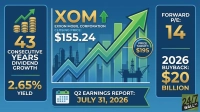
Exxon has a 43-year streak of annual dividend increases; Chevron has 39. The most recent raises were comparable, with Chevron lifting the quarterly from $1.71 to $1.78 and Exxon from $0.99 to $1.03. What separates them is behavior in stress: Exxon’s quarterly dividend held flat at $0.87 across 2019 and 2020 but never cut, and it kept raising through every downturn since 1982. Chevron’s history is comparably clean, but the shorter streak crossed fewer commodity troughs at today’s scale.
Winner: Exxon. Longer runway of tested increases.
Verdict
For the retirement investor who needs the check to arrive in every crude environment, Exxon Mobil is the more durable dividend. The lower leverage, the 56x interest coverage, the integrated refining and chemicals ballast, and the Guyana free-cash-flow ramp all point the same direction. Chevron wins if the priority is maximum current income and the buyer is comfortable with the Hess-related leverage bump; its 3.07% yield is a genuine advantage. But for durability, which is the criterion that matters when you are living off the payout, Exxon takes it.
Contact [email protected] for any questions or corrections.
Chris Lange is a financial and geopolitical writer with more than a decade of experience covering a myriad of topics. He has published thousands of articles for 24/7 Wall St., with past coverage focused heavily on stocks, IPOs, healthcare, defense, global affairs, and technology.
His work has been quoted, or referenced by a number of outlets including Business Insider, USA Today, Yahoo Finance, MSN, The Motley Fool, and many other publications. A graduate of Southwestern University, he studied business with a focus on investments and has previous experience in banking and startups.
When not reading or writing the news, he is following his passion for Lacrosse, playing chess, or building solar projects with his dad.