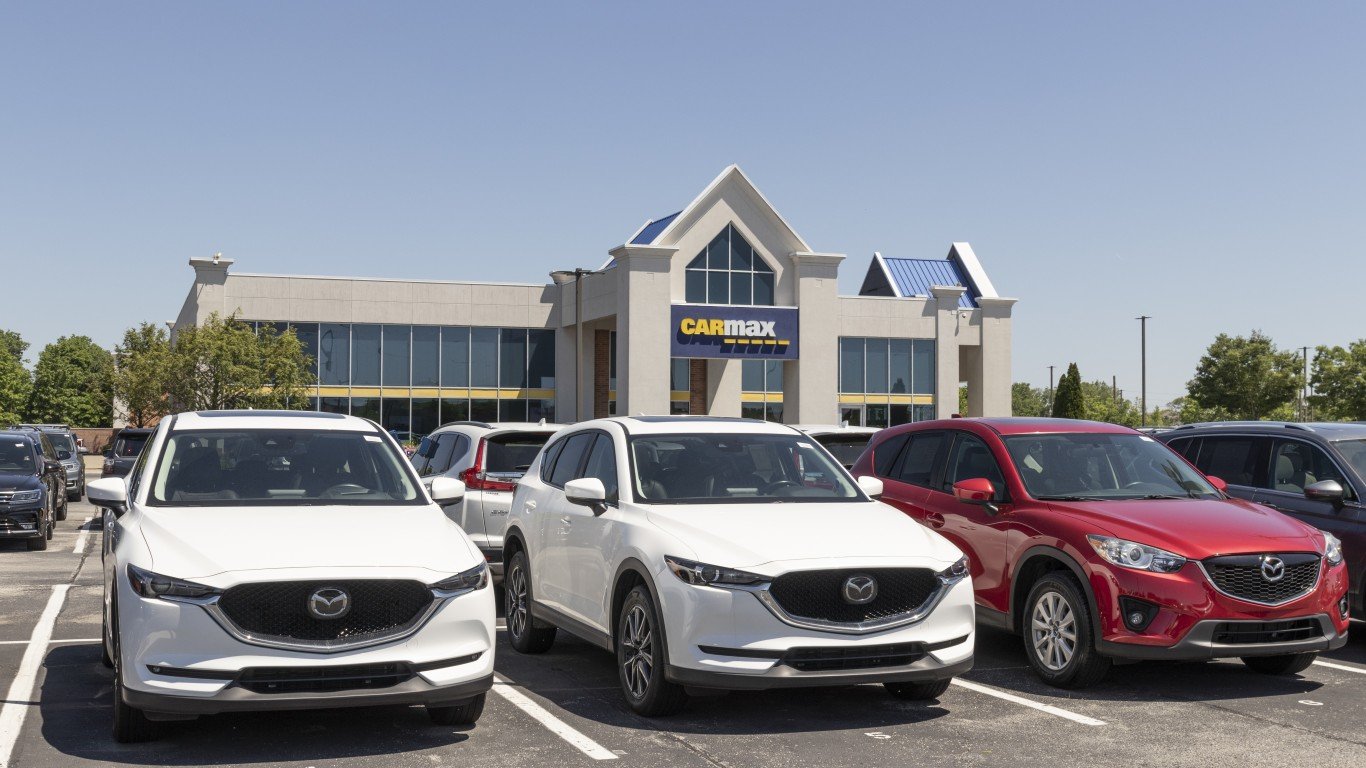
Carvana Is Down 30% in 2026 While CarMax Is Up 50%. Should Investors Sell One and Buy the Other?
Carvana just posted record revenue and profits yet its stock is getting crushed in 2026, while a struggling rival is suddenly Wall Street's darling. The case for switching sides is more complicated than the performance gap suggests.

Shares of Carvana (NYSE:CVNA | CVNA Price Prediction) are down 11% Thursday afternoon, marking Carvana stock’s worst session since late January, after full-year guidance underwhelmed. CarMax (NYSE:KMX) stock is little changed on the day. The move widens what’s already a striking year-to-date (YTD) gap between the two big used-car retailers.
Carvana stock is down 30% YTD in 2026, while CarMax stock is up 51% YTD. That kind of divergence between direct peers naturally raises the question of whether investors should favor one over the other.
The setup is a classic relative-value debate. One name is a high-growth momentum story taking a breather, and the other is a battered incumbent finally gaining turnaround credit. The catalysts driving today’s split are worth unpacking.
Carvana’s Guidance Overshadows a Record Quarter
Carvana’s Q2 2026 earnings report was operationally exceptional. Revenue hit $7.376 billion, up 52.4% year over year (YoY) and a quarterly record, adjusted EPS came in at $0.42 versus $0.3823 expected, and Carvana’s retail units reached a record 197,325, up 38%. Furthermore, Carvana’s record adjusted EBITDA of $769 million landed near a 10.4% margin.
The issue was Carvana’s outlook. The company’s full-year 2026 adjusted EBITDA guidance of $2.70 billion to $3.00 billion has a midpoint below the roughly $3 billion consensus, and Q3 commentary offered only a “sequential increase” in units with no specific figure. CEO Ernie Garcia struck an optimistic note, saying Carvana is still “just 1.5% of the U.S. automotive market.”
Wall Street trimmed targets while keeping bullish ratings. Morgan Stanley cut its Carvana stock price target to $90 from $102 (Overweight), and Wells Fargo lowered its Carvana price target to $80 from $85 (Overweight). Both firms characterized the near-term EBITDA pressure as temporary rather than structural.
The broader Carvana thesis remains intact for bulls. The company’s total gross profit per unit slipped $412 YoY but rose $231 quarter over quarter, and Carvana’s SG&A per retail unit improved to $3,568. CVNA ratings still skew heavily bullish, with 16 Buys, 7 Holds, and 1 Sell.
CarMax’s Turnaround Gains Analyst Traction
CarMax has been the mirror image. Under new CEO Keith Barr, who started March 16, 2026, CarMax delivered a Q1 FY2027 beat with EPS of $1.31 versus $0.94 expected on revenue of $8.01 billion. Management raised CarMax’s SG&A exit-rate savings target to $200 million by the end of FY2027.
JPMorgan upgraded CarMax stock to Neutral from Underweight and lifted its CarMax price target to $60 from $38, citing stronger sales trends and improved pricing while flagging limited upside after the rally. Meanwhile, Barclays upgraded CarMax stock to Equal Weight from Underweight and lifted its CarMax price target to $61, explicitly playing catch-up with the run.
The consensus, however, remains measured. KMX ratings cluster around Hold, and the mean CarMax price target near $49.64 sits below the current CarMax stock price. The company’s fiscal Q2 FY2027 results are due Sept. 29, and Barr’s first Strategic Update is scheduled for late fall 2026.
Valuation and the Pairs Debate
The valuation picture complicates the “sell one, buy the other” reflex. Carvana trades at a TTM P/E ratio of 31.25x, arguably reasonable for a name compounding revenue above 50% YoY. CarMax carries a TTM P/E ratio of 36.32x on a business that’s still just stabilizing, which reads as somewhat less favorable.
Insider activity tells opposing stories, too. Carvana has logged 67 recent insider transactions with net selling, while CarMax shows 18 transactions with net buying. That’s a notable divergence in how each management team is treating their own stock after this year’s split in performance.
For reference, CarGurus (NASDAQ:CARG) stock is down 7% in 2026 so far, while AutoNation (NYSE:AN) shares are up 5% YTD. The State Street SPDR S&P 500 ETF Trust (NYSE ARCA:SPY), which tracks the S&P 500, is up 9% this year.
What to Watch Now
The pairs debate is nuanced. Carvana stock is being penalized for guiding to record profits that fell short of consensus, and analysts still frame the reset as a temporary EBITDA squeeze. CarMax stock has already absorbed a lot of turnaround optimism, trading above its own consensus target.
Investors can watch for whether Carvana stock stabilizes into next week and whether CarMax’s Sept. 29 fiscal Q2 print validates the rally. However, one of these YTD gaps typically closes, and the next catalysts are already on the calendar. Position sizing should stay modest on both names, given the wide spread between bull and bear cases here.
Contact [email protected] for any questions or corrections.
David Moadel is financial writer specializing in stocks, ETFs, options, precious metals, and Bitcoin. David has written well over 1,000 articles for leading online publications, helping investors understand markets, income strategies, and risk.His work has appeared in The Motley Fool, InvestorPlace, U.S. News & World Report, TipRanks, ValueWalk, Benzinga, Market Realist, TalkMarkets, Finmasters, 24/7 Wall St., and others.With a master’s degree in education, David has taught at the elementary, high school, and college levels. That teaching background shapes his writing style: clear, educational, and practical. David has also built a loyal social-media audience by providing trustworthy financial content on YouTube, X/Twitter, and StockTwits.