Carvana Drops 7% With Bulls, Bears Split Over the Business Model
Carvana just posted its best quarter ever, yet the stock keeps sliding while a traditional rival is up over 50% this year. Something about that gap deserves a closer look.

Shares of Carvana (NYSE:CVNA | CVNA Price Prediction) are down 7% to $65.50 Tuesday morning, extending a slide that has left Carvana stock lower for 2026 even as the used-vehicle disruptor just posted its best quarter on record. The move puts the year-to-date figure squarely at odds with the operating story.
Through Monday’s close, Carvana stock was down 17% year to date (YTD). CarMax stock, meanwhile, was up 51% over the same stretch. That inversion is the headline, and it puts pressure on the original thesis that Carvana’s online-first model was uniquely defensible against traditional dealers.

Record Quarter, Falling Stock
Carvana’s Q2 2026 report on July 29 delivered all-time records. Total revenue reached $7.4 billion, up 52% versus Q2 2025, net income was $513 million, up 66.6%, and retail units sold hit 197,325, up 38%.
Carvana’s gross profit per unit was $7,014, down 5.4%, the one operating metric moving the wrong way. Online used-vehicle inventory at Carvana reached roughly 77,000 as of June 30, up from 75,000 at year-end 2025 and 53,000 a year earlier.
CEO Ernie Garcia III flagged inventory as a drag on the July 29 call, stating “Inventory has undergrown sales over the last several months, and that certainly creates a headwind to just the overall business. The team’s got a great plan, and we’re confident they’ll catch up and hopefully surpass it in the not-too-distant future.” The comment framed inventory build as a near-term margin headwind rather than a demand problem.
Garcia frames Carvana’s growth as a virtuous circle where more inventory drives more sales, sales make marketing more efficient, and demand pulls in more inventory. The company is also integrating ADESA, acquired in 2022, across 56 U.S. locations, with a stated goal of selling 3 million used cars annually within five to 10 years.
The Bear Debate
Retail investor debate on Stocktwits has moved past the quarterly beat at Carvana. Community threads flag skepticism about the business model, concerns over aggressive accounting, elevated institutional short interest, and recent reports of federal scrutiny of related-party transactions.
None of those concerns are established fact against Carvana, and the company holds 2% of the U.S. used retail vehicle market with capacity for 1.5 million annual retail units and real estate to scale to 3 million. Yet the friction between short holders and long holders has widened, and Carvana stock reflects that unease more than the record quarter.
Peers Sit Flat as CarMax Runs
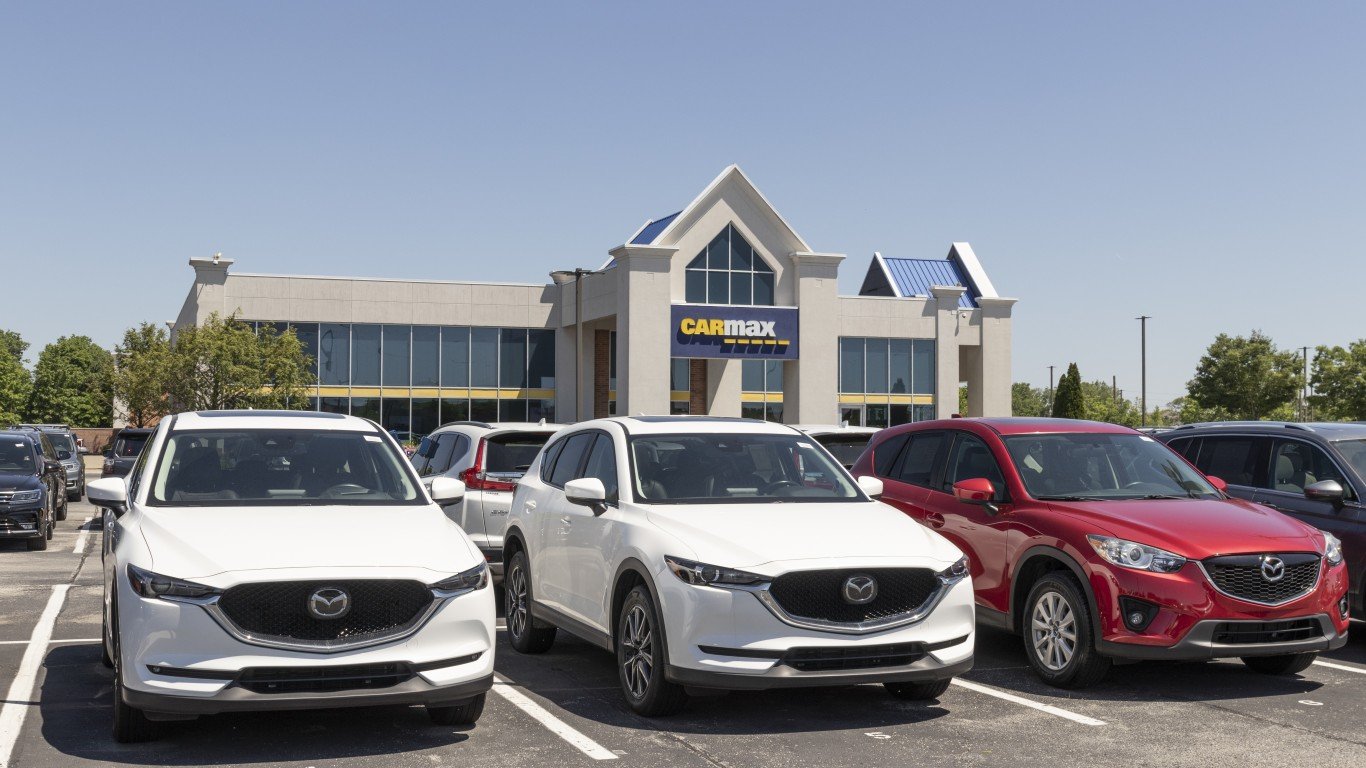
CarMax (NYSE:KMX) stock is down 0.4% to $58.29 Tuesday, with CarMax shares up 51% year to date through Monday’s close. The company runs more than 255 stores, with digital capabilities supporting 84% of retail unit sales, and CarMax Auto Finance originated $8 billion in loans in fiscal 2026 against a $16 billion portfolio.
Meanwhile, Lithia Motors (NYSE:LAD) stock is down 0.4% to $367.91, with Lithia shares up 12% year to date through Monday. The company operates the largest global automotive retail footprint, including Driveway.com, GreenCars.com, and Driveway Finance Corporation across the U.S., U.K. and Canada.
Also, AutoNation (NYSE:AN) stock is down 0.8% to $203.43, with AutoNation shares down 0.7% year to date through Monday. The company runs franchised dealerships nationwide, and AutoNation Finance carries a portfolio exceeding $2.7 billion.
The read is straightforward. The incumbents have built their own digital storefronts and captive-finance arms, which weakens the argument that Carvana’s online model is uniquely defensible. CarMax’s large 2026 gain against Carvana’s decline is the clearest expression of that shift.
The Consumer Discretionary Select Sector SPDR Fund (NYSEARCA:XLY) shares are down 2% year to date through Monday’s close. The fund holds Carvana among many constituents, so it offers a loose read on used-vehicle retail, with concentration in a small number of large consumer names and no leverage.
What to Watch
Investors could look for signs that Carvana’s inventory growth catches up to sales in coming quarters. Any formal disclosure tied to the reported scrutiny of related-party transactions could reframe the bear case at Carvana.
Carvana’s gross profit per unit is the other line to track, since it was the sole operating metric moving the wrong way last quarter. Stabilization there would blunt one of the loudest points in the short thesis.
On the peer side, CarMax’s late-fall Strategic Update under new CEO Keith Barr is the next major catalyst for the incumbents. A credible turnaround plan could sustain the KMX rerating and keep pressure on the argument that Carvana’s model is uniquely defensible.
Contact [email protected] for any questions or corrections.
David Moadel is financial writer specializing in stocks, ETFs, options, precious metals, and Bitcoin. David has written well over 1,000 articles for leading online publications, helping investors understand markets, income strategies, and risk.His work has appeared in The Motley Fool, InvestorPlace, U.S. News & World Report, TipRanks, ValueWalk, Benzinga, Market Realist, TalkMarkets, Finmasters, 24/7 Wall St., and others.With a master’s degree in education, David has taught at the elementary, high school, and college levels. That teaching background shapes his writing style: clear, educational, and practical. David has also built a loyal social-media audience by providing trustworthy financial content on YouTube, X/Twitter, and StockTwits.