Visa vs PayPal: The Post Earnings Winner
Visa crossed $4 trillion in global payments volume the same quarter PayPal brought in a new CEO to salvage branded checkout, and the two earnings reports could not paint a more different picture of where fintech power is actually concentrating.


Visa (NYSE:V | V Price Prediction) and PayPal (NASDAQ:PYPL) both reported on July 28, 2026, and the split screen is striking.
Visa ran its payment rails at record speed, crossing $4 trillion in global payments volume for the first time. PayPal, meanwhile, spent the quarter proving its turnaround is real, with a new CEO trying to steady branded checkout while Venmo and Braintree carry the momentum.
One Runs the Rails. The Other Rebuilds the Checkout.
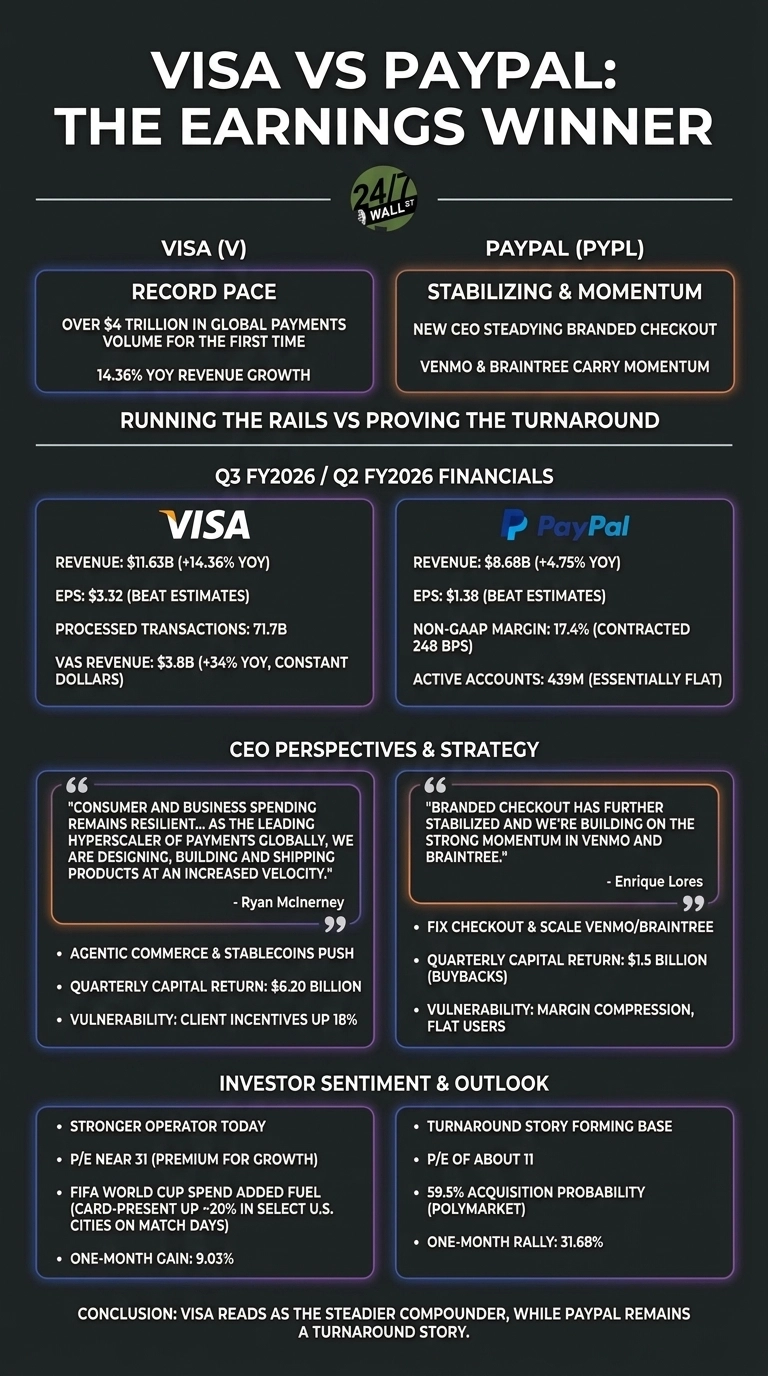
Visa printed $11.63 billion in revenue, up 14.36% year over year, with EPS of $3.32 beating estimates. Data processing revenue jumped 17% on 71.7 billion processed transactions, and value-added services revenue climbed 34% in constant dollars to $3.8 billion.
CEO Ryan McInerney framed it plainly: “Consumer and business spending remains resilient… As the leading hyperscaler of payments globally, we are designing, building and shipping products at an increased velocity.”
FIFA World Cup spend added real fuel, with card-present transactions up as much as 20% in select U.S. host cities on match days.

PayPal delivered $8.68 billion in revenue, up 4.75%, with EPS of $1.38 topping estimates by 8.02%. Total payment volume grew 10% to $486.4 billion, but non-GAAP operating margin contracted 248 basis points to 17.4%, and active accounts stayed essentially flat at 439 million.
New CEO Enrique Lores said, “Branded checkout has further stabilized and we’re building on the strong momentum in Venmo and Braintree.” Stabilized is the operative word, still short of genuine growth.

Hyperscaler of Payments vs. Turnaround With a Deadline
| Lens | Visa | PayPal |
| Core Bet | Agentic commerce, stablecoins, VAS | Fix checkout, scale Venmo/Braintree |
| Quarterly Capital Return | $6.20 billion | $1.5 billion in buybacks |
| Key Vulnerability | Client incentives up 18% | Margin compression, flat users |
Visa is spending like a company that sees a bigger prize. It joined an Open Standard partnership to issue OpenUSD, launched a stablecoin platform, and struck deals with OpenAI and Meta to power agentic commerce.
It also took a $563 million severance charge to reshape engineering into small agentic squads, with McInerney citing 80% more code commits.
PayPal is playing a different game entirely, leaning on 7% U.S. revenue growth while international revenue slipped 3% FXN. Tech spend hit $849 million versus $767 million a year ago, so profitability will keep feeling the squeeze.
The Next Test Is Whether PayPal Grows Users Again
For Visa, I want to see cross-border e-commerce hold the 16% growth pace after the FIFA sugar rush fades, and I will judge the stablecoin push by whether Pismo integrations produce real client wins.
PayPal raised full-year non-GAAP EPS guidance to about $5.38, but Q3 EPS is expected to decline low-single digits. That leaves little room for slippage in Venmo monetization or branded checkout conversion. The 59.5% acquisition probability on Polymarket is a reminder that patience for Lores is finite.
Why I Lean Toward Visa but Keep Watching PayPal
On the setup, Visa looks like the stronger operator today. The 9.03% one-month gain tells me investors already agree, and a P/E near 31 is not cheap, but the growth algorithm, buyback firepower, and agentic commerce optionality justify the premium for me.

PayPal fits a different profile. If you like turnarounds, the P/E of about 11, insider buying, and the 31.68% one-month rally suggest a base is forming. One clean quarter of active account growth would strengthen the PayPal thesis materially.
Until then, Visa reads as the steadier compounder, while PayPal remains a turnaround story.
Contact [email protected] for any questions or corrections.
Vandita Jadeja is a financial publisher with over a decade of experience writing about financial topics, including investment, savings, retirement, insurance and banking. Vandita is a Chartered Accountant who loves to debunk financial concepts for readers.
Her work has appeared on sites that include The Motley Fool, InvestorPlace, and Benzinga. She covers investing and focuses on stock picks and price prediction for 24/7 Wall St.
When not looking for the next stock investment opportunity, she can be found traveling, reading, chasing sunsets and enjoying her iced latte.