Marvell Down Huge This Month: The Pros See 120% Returns in 12 Months
Marvell collapsed 32% in a single month while 44 analysts refused to cut their targets, leaving a widening gap between where the stock trades and where the Street thinks it belongs.


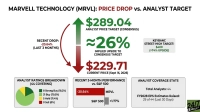
Marvell Technology (NASDAQ:MRVL | MRVL Price Prediction) currently trades at $183.30, while Wall Street’s average 12-month price target sits at $256.91. That leaves the stock roughly 40% below where analysts think it should be, and the Street-high target implies more than double that gap.
Marvell is one of two dominant custom AI silicon designers. Data center now accounts for 76% of revenue on hyperscaler demand for custom XPU accelerators, 800G and 1.6T optical interconnects, and 51.2T Ethernet switches. Its closest peer Broadcom held up far better through the summer, suggesting either a discount or a warning.
Anatomy of a 32% Monthly Collapse
Marvell shed 32.61% in July, a drawdown clearing the 30% crash threshold. The stock slid from $271.98 to $183.30 in one month, including a 12.43% weekly loss and an RSI reading of 31.9 on July 29, textbook oversold. Shares bounced 12.18% on the most recent trading day.
The catalyst was macro. Q1 FY27 revenue of $2.418 billion beat consensus, non-GAAP EPS of $0.80 cleared estimates, and free cash flow surged 126.8%. CEO Matt Murphy said Marvell is seeing “exceptional AI-related bookings” and raised FY27 and FY28 revenue outlooks.
Damage came from macro. Investors soured on AI capex sustainability, new U.S. tariffs on 60 trading partners hit the sector, Chinese chip competition intensified, and Marvell’s Q1 net income collapsed 80.61% YoY after a $331.8 million contingent consideration charge. A $2 billion convertible preferred issuance on March 31 stoked dilution fears.
Why 44 Analysts Refuse to Downgrade
The bull thesis is unchanged: Marvell owns defensible custom AI silicon share, and hyperscalers are accelerating spend. Coverage stands at 7 Strong Buy, 31 Buy, 5 Hold, and 1 Strong Sell ratings, with recent revisions skewing higher.
KeyBanc Capital Markets’ John Vinh holds the Street-high $400 price target, raised from $385 with an Overweight rating. That implies roughly 118% upside. Vinh’s thesis rests on aggressive modeling of custom AI ASIC ramps at Amazon (Trainium/Inferentia), Google, and Meta; deep conviction in Marvell’s electro-optics leadership via PAM4 DSPs and 800G/1.6T transceivers; and exponentially rising optical content per AI node as clusters scale.
Management backs the trajectory. Q2 FY27 revenue guidance of $2.70 billion implies roughly 35% YoY growth, and Murphy expects growth to accelerate each quarter through fiscal 2027. Marvell closed acquisitions of Celestial AI (photonic fabric) and XConn Technologies (chiplet connectivity), tightening its interconnect story as scale-up networking becomes the next AI battleground.
The catch is time. Analyst targets are 12-month projections. If custom silicon bookings soften, the $400 target becomes hard to defend.
Broadcom Held Ground, Marvell Fell Alone
Broadcom (NASDAQ:AVGO) gained 2.67% in July and trades at $387.84 against a $527.88 target, roughly 36% upside. Coverage is 44 Buy and 4 Hold, no sells, with revisions higher on $10.8 billion in Q2 AI semi revenue.
NVIDIA (NASDAQ:NVDA) slipped 2.52% to $195.04. Its $302.83 target implies about 55% upside, backed by 58 Buy, 2 Hold, and 1 Sell ratings.
Advanced Micro Devices (NASDAQ:AMD) fell 16.44% in July but remains up 126.65% year to date at $485.39. Its consensus target of $575.49 implies only 18.6% upside, the smallest in the group.
The largest analyst-implied upside sits with Marvell. Marvell was singled out.
Cheapest Setup, Highest Beta
Marvell is up 116.01% year to date despite July’s carnage, while the S&P 500 gained 8.76%. On a one-year basis, MRVL is up 124.73%. Coverage from 44 analysts averages a $256.91 target, roughly 40% above current levels, with KeyBanc’s $400 high pointing to 118% upside.
Valuation remains rich: trailing P/E of 56x, forward P/E of 43x, and price-to-sales of 17. Beta of 2.2 amplifies macro moves. Institutional ownership at 85.5% means fund unwinds can move the stock hard.
Trap or Setup?
The bull case rests on custom AI silicon being a durable multi-year franchise and hyperscalers continuing to expand cluster scale. The path to consensus target requires Q2 delivery at or above the $2.70 billion guide, continued XPU design wins, and AI sector stabilization. Those three hits close the gap quickly because coverage is Buy-heavy and the oversold bounce has started.
The bear case is that the July selloff signals something fundamentals have not caught. Customer concentration is real, hyperscalers build their own silicon, contingent liabilities can whipsaw net income, and beta above 2 sends this lower on any AI capex wobble.
The lean is cautiously bullish. The oversold bounce is real, earnings trajectory intact, and peers are trading in line with an intact thesis. A smaller weighting than Broadcom or NVIDIA, with roughly two quarters to confirm the ramp stays on track, is one framing analysts are using.
Contact [email protected] for any questions or corrections.
Alex Sirois is a financial writer with experience spanning both retail and institutional investing. He has written for InvestorPlace and held roles at BNY Mellon and Bernstein, giving him a perspective that bridges Main Street portfolios and Wall Street analysis.
Alex holds an MBA from George Washington University and has built his career across multiple industries, including e-commerce, education, and translation — a breadth of experience that informs how he breaks down complex financial topics for everyday investors. His writing is conversational, actionable, and grounded in long-term, buy-and-hold investing principles.
At 247 Wall St., Alex focuses on delivering analysis that is both accessible and useful, with a clear emphasis on helping readers make more informed decisions with their money.