Marvell Technology Fell Hard Over 3 Months: It Has Momentum and a Wall Street Pro’s Confidence That 78% Gains are Coming
Marvell has dropped 20% in three months even as AI peers held steady, and one analyst sees that disconnect as the setup for gains that leave the Wall Street consensus looking timid.


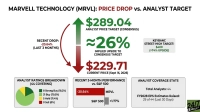
Marvell Technology (NASDAQ:MRVL | MRVL Price Prediction) currently trades at $244.25, while the average Wall Street price target sits at $289.04, an implied upside gap of roughly 18%.
Marvell designs the custom AI silicon and high-speed optical interconnects that hyperscalers depend on to move data inside their AI clusters. That positioning just earned the company an expanded custom-chip partnership with Google, complete with a warrant allowing Google to acquire up to 7% of Marvell shares tied to revenue milestones.
Marvell just posted 37% year-over-year revenue growth and raised guidance twice, yet the stock has slid over the past three months. One analyst thinks the reset is a gift, calling for gains that dwarf the consensus.
A Data Center Darling Gave Back Its Summer Rally
Marvell fell 20.64% over the past three months, sliding from $307.78 to $244.25. The pullback followed a scorching first-half run that still leaves shares up 187.84% in 2026.
Profit-taking and valuation drove the drop. Shares hit a 52-week high of $329.80, then rolled over as AI infrastructure names traded lower and investors flagged customer concentration risk. Marvell’s Q2 fiscal 2027 earnings report beat both revenue and EPS estimates, but the reaction was muted because expectations had run far ahead of the release.
Underlying data center metrics were strong. Data center revenue reached $2.17 billion, up 46% year over year, and now accounts for 79% of company revenue. Positioning drove the selloff.
KeyBanc Sees a $400 Path and Nobody Is Selling
KeyBanc Capital Markets analyst John Vinh carries the Street-high $400 price target on Marvell, implying roughly 64% upside from current levels. His thesis rests on three pillars: a massive multi-year ramp in custom AI accelerators for hyperscalers, dominance in 800G and 1.6T optical interconnects and PAM4 DSP chips, and structural margin expansion as those high-value products claim a larger share of the mix.
Management is not disagreeing. CEO Matt Murphy raised fiscal 2027 revenue guidance to approximately $12 billion and lifted fiscal 2028 revenue growth to roughly 50%, with the custom business expected to more than double. One analyst referenced $120 billion in cumulative revenue over six years tied to the Google program, a scale management did not dispute (the kind of early-innings setup we reverse-engineered from past 100x tech winners in a free playbook here).
Of 44 analysts covering the stock, 8 rate it Strong Buy, 31 rate it Buy, 5 rate it Hold, and none rate it Sell. Fiscal 2028 EPS consensus climbed from $6.1726 ninety days ago to $6.7609, with 31 upward revisions in the trailing seven days. The Investor Day on October 6 is the next catalyst. The direction of the revisions matters more than any single price target.
Marvell Fell Alone While AI Peers Held Up
Marvell’s peer group did not sell off with it. Custom-silicon and AI-connectivity names have mostly traded flat or higher, framing this drop as stock-specific.
Broadcom (NASDAQ:AVGO) trades at $357.61, up 3.33% year to date, versus an average target of $531.85 for implied upside of about 49%. Of 49 covering analysts, 45 rate it Buy or Strong Buy, with revisions still climbing after a blowout AI earnings report.
NVIDIA (NASDAQ:NVDA) sits at $222.27, up 19.18% year to date, against a target of $327.70 for roughly 47% implied upside, with 57 of 60 analysts rated Buy or better.
Astera Labs (NASDAQ:ALAB) trades at $303.25, up 82.29% year to date, with a target of $389.95 and about 29% upside. Ratings skew Buy but include 7 Holds.
Broadcom carries the largest average-target upside in the group, but Marvell’s Street-high scenario would dwarf it. On consensus alone, Marvell screens as the least generous of the four.
Numbers That Frame the Reset
Marvell changes hands at $244.25, with a 44-analyst consensus target of $289.04 and a forward P/E of 58. The one-year gain stands at 229.75%, and the year-to-date advance of 187.84% towers over the S&P 500’s 11.70% gain. Both the past week (+3.45%) and past month (+2.94%) turned positive, suggesting selling pressure is easing.
What Would Confirm or Break the Marvell Thesis
The bull case strengthens if the second-half custom silicon ramp lands as management describes and the Google program’s fiscal 2029 tail materializes near the numbers analysts are floating. That path leads toward the $400 zone Vinh is targeting. The case weakens if hyperscaler capex plans slip, if the Google warrant signals pricing concessions rather than partnership, or if a major customer vertically integrates the parts Marvell now supplies. The fundamental momentum is real, the analyst posture is unified, and the recent pullback reads more like digestion than lasting damage.
Contact [email protected] for any questions or corrections.
Alex Sirois is a financial writer with experience spanning both retail and institutional investing. He has written for InvestorPlace and held roles at BNY Mellon and Bernstein, giving him a perspective that bridges Main Street portfolios and Wall Street analysis.
Alex holds an MBA from George Washington University and has built his career across multiple industries, including e-commerce, education, and translation — a breadth of experience that informs how he breaks down complex financial topics for everyday investors. His writing is conversational, actionable, and grounded in long-term, buy-and-hold investing principles.
At 247 Wall St., Alex focuses on delivering analysis that is both accessible and useful, with a clear emphasis on helping readers make more informed decisions with their money.