The Quiet Winner of the AI Buildout Just Posted Its Best Year Ever
While flashier AI names grabbed headlines, Cisco quietly rewired itself for the infrastructure boom and just delivered numbers that stopped Wall Street's skeptics cold. The question now is whether the market has actually caught up to what the business has…


Cisco Systems (NASDAQ:CSCO | CSCO Price Prediction) just wrapped up what management called its best year ever, and the stock is finally being treated like an AI infrastructure winner rather than a legacy networking name.
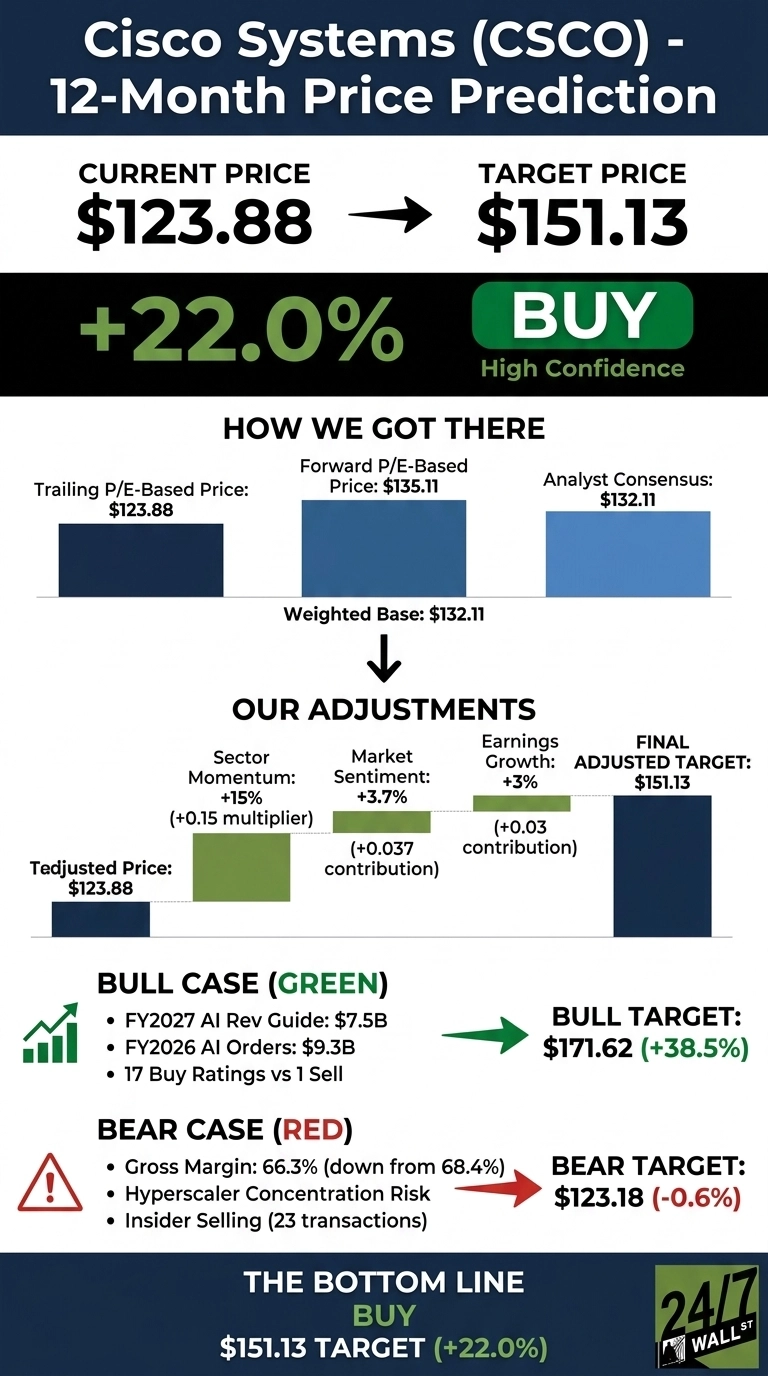
With shares at $123.88 after a 63.15% year-to-date run, the numbers still support meaningful upside from here.

24/7 Wall St. Price Target Summary
| Metric | Value |
|---|---|
| Current Price | $123.88 |
| 24/7 Wall St. Price Target | $151.13 |
| Upside | 22.0% |
| Recommendation | BUY |
| Confidence Level | 90% |
A Record Close to Fiscal 2026
Cisco posted Q4 revenue of $17.25 billion, up 17.58% year over year, with non-GAAP EPS of $1.22 beating consensus for the fifth straight quarter. Full-year revenue reached $63.33 billion and net income jumped 30.32%. Networking product orders climbed 40% in Q4, the eighth consecutive quarter of double-digit growth.
CEO Chuck Robbins framed the year plainly: “We delivered a very strong close to fiscal 2026, marking another record year for Cisco.” Shares sit just 2% below the 52-week high of $129.88, with a 77.12% one-year gain.
The Case for $170+
The bull case rests on FY2027 guidance that most models have not fully digested. Management guided revenue to $72.2 billion to $73.4 billion and non-GAAP EPS to $5.05 to $5.11. AI infrastructure revenue is expected to roughly double to $7.5 billion as Silicon One and Acacia coherent optics win hyperscaler design slots.
Q4 AI orders alone hit $4 billion, and FY2026 AI orders totaled $9.3 billion. Analyst consensus sits at $132.59 with 17 buy ratings versus 1 sell. A bull scenario points to $171.62, a 38.5% return, if AI hyperscale revenue exceeds the $7.5 billion target.
What Could Go Wrong
Non-GAAP gross margin fell to 66.3% from 68.4% as AI mix shifts toward lower-margin systems. Trailing P/E is 40, elevated for a company that grew revenue 11.77% for the full year. Hyperscaler concentration is a concern, and Goldman Sachs flagged that a reversal of AI-related investments could pressure AI-linked wealth gains.
Insider activity has trended toward selling across 23 recent transactions. Bulls argue margin compression reflects the product mix shift toward faster-growing AI silicon, and forward P/E of 26 is reasonable. A bear scenario lands at $123.18, essentially flat.
How Cisco Compares to Arista and HPE
Arista Networks (NYSE:ANET) is the pure-play Ethernet AI networking rival. Arista posted Q2 2026 revenue of $3.04 billion, up 37.7%, but trades at a trailing P/E of 75 with a market cap of $265 billion. That premium makes Cisco’s forward P/E of 26 look reasonable for a business growing AI orders at similar magnitudes.
Hewlett Packard Enterprise (NYSE:HPE) offers integrated networking-plus-compute after its Juniper acquisition, with fiscal Q2 2026 revenue of $10.68 billion, up 40%. HPE carries a cheaper multiple but faces integration risk and lower margins. Against both, our $151.13 target for Cisco looks reasonable, positioned between HPE’s value discount and Arista’s growth premium.
Cisco Price Prediction 2026-2030

My 24/7 Wall St. price target for Cisco is $151.13, a buy with 90% confidence. The tipping factor is the FY2027 AI revenue guide of $7.5 billion.
The thesis is confirmed if Q1 FY2027 revenue lands in or above the guided $18 billion to $18.2 billion range. The thesis weakens if gross margin drops below 65% or hyperscaler order growth cools.
| Year | 24/7 Wall St. Price Target |
|---|---|
| 2026 | $151 |
| 2027 | $170 |
| 2028 | $190 |
| 2029 | $208 |
| 2030 | $225 |
These projections assume Cisco continues executing on AI infrastructure and maintains networking share. Upside could come from accelerated enterprise AI adoption; downside risk centers on hyperscaler spending pauses.
Contact [email protected] for any questions or corrections.
Vandita Jadeja is a financial publisher with over a decade of experience writing about financial topics, including investment, savings, retirement, insurance and banking. Vandita is a Chartered Accountant who loves to debunk financial concepts for readers.
Her work has appeared on sites that include The Motley Fool, InvestorPlace, and Benzinga. She covers investing and focuses on stock picks and price prediction for 24/7 Wall St.
When not looking for the next stock investment opportunity, she can be found traveling, reading, chasing sunsets and enjoying her iced latte.