Drone Stocks See Limited Losses Tuesday During Nasdaq Sell-Off: Red Cat, Ondas Flat While AeroVironment Tumbles
While AI hardware stocks cratered on Tuesday and the Nasdaq bled red, a handful of drone names barely flinched. Here is why their revenue stream insulates them from the chaos hammering the rest of the market.


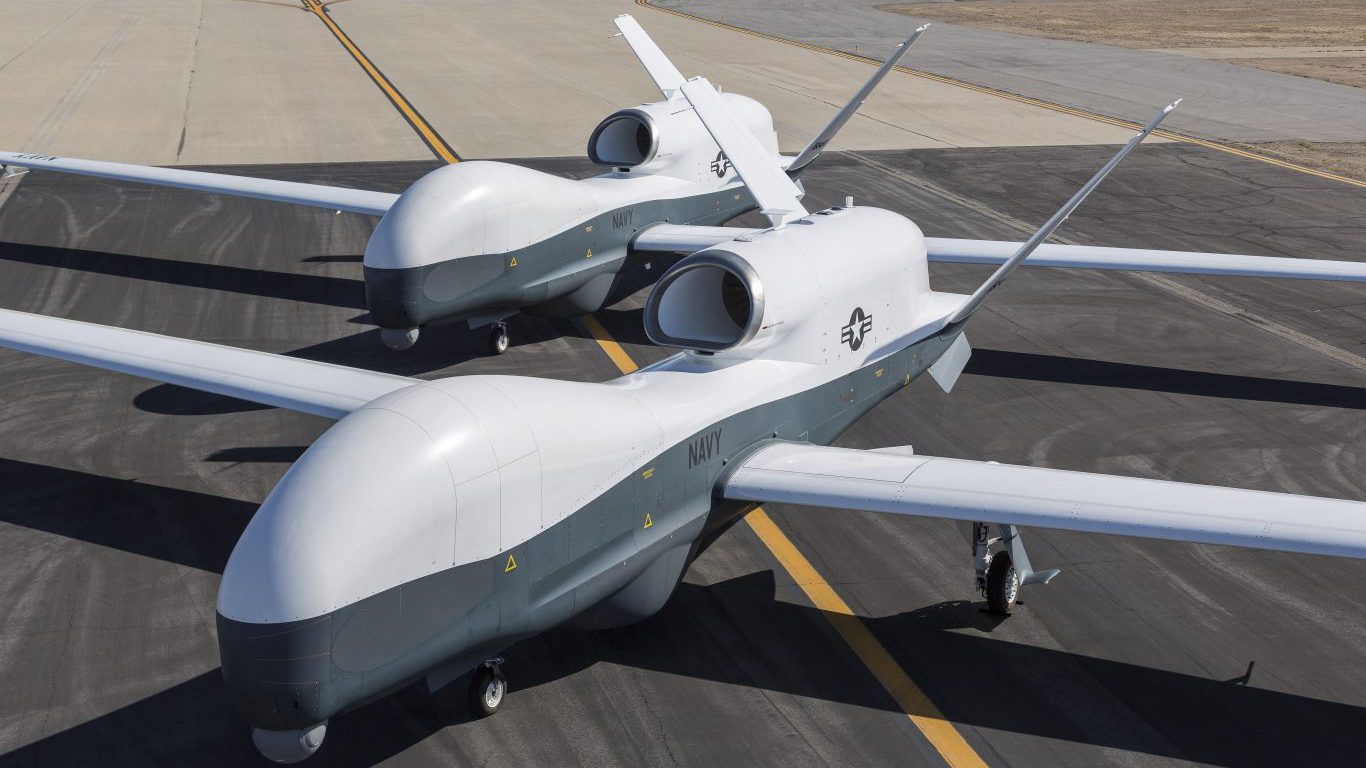
Drone stocks held up remarkably well during Tuesday’s Nasdaq sell-off. Red Cat Holdings (NASDAQ:RCAT) closed down 2%, Ondas Holdings (NASDAQ:ONDS) finished up 1%, essentially flat, while AeroVironment (NASDAQ:AVAV | AVAV Price Prediction) fell roughly 4% to around $174.
Let’s review trading during in especially wild market day.
Defense Names Sidestep the AI Hardware Rout
Today’s action told a clean story about where revenue comes from. The iShares Semiconductor ETF (NASDAQ:SOXX) closed down roughly 5% as AI hardware, memory, optics and neocloud names took double-digit hits in some cases. The iShares U.S. Aerospace & Defense ETF (NYSEARCA:ITA) closed up 0.38%. Drone stocks sit on the defense side of that ledger.
Their revenue is tied to government procurement budgets and program awards, not hyperscaler AI capex. The FY 2027 President’s Budget requested $413.1 billion in procurement and $343.7 billion in RDT&E, and the budget explicitly carves out $20.6 billion for one-way attack, counter small UAS, and related programs, plus $4.5 billion to develop autonomous systems operating collaboratively at scale. That is the demand curve behind these names, and it does not depend on Alphabet, Meta or Oracle building another data center.
AeroVironment Is the Outlier
No company-specific catalyst was identifiable for AVAV today. The likely explanation is profit-taking. The stock had run roughly 27% over the past month, which makes it more vulnerable when broader risk-off flows hit the market. It also carries the largest market cap of the three at roughly $9.76 billion and the highest institutional ownership at 88.4%, so institutional trims move the price harder.
The longer arc still looks heavy. AVAV is down roughly 25% year to date and down about 27% over the past year, well off the 52-week high of $418. Wall Street is still supportive of the stock, with an average analyst target of $226.

Red Cat and Ondas Show Their Momentum
Red Cat has been the runaway leader among small-cap drone names. Shares are up roughly 37% over the past month and 32% year to date, supported by a reaffirmed FY26 revenue target of $150 million to $180 million. Q2 FY26 revenue landed at $20.19 million, up 527% year over year, missing the $23 million consensus. Shares closed down 2% today. Considering the performance of most growth stocks today, that’s an admirable performance.
Ondas is the more interesting technical setup. The stock closed up roughly 38% over the past month, is up 133% over the past year, but remains down about 8% year to date. The company raised its FY26 revenue target to at least $390 million, roughly 670% growth. Ondas dropped 7% after earnings earlier this session despite stellar earnings. Its slight gain today is interesting as few momentum stocks survived the day with gains.
What to Watch
The 30-year Treasury hit a 19-year high today, and the WSJ estimates nine top tech companies have roughly $3 trillion of off-balance-sheet AI commitments. If the AI capex trade continues to wobble, defense-linked drone names could keep acting as a rotation destination. I would watch whether ITA extends its lead over SOXX into Wednesday’s open, and whether AVAV can find support near its 50-day moving average of $163.
Contact [email protected] for any questions or corrections.
Eric Bleeker, CFA has been investing for more than 20 years. He began his career working at Microsoft before joining Motley Fool, one of the largest publishers of financial research. In his 15 years at Motley Fool Eric served as the General Manager for Fool.com and led coverage in the Technology & Telecom sector. In addition, he was a featured columnist and has hosted dozens of investing seminars attended by more than a million total investors. Eric has more than 1,000 financial bylines to his name and has been featured in The Wall Street Journal, CNBC, Fox Business, and many other leading publications. He is currently focused on artificial intelligence investing and is a CFA Charterholoder.