Expert Predicts Drones Are the ‘Unlikely Catalyst’ for Battery Breakthroughs. Time to Buy AeroVironment, Ondas, and Red Cat?
On a recent episode of the Catalyst with Shayle Kann podcast themed around the “electric supercycle,” investor Andy Lubershein floated a provocative idea: military drones, not electric vehicles, may be the unlikely catalyst for next-generation battery technology. “Defense historically has…

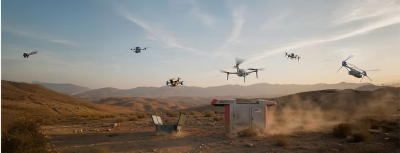
On a recent episode of the Catalyst with Shayle Kann podcast themed around the “electric supercycle,” investor Andy Lubershein floated a provocative idea: military drones, not electric vehicles, may be the unlikely catalyst for next-generation battery technology. “Defense historically has been a sector that has a high willingness to pay for performance,” Lubershein argued lithium-ion cells are “kind of good enough from a range standpoint” for cars. Pay four times the price for triple the energy density? Carmakers will pass. The Pentagon will not.
Why Drones Could Crack the Battery Funding Problem
Lubershein’s framing is a venture capital question applied to chemistry: “The question is always like, who’s going to pay for the first 1,000, and then how are you going to scale it up?” Drones are already shipping “in the hundreds of millions, probably getting towards the billions.” Host Shayle Kann noted the government is moving: an ARPA-E program called “1K” targeted a 1,000 watt-hour per kilogram cell, roughly 3x today’s best, and a DOD initiative aiming for 2,000 watt-hour per kilogram batteries, driven predominantly by drone applications. The spillover thesis is the payoff. “If you had a 2,000 watt-hour per kilogram battery and then you applied that into, for example, heavy-duty transportation, complete game changer,” Lubershein said.
The macro backdrop fits. The FY2027 Department of War budget request includes $54.0 billion for autonomous and remotely operated systems, with $39.2 billion tied to a multi-year Drone Dominance mandatory funding request, plus $20.6 billion for one-way attack munitions, counter-small-UAS, and related programs. The three names below make drone platforms, not breakthrough cells, so they benefit indirectly through stronger procurement budgets and pull-through demand for any battery the DoD ultimately funds.
AeroVironment: The Lower-Risk Anchor
AeroVironment (NASDAQ:AVAV | AVAV Price Prediction) is the established play. Q3 FY2026 revenue hit $408.05M, up 143.4% year over year, though it missed consensus by 14.21% after a $151.31M goodwill impairment on the BADGER SCAR stop-work order. Funded backlog hit a record $1.10B with a 1.6x book-to-bill, and CEO Wahid Nawabi said “demand for our unique solutions remains robust” in the filing.
At $169.61, the stock is down 29.88% year to date. Our proprietary 24/7 Wall St. price target sits at about $236 (roughly 39% upside) with Street consensus near $310 and a 6/10/3 strong-buy/buy/hold split. Forward EPS of about $3.16 makes it the only profitable name in the trio.

Ondas: Higher Torque, Higher Beta
Ondas Holdings (NASDAQ:ONDS) posted Q1 2026 revenue of $50.12M, up 1,079.8% year over year, with pro forma backlog jumping to $457M from $68.3M at year-end 2025. CEO Eric Brock cited “powerful demand tailwinds, particularly across counter-UAS and defense robotics markets” and raised the FY2026 target to at least $390M. The Mistral acquisition brought a $982M IDIQ program with the U.S. Army for loitering munitions.
Beta sits at 2.622. Shares trade at $9.27, up 498.06% over one year, against a model target of about $13 (roughly 41% upside). Adjusted EBITDA remains a loss of $10.88M, with profitability not expected until Q1 2028.
Red Cat: The Speculative Sleeve
Red Cat Holdings (NASDAQ:RCAT) delivered Q1 FY2026 revenue of $15.47M, up 849.3% year over year, with gross margin swinging to 12.7% from negative 52.1%. Operating cash burn was $31.95M. CEO Jeff Thompson flagged “budget allocations of up to $74 billion for UAV and USV procurement” for 2027 and the short-to-medium term revenue target of $150M to $180M.
At $11.44, Wall Street’s average price target sits at about $22 with lower model confidence, and forward EPS is about negative $0.71.
Which Wins if the Battery Push Materializes?
If the Lubershein-Kann thesis plays out, every DoD dollar chasing higher energy density flows through drone platform demand. AeroVironment is the lower-risk anchor: real backlog, real non-GAAP earnings, and the broadest portfolio. Ondas offers higher torque for investors comfortable with a 2.6 beta and acquisition-driven growth. Red Cat is the speculative sleeve for those willing to underwrite execution risk against a large potential payoff. The battery breakthrough may be years away, but procurement budgets are funding the runway today.
Contact [email protected] for any questions or corrections.
I've spent more than 15 years inside enterprise software, working alongside the finance, sales operations, and HR leaders who run the revenue engines at some of the largest tech companies in the country.
My day job is helping enterprise executives make smarter decisions about retention, compensation, and growth. These are the same operational levers that show up in every earnings report investors actually read. That perspective shapes my writing for 24/7 Wall St.
The headline numbers are easy. The interesting stuff is underneath: how companies make money, what executives are worried about, and what any of it means for the person checking their 401(k) on a Sunday afternoon. I write about personal finance and business as someone who has spent her career inside the rooms where these decisions get made.