Prediction: Microsoft’s AI Boom Is Bigger Than Investors Realize
Azure just crossed a milestone the bears called impossible, Copilot is scaling fast, and yet Microsoft shares are flat on the year. Something in that disconnect points toward a target most analysts haven't dared to model.


Microsoft’s (NASDAQ:MSFT | MSFT Price Prediction) AI franchise just did something the bears said couldn’t happen. Azure crossed $100 billion in annual revenue, Copilot passed 30 million paid seats, and commercial RPO exploded to $678 billion, up 84%.
Yet Microsoft shares are essentially flat on the year. That disconnect is why I’m asking a bigger question. Can this stock hit $700 by 2027? I think the math works, and I’ll show you exactly how.

Why Microsoft Shares Are Stuck Despite a Blowout Year
The setup is strange. Microsoft just delivered FY2026 revenue of $331.8 billion, up 17.79%, with net income up 31.34%. And the stock is up 0.03% year to date and down 6.11% over one year. Shares fell 4.4% in the past week even after a 22.3% snapback over the last month.
The reason is capex. Microsoft spent $115.9 billion, up 79.62% year over year, on AI infrastructure, and FY27 guidance points to roughly $175 billion. Investors are worried about ROI. With a beta of 1.1, the stock swings when sentiment on AI monetization wobbles. Right now, it’s wobbling.
Wall Street Sees 18% Upside. Our Model Sees More
The consensus is loud. 14 Strong Buys, 40 Buys, 3 Holds, 0 Sells, with an average target of $569.56. Our base case is more aggressive at $596.34, implying 23.82% upside, with a bull scenario of $620.42 and a bear floor of $511.72. Confidence sits at 90%.

My view is that Wall Street is anchoring on the capex overhang. With 95% analyst bullishness and earnings growth running at 31.7%, targets should be marching higher. Analysts are underweighting a Copilot inflection that already happened.
The Path to $700 Per Share
Here is the math. Reaching $700 from today’s price of $481.63 would require a gain of 45.3%. With forward EPS of $19.96, a price of $700 implies a forward P/E of 35x. Our base case of $596.34 already implies 28x, meaning the bold target requires 7x of additional multiple expansion.
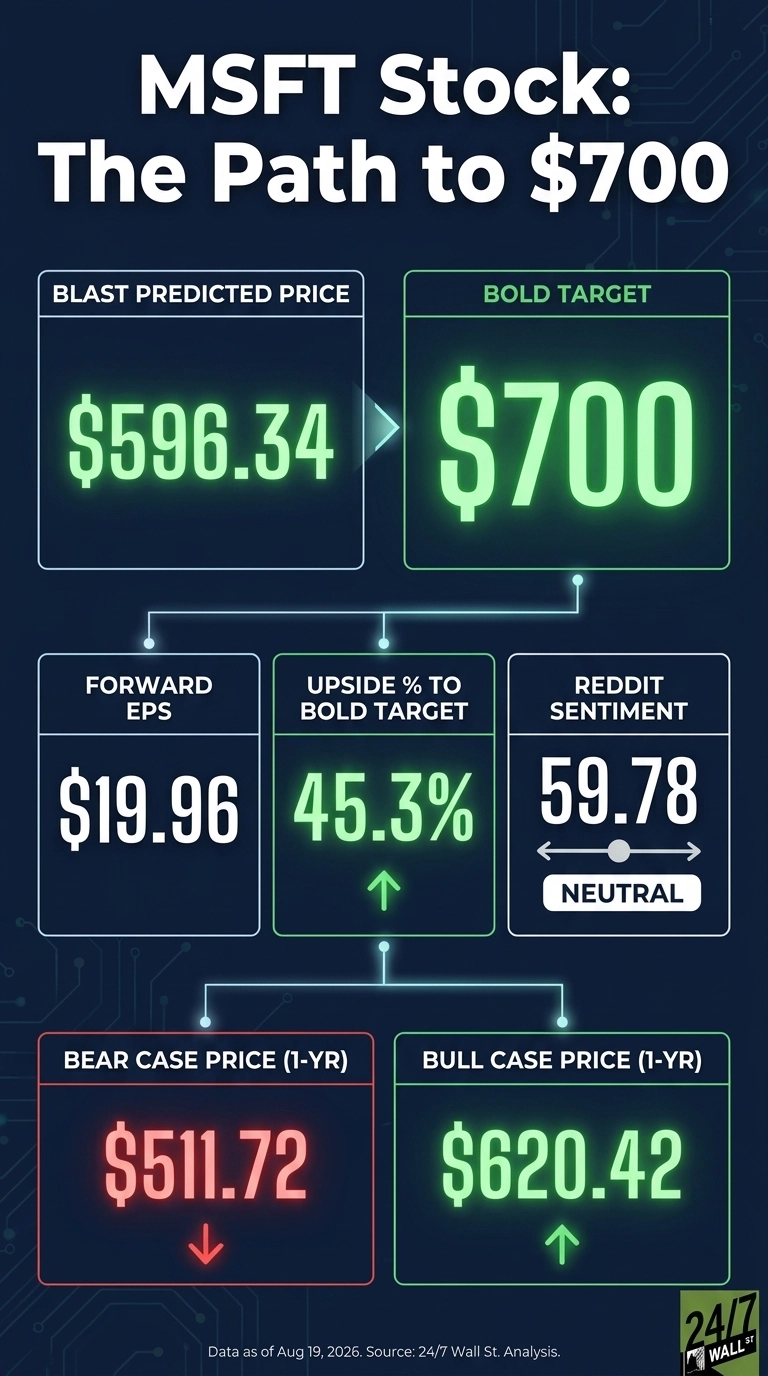
Is that achievable? I think yes, and here is why. The 247Factor of 1.154 is powered by a 1.15x technology sector multiplier and 95% bullish analyst consensus.
If Azure re-accelerates to 45% constant currency growth in Q1 FY27 and Copilot ARPU expands as the E7 suite scales (EY alone deployed 400,000 seats), FY27 EPS estimates get revised sharply higher.
Nadella said it plainly on the call: “I’ve never been more confident in Microsoft’s opportunity to drive durable long-term growth.” The primary risk is that AI capex ROI disappoints and multiple compression takes hold.

Where Microsoft Trades Today vs Its Earnings Power
At $481.63, Microsoft trades at a forward P/E of roughly 24x on $19.96 in forward EPS. That is cheap for a business compounding earnings at 31%.
Shares sit well off the 52-week high of $550.24 and comfortably above the low of $349.20. Zoom out and MSFT has returned 839.53% over ten years. The problem is the narrative, not the valuation.
Is $700 Realistic? Here’s My Take
Reaching $700 requires a gain of 45.3% from here. Is it realistic? It’s a stretch, but a defensible one.
Three things need to go right: Azure needs to sustain 40%+ growth into FY27, Copilot ARPU has to expand as E7 and usage-based GitHub pricing scale, and AI capex has to visibly convert into free cash flow so investors reward the multiple rather than punish it.
What derails it is a broad AI capex unwind that forces every hyperscaler multiple lower at once. Returns at this level shouldn’t be expected every year, but we’ve outlined the blueprint for how Microsoft could reach $700 in 2027.
Contact [email protected] for any questions or corrections.
Vandita Jadeja is a financial publisher with over a decade of experience writing about financial topics, including investment, savings, retirement, insurance and banking. Vandita is a Chartered Accountant who loves to debunk financial concepts for readers.
Her work has appeared on sites that include The Motley Fool, InvestorPlace, and Benzinga. She covers investing and focuses on stock picks and price prediction for 24/7 Wall St.
When not looking for the next stock investment opportunity, she can be found traveling, reading, chasing sunsets and enjoying her iced latte.