Prediction: This Could Be One of the Best Stocks to Own Through 2030
Azure just crossed $100 billion in revenue and Microsoft 365 Copilot is selling like wildfire, yet the stock has gone nowhere for a year. Something in that gap points to a very specific opportunity with a deadline of 2030.


Microsoft (NASDAQ:MSFT | MSFT Price Prediction) just closed a fiscal year where Azure crossed $100 billion in revenue, Microsoft 365 Copilot passed 30 million paid seats, and commercial remaining performance obligations surged 84% to $678 billion.
Yet shares are up just 3.14% year to date. That is the disconnect I want to unpack. Can Microsoft, at $495.63, actually reach $750 per share by 2030? I think the blueprint exists, and I want to walk through it.

Why Microsoft Shares Are Stuck Despite Blowout Fundamentals
The stock has gone nowhere for a year. MSFT is down 0.26% over the past 12 months, off 0.81% in the last week, and up a modest 0.84% over the last month.
The market’s concern is simple. Capital expenditures exploded to $115.95 billion in FY2026, up 79.62%, and free cash flow fell 6.46% despite record profits. Investors are asking whether the AI infrastructure buildout will earn its cost of capital. With a beta of 1.11, MSFT is not shielded from that anxiety.
CFO Amy Hood pushed back directly, saying the CapEx pivot toward “short-lived assets” like CPUs and GPUs gives Microsoft flexibility if demand shifts. The market is not buying that argument yet.
Wall Street Is Bullish. Our Model Says They’re Still Underestimating
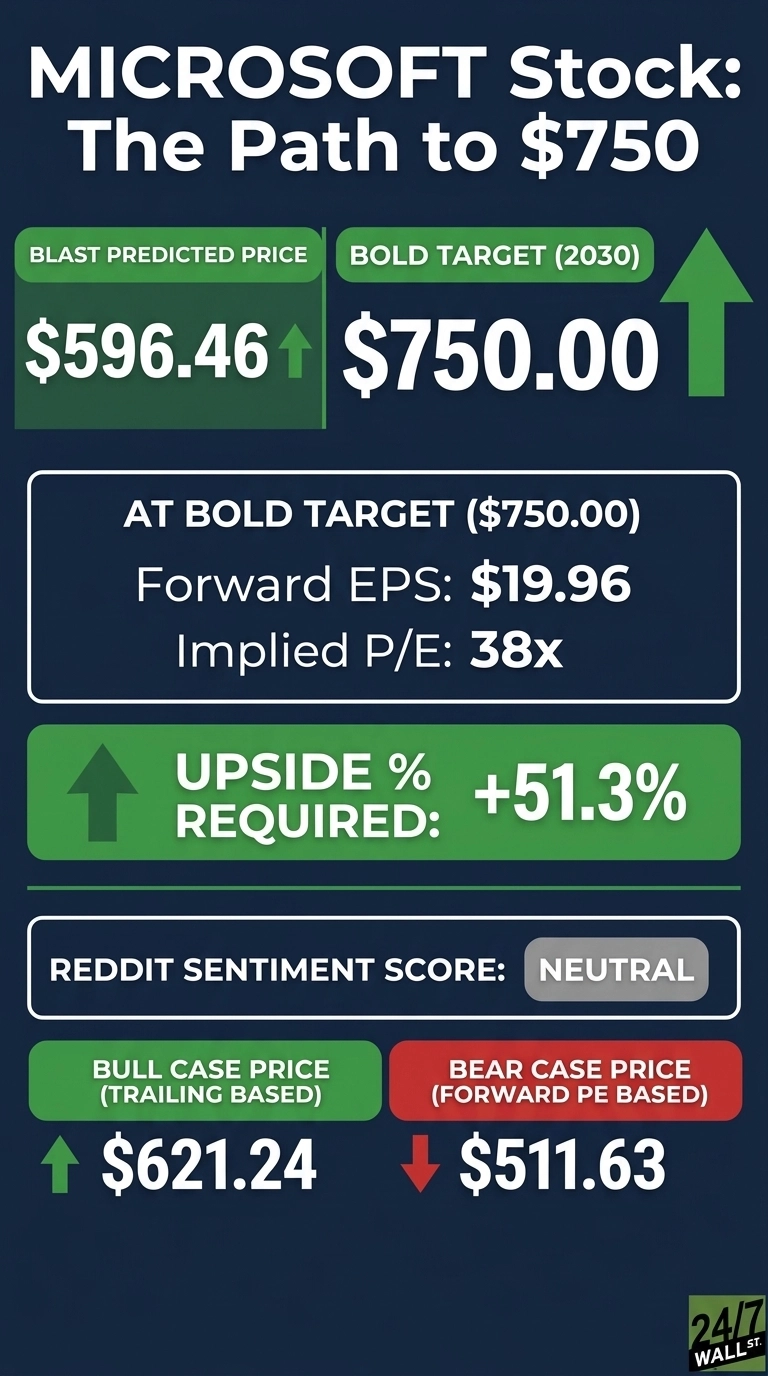
Consensus target sits at $572.92, backed by 14 strong buy and 38 buy ratings against just 3 holds and zero sells. Our internal model calls for $596.46 one year out, implying 20.34% upside, with high confidence at 0.9. The bull scenario runs to $621.24, the bear case to $511.63.
I think even the bulls are anchoring too closely to trailing multiples. With analyst sentiment 95% bullish and earnings growth of 31.7% year over year, the multiple compression thesis I keep hearing does not match the operating reality.

Blueprint to $750 Per Share by 2030
Here is the math. Reaching $750 from today’s price of $495.63 would require a gain of 51.3%. With forward EPS of $19.96, a price of $750 implies a forward P/E of 38x. Our base case of $596.46 already implies 29x, meaning the bold target requires about 8.9x of additional multiple expansion.
That looks demanding on today’s earnings. On 2030 earnings, it becomes reasonable. Analyst consensus already models FY2028 EPS at $23.57, and by FY2030 the same growth arc puts the P/E on $750 in the mid-20s.
The catalysts are already in the numbers. Azure guidance of 45% constant-currency growth in Q1 FY27, Foundry reaching 100,000 customers, and GitHub Copilot revenue accelerating more than 60% quarter over quarter.
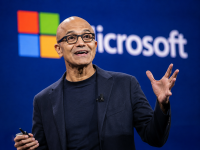
CEO Satya Nadella put it plainly: “The secular shift is clear and we’re very bullish about us coming with the right sort of mix of business and the right margin structure.” The main risk is that hyperscale AI CapEx never earns its return.
Where Microsoft Trades Today vs Its Earnings Power
At $495.63, MSFT trades at roughly 25x forward EPS of $19.96. That is not demanding for a business compounding earnings at 31.7%.
Shares sit between a 52-week high of $549.20 and a low of $348.54, closer to the top but well off it. Long term, MSFT is up 887.35% over 10 years. If AI monetization keeps pace with capacity coming online, current levels look like a coiled spring.
Is $750 Realistic? My Verdict
Reaching $750 by 2030 requires that 51.3% gain, which annualized across four years is a very reasonable pace for a compounder of this quality. I think it is realistic.
Three things need to go right: Azure growth stays above 30%, Copilot per-seat plus consumption pricing lifts Microsoft 365 revenue meaningfully, and CapEx growth peaks and rolls over as capacity catches up to demand.
What derails it is a hyperscaler AI oversupply that compresses cloud margins before revenue catches up. Returns at this level shouldn’t be expected every year, but we’ve outlined the blueprint for how Microsoft could reach $750 in 2030.
Contact [email protected] for any questions or corrections.
Vandita Jadeja is a financial publisher with over a decade of experience writing about financial topics, including investment, savings, retirement, insurance and banking. Vandita is a Chartered Accountant who loves to debunk financial concepts for readers.
Her work has appeared on sites that include The Motley Fool, InvestorPlace, and Benzinga. She covers investing and focuses on stock picks and price prediction for 24/7 Wall St.
When not looking for the next stock investment opportunity, she can be found traveling, reading, chasing sunsets and enjoying her iced latte.