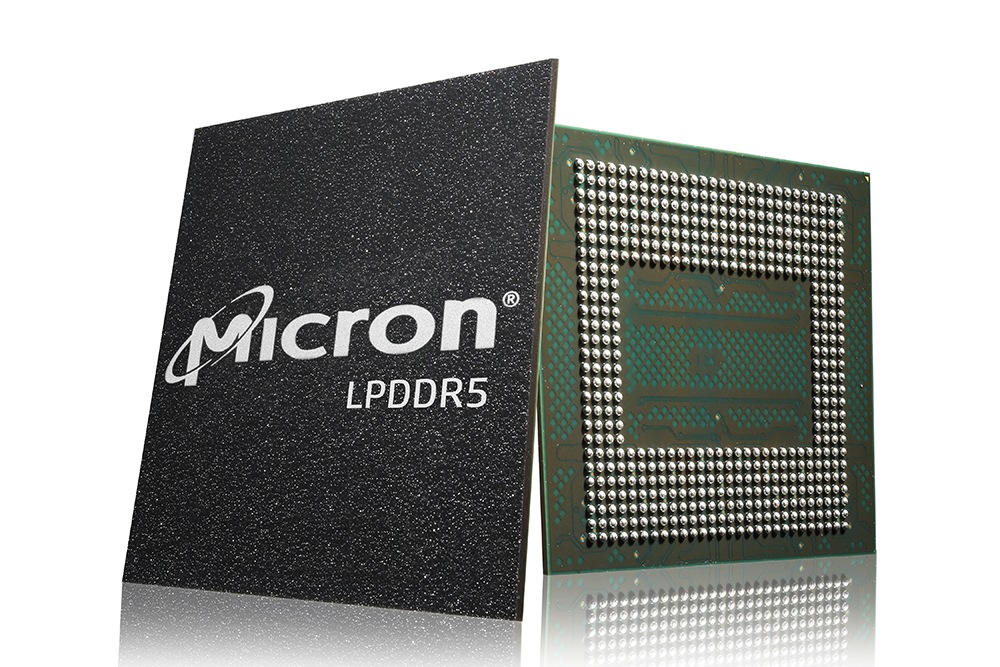
Nvidia Vs Micron: Among The Best-Positioned AI Plays as Treasury Yields Spook The Market
Blowout earnings from two AI heavyweights landed just as rising Treasury yields rattled growth stocks, and the two companies are responding to that pressure in strikingly different ways.


NVIDIA (NASDAQ: NVDA | NVDA Price Prediction) and Micron Technology (NASDAQ: MU) just delivered blowout earnings into a market rattled by the 4.65% 10-year Treasury yield, sitting in the 92.8th percentile of the past year. Both sit at different layers of the AI stack: NVIDIA sells the accelerators and networking fabric, Micron supplies the HBM and DRAM those accelerators cannot function without.
Blackwell Ramp Meets an HBM4 Cash Machine
NVIDIA’s Q1 FY27 revenue hit $82 billion, up 85% year-over-year, with Data Center at $75 billion and networking nearly tripling. Jensen Huang called the buildout “the fastest product ramp in our company’s history,” pointing to Microsoft’s Fairwater site running “hundreds of thousands of Blackwell GPUs.” Guidance for Q2: $91 billion in revenue at a 75% non-GAAP gross margin.
Micron’s fiscal Q3 tells a different but connected story. Revenue reached $41.5 billion, up 346% year-over-year, with gross margin at a record 84.9%. CEO Sanjay Mehrotra said “DRAM and NAND industry demand continues to significantly exceed industry supply” and expects tightness beyond calendar 2027. HBM4 revenue already crossed $1 billion, ramping twice as fast as HBM3E.
| Business Driver | NVIDIA | Micron |
| Growth Engine | Blackwell and Rubin platforms | HBM4, DDR5, and NAND |
| Q2/Q4 Revenue Guide | $91B | $50B |
| Durability Lever | $145B supply commitments | 16 Strategic Customer Agreements |
Full-Stack Platform vs. Contracted Memory Fortress
NVIDIA is doubling down on secular platform economics. Huang forecast “$1 trillion in Blackwell and Rubin revenue” from 2025 through calendar 2027, with the Vera CPU opening what he framed as a “brand new 200 billion TAM.” China Data Center compute stays excluded from guidance, a real overhang.
Micron’s angle is more clever than the memory playbook usually allows. Its 16 Strategic Customer Agreements lock in roughly $100 billion in minimum contracted revenue with price floors Mehrotra said sit “well above our peak quarterly margins in any past cycle.” Customer cash deposits total $22 billion. Memory has historically been brutally cyclical. This is an attempt to neuter that.
What Yields Actually Threaten Here
Higher rates typically bruise expensive growth stocks. NVIDIA trades at a forward P/E of 25x; Micron sits at just 6x forward earnings. NVIDIA fell 3.75% last week, while Micron gained 2.58% and is up 241.59% year-to-date. Retail sentiment on Reddit swung bullish on Micron after the SCA disclosures.
Micron for Value, NVIDIA for Compounding
For value-focused investors, Micron’s setup screens as a compelling risk-reward today. The SCAs offer visibility memory investors have rarely had, and the multiple looks compressed relative to earnings power. For those seeking the purest AI compounder who can stomach multiple compression when yields spike, NVIDIA remains the dominant platform. Signs of HBM pricing cracks or trimmed hyperscaler capex plans would be the key risks to monitor for both names. That capex also has to be powered, cooled, and networked by somebody, and we profiled seven suppliers doing exactly that in a free AI infrastructure report.
Contact [email protected] for any questions or corrections.
Alex Sirois is a financial writer with experience spanning both retail and institutional investing. He has written for InvestorPlace and held roles at BNY Mellon and Bernstein, giving him a perspective that bridges Main Street portfolios and Wall Street analysis.
Alex holds an MBA from George Washington University and has built his career across multiple industries, including e-commerce, education, and translation — a breadth of experience that informs how he breaks down complex financial topics for everyday investors. His writing is conversational, actionable, and grounded in long-term, buy-and-hold investing principles.
At 247 Wall St., Alex focuses on delivering analysis that is both accessible and useful, with a clear emphasis on helping readers make more informed decisions with their money.